Northwestern's FLIP method raises JWST sensitivity up to 15 times and reveals 51 Eridani b
Physics-based processing of archival JWST coronagraph images removed residual starlight and revealed the giant planet 51 Eridani b, which conventional processing missed.

Astrophysicists at Northwestern University, led by Rodrigo Ferrer-Chavez, have developed a computational method that improved the sensitivity of James Webb Space Telescope (JWST) observations by 2 to 15 times. According to news.northwestern.edu, the technique revealed the giant exoplanet 51 Eridani b in two-year-old JWST data, where conventional processing could not see it. The study was published on 4 November 2026 in Nature. northwestern.edu
news.northwestern.edunews.northwestern.eduOpen source ↗
Why starlight hides planets
Planets are about a million times fainter than their stars, said Ferrer-Chavez. Even relatively bright young giant planets can be 100,000 times fainter than their host stars. northwestern.edu
news.northwestern.edunews.northwestern.eduOpen source ↗
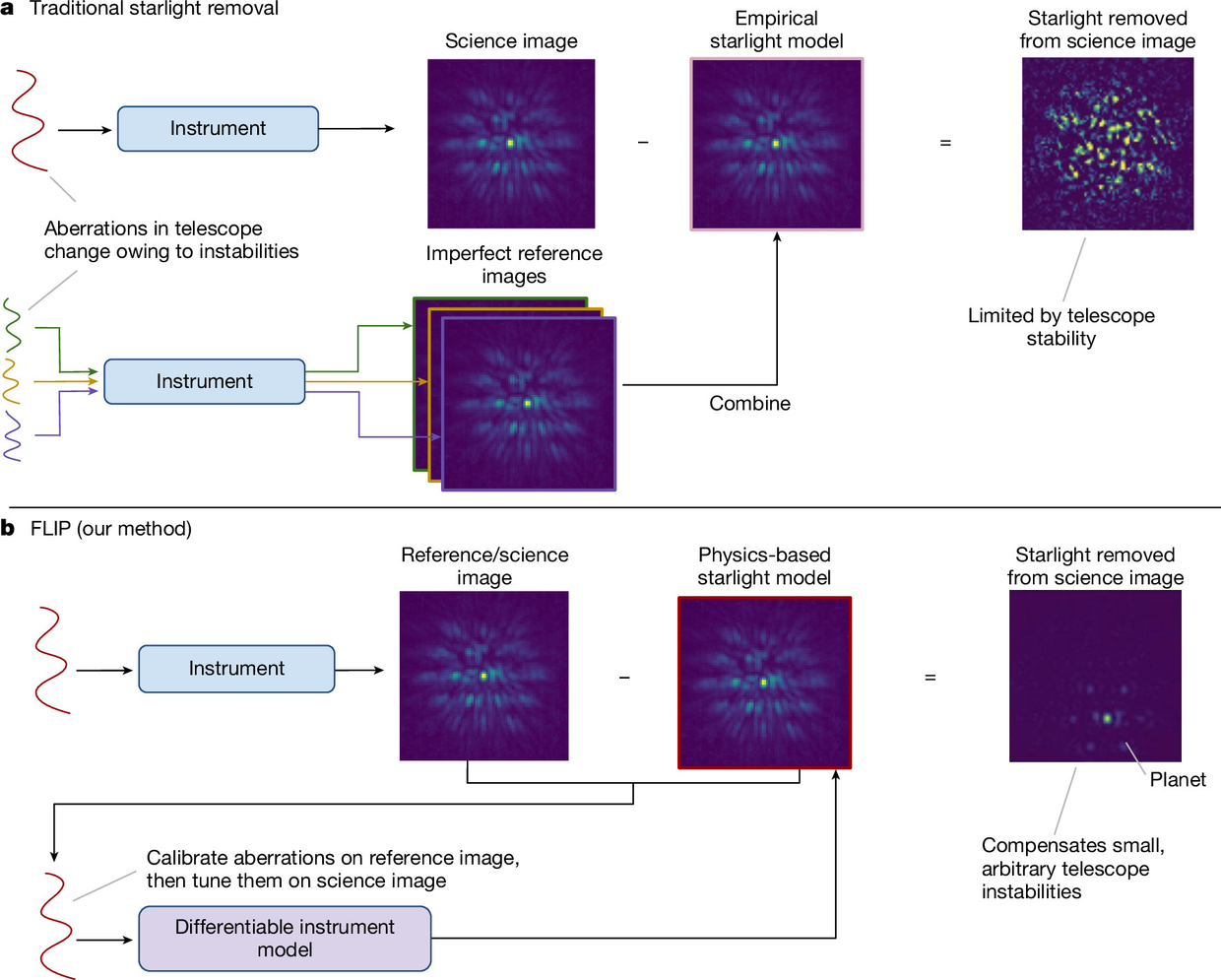
Coronagraphs block most of the starlight, but some still leaks through and forms a hazy pattern that can obscure a planet. For about 20 years, astronomers have subtracted an image of a different star used as a reference. northwestern.edu
news.northwestern.edunews.northwestern.eduOpen source ↗
The reference never matches the observation exactly, because the telescope's structure is never perfectly stable. Shifts or tilts of a few nanometers change the light pattern. Wang named thermal changes that can expand or contract a mirror by a picometer, and vibrations from the motors of the cryocoolers. The leftover mismatch can be enough to hide a faint planet. northwestern.edu
news.northwestern.edunews.northwestern.eduOpen source ↗
How FLIP works
The method is called Physics-based Learning for Imaging Planets (FLIP). It builds a "digital twin" of the telescope, a virtual replica that simulates how starlight travels through the mirrors to the detectors. The team tuned millions of its parameters to account for small shifts in position and distortions in the optics. The twin was adjusted repeatedly until it closely matched the actual observation, and the simulated glare was then subtracted from the image. northwestern.edu
news.northwestern.edunews.northwestern.eduOpen source ↗
To test it, the team reanalyzed earlier JWST data on two stars with known planets, HIP 65426 and 51 Eridani, and on a third star, TYC 5899, with no known planetary companions. In all the observations, FLIP outperformed conventional image processing, improving sensitivity to faint planets by 2 to 15 times. northwestern.edu
news.northwestern.edunews.northwestern.eduOpen source ↗
This let the team detect 51 Eridani b, which astronomers had previously discovered with ground-based telescopes. Carbon dioxide in its atmosphere absorbs light at the infrared wavelength JWST observes, which makes the planet's signal fainter still. The authors say the approach could help find smaller, colder and fainter planets without changing the telescopes. northwestern.edu
news.northwestern.edunews.northwestern.eduOpen source ↗