SITP prototype camera records 167 spectral bands and full-Stokes polarization at 55 fps
Researchers at the Shanghai Institute of Technical Physics built a near-infrared camera with a metasurface that captures spectrum and polarization in one exposure.
A team led by Wei Lu, Xiaoshuang Chen and Jing Zhou from the Shanghai Institute of Technical Physics, Chinese Academy of Sciences, demonstrated a near-infrared camera that records spectrum and full-Stokes polarization in a single exposure. According to the paper in Light: Science & Applications, the device covers 1150–1650 nm with 167 spectral channels and images at 55 frames per second doi.org
Light Science & Applicationsdoi.orgOpen source ↗. The release was published on 5 November 2026. This is a laboratory demonstration of a compact camera, not a commercial product.
Metasurface as a multidimensional encoder
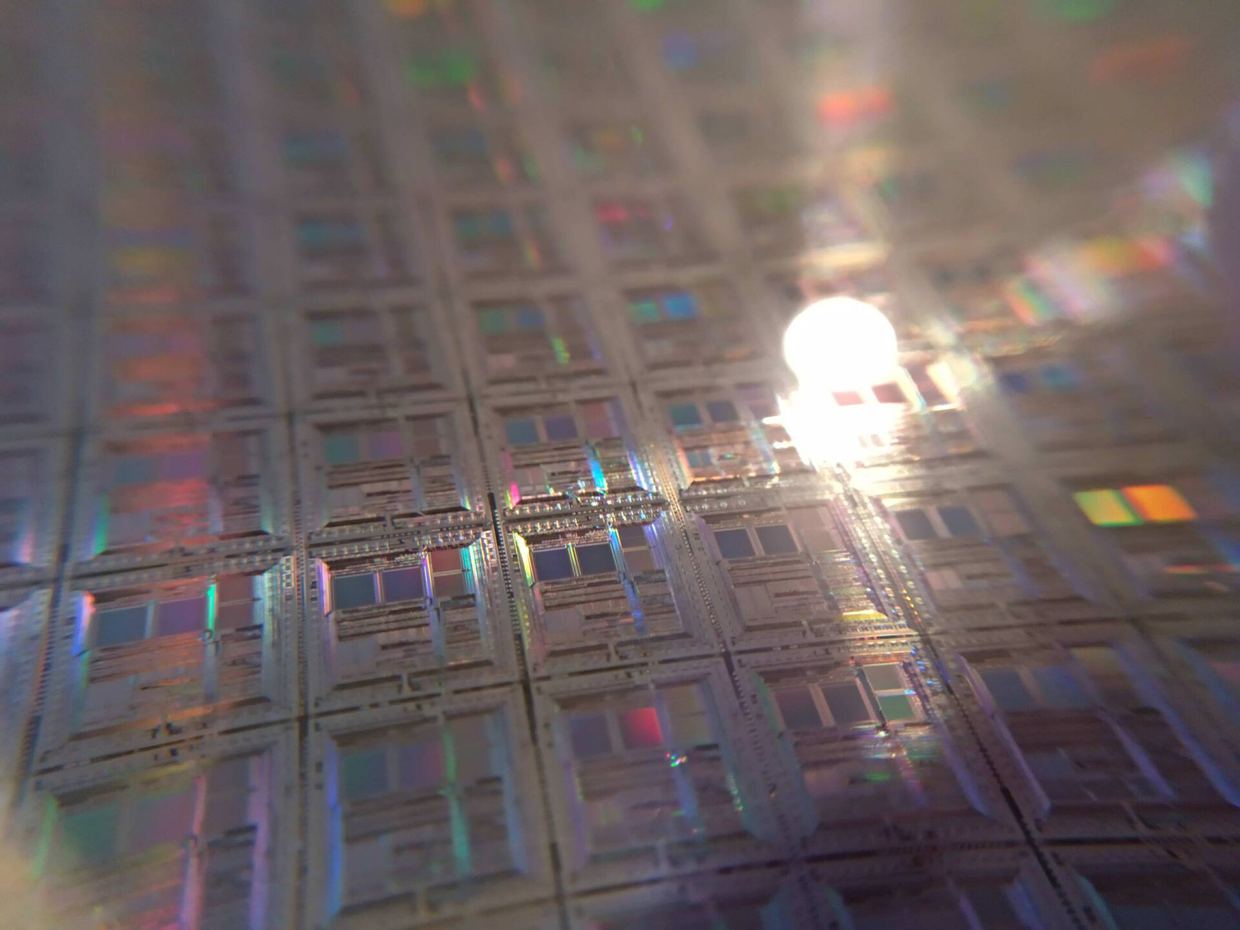
Light carries intensity, polarization and spectrum, and capturing all of them at once with a small device is difficult. In this design a metasurface is integrated with an InGaAs focal plane array. The metasurface performs polarization multiplexing and spectral dispersion at the same time, so it works as an encoder of multidimensional information doi.org
Light Science & Applicationsdoi.orgOpen source ↗.
Different polarization states are spatially multiplexed into different diffraction channels, while different wavelengths are dispersed continuously along the radial direction. Conventional approaches try to suppress wavelength-dependent dispersion. Here the authors use the coupling between polarization and dispersion as the encoding mechanism doi.org
Light Science & Applicationsdoi.orgOpen source ↗.
The encoded data are recorded as a single grayscale image. A tailored reconstruction algorithm, HSPI-net, which includes a residual attention module and is trained on the optical system's response, restores the hyperspectral full-Stokes information from that frame doi.org
Light Science & Applicationsdoi.orgOpen source ↗.
Measured characteristics
The authors report a minimum distinguishable wavelength interval of 3 nm and an average polarization reconstruction error of 0.14° doi.org
Light Science & Applicationsdoi.orgOpen source ↗. According to the paper, spectral and image resolution and the accuracy of spectral and polarization reconstruction all exceed the best-reported specifications of hyperspectral-polarimetric cameras, by amounts from several-fold to one order of magnitude
doi.org
Light Science & Applicationsdoi.orgOpen source ↗. The authors also state that even intricately coupled multidimensional information can be resolved.
Acquisition, processing and inference together take 18 ms, which allows imaging at 55 frames per second in real time doi.org
Light Science & Applicationsdoi.orgOpen source ↗. The team additionally validated deployment on an embedded platform, which, in their words, indicates the potential for compact sensing systems.
The work is described in the paper "High-accuracy hyperspectro-polarimetric real-time imaging via a deep learning empowered infrared meta-sensor" (DOI 10.1038/s41377-026-02407-1).