UCL team enables four-electron iodine conversion in a halogen-free aqueous battery electrolyte
Researchers led by UCL used a halogen-free aqueous electrolyte to double the electrons exchanged per iodine atom in laboratory Zn–I2 and Al–I2 cells, raising theoretical capacity.
A team led by University College London has described an electrolyte that allows reversible four-electron iodine conversion in aqueous metal–iodine batteries without halogen-containing salts. The paper appeared in Nature on 13 November 2026 (nature.com) nature.com
nature.comnature.comOpen source ↗. The authors tested the approach in coin cells and soft pouch cells, and in both Zn–I2 and Al–I2 batteries. This is laboratory-stage work.
The motivation is grid storage for renewable energy beyond lithium-ion batteries. Aqueous metal–iodine batteries combine earth-abundant electrode materials, aqueous electrolytes and conversion-type iodine chemistry.
Why four electrons matter
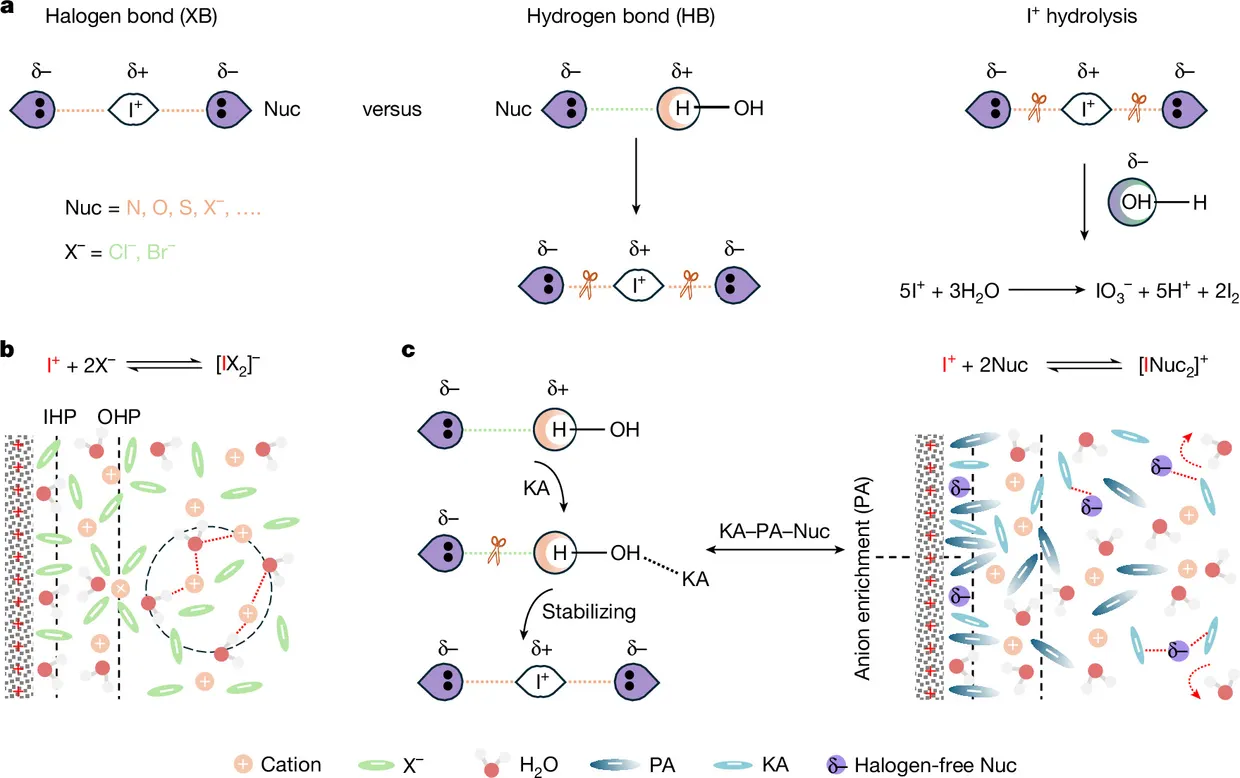
Most aqueous iodine batteries use the two-electron I−/I0 couple, with a theoretical capacity of 211 mAh g−1 at 0.54 V versus the standard hydrogen electrode. Adding the I0/I+ step doubles the theoretical capacity to 422 mAh g−1 and adds a higher redox potential of 1.07 V versus the standard hydrogen electrode. The difficulty is that electron-deficient I+ is strongly electrophilic. Water attacks it, causing hydrolysis and poor reversibility.
Earlier studies stabilized I+ as interhalogen complexes, for example ICl2 or IBr2, in highly concentrated chloride- or bromide-containing electrolytes nature.com
nature.comnature.comOpen source ↗. According to the authors, the high salt content and corrosivity of these electrolytes limit broader implementation.
Kosmotropic anion–polar anion framework
The new framework combines a kosmotropic anion, a polar anion and a nucleophilic species (Nuc). Polar anions create a water-deficient, anion-enriched interfacial microenvironment. Kosmotropic anions regulate water–Nuc interactions, which increases the availability of Nuc for stabilizing I+ through Nuc–I+–Nuc halogen bonds.
The authors report that the framework works with four halogen-free nucleophiles: urea, acetamide, pyridine and nicotinamide. They describe it as a mechanism distinct from interhalogen stabilization, based on systematic experiments and theoretical calculations.