ExoMars orbiter finds localized HCl over fresh fissures at Alba Mons; authors link it to magma
Atmospheric Chemistry Suite recorded parts-per-billion hydrogen chloride in the cold season over one region of Mars; the authors see it as a sign of ongoing igneous processes.
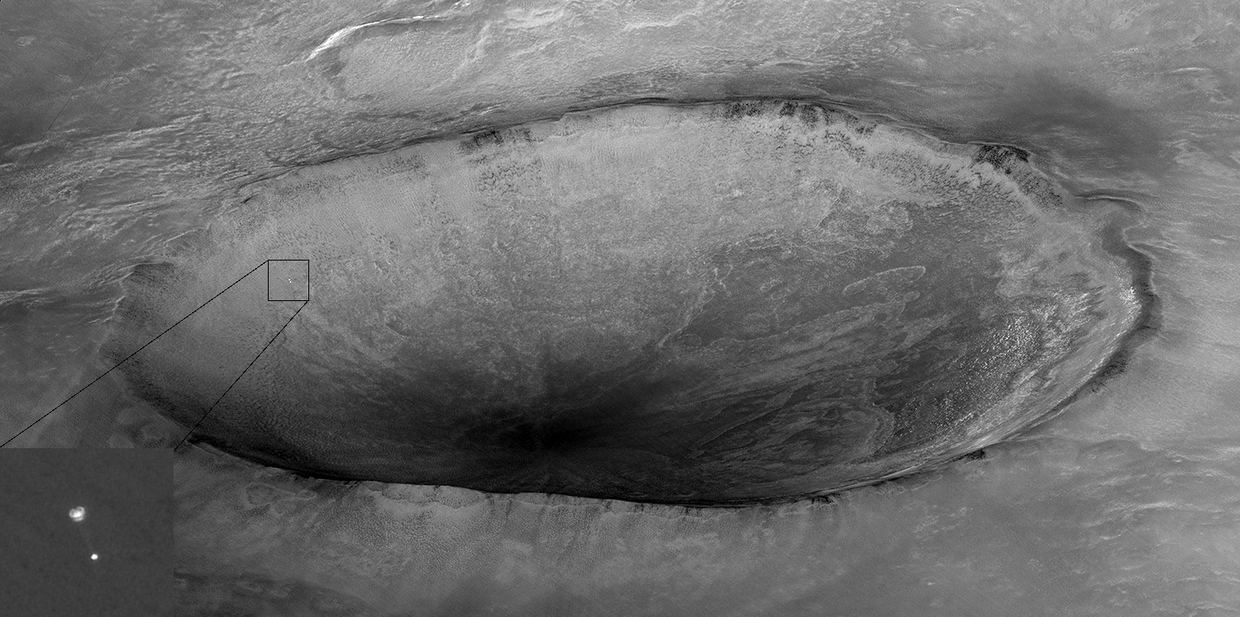
A team led by Alexander Trokhimovskiy reported in Science Advances on 4 November 2026 hydrogen chloride (HCl) at parts-per-billion levels in the Martian atmosphere above the Alba Mons region. The gas was recorded during the cold aphelion season. doi.org
Science Advancesdoi.orgOpen source ↗ The data come from the Atmospheric Chemistry Suite on the ExoMars Trace Gas Orbiter. The authors conclude that the results are best explained by ongoing igneous processes in the Martian interior.
doi.org
Science Advancesdoi.orgOpen source ↗
HCl detections at aphelion
Mars is reputed to lack ongoing volcanic activity. However, marsquakes were detected recently, and clues to volcanism younger than tens of millions of years have accumulated. doi.org
Science Advancesdoi.orgOpen source ↗ Sulfur dioxide, which could testify to eruptive activity, has so far not been detected. According to the authors, evidence of active magma chambers may be better identified by seepage of halogen gases such as HCl.
doi.org
Science Advancesdoi.orgOpen source ↗
Earlier observations by the same instrument found HCl at part-per-billion levels widely in the atmosphere during the warm perihelion period. That HCl was attributed to aerosol-atmospheric sources. doi.org
Science Advancesdoi.orgOpen source ↗ The new detections differ: they were made in the cold aphelion season and are isolated in the Alba Mons region. The HCl was observed at low altitudes, and the authors say it is not explained by the observed atmospheric state and models.
doi.org
Science Advancesdoi.orgOpen source ↗
Fresh fissures as possible gas pathways
In the same area the team identified fresh, narrow fissures less than 1 meter wide. doi.org
Science Advancesdoi.orgOpen source ↗ The authors interpret them as potential pathways for HCl rooted in magmatic bodies at depth. The gas appears locally above this region of fissures.
"Detections of HCl at low altitudes, unexplained by observed atmospheric state and models, together with the geological context of the region, hint at an igneous origin of this gas," the authors write. doi.org
Science Advancesdoi.orgOpen source ↗
The result rests on orbital observations and the authors' interpretation of the fissures. Sulfur dioxide has not been detected, and the link between the fissures and magmatic bodies at depth remains a hypothesis.