ICTER hybrid iNIRS resolves blood flow by photon time of flight in two healthy volunteers
Polish researchers combined swept-source interferometric NIRS with camera-based multi-speckle detection, a prototype tested on the forearm and forehead of two healthy volunteers.
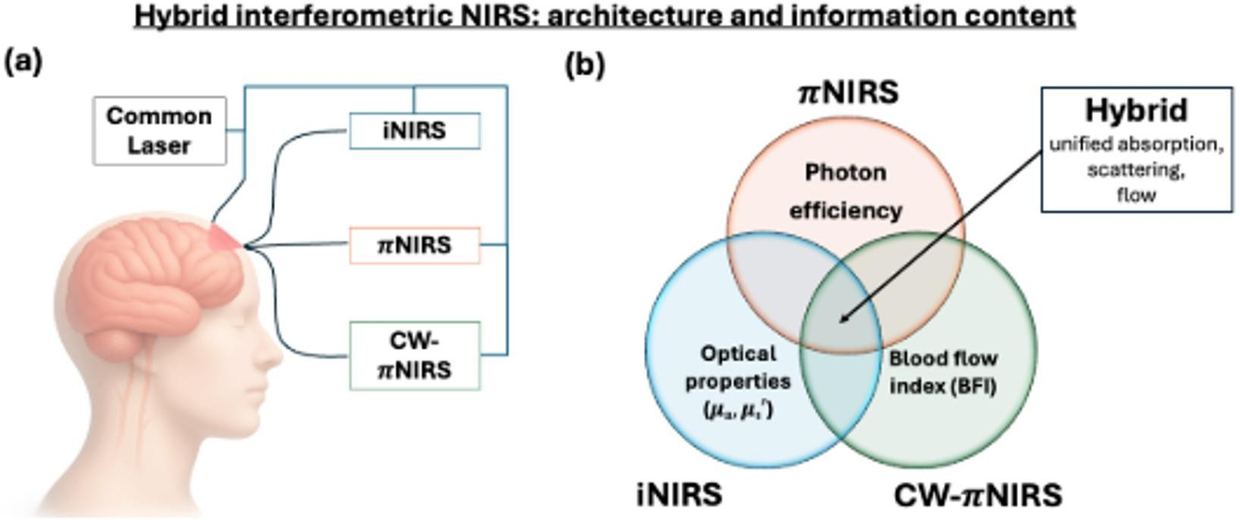
Researchers associated with the International Centre for Translational Eye Research (ICTER) at the Institute of Physical Chemistry of the Polish Academy of Sciences built a hybrid swept-source interferometric near-infrared spectroscopy (hybrid iNIRS) system. According to an open-access paper on nature.com, published in Scientific Reports, they tested it on the forearm and forehead of two healthy volunteers nature.com
nature.comnature.comOpen source ↗. The authors, Marcin Marzejon and Dawid Borycki, combined time-of-flight (TOF) encoding with multi-speckle heterodyne detection on a camera
nature.com
nature.comnature.comOpen source ↗. The laser wavelength was approximately 780 nm
nature.com
nature.comnature.comOpen source ↗.
Why two approaches were combined
Conventional iNIRS sorts signals by the time light takes to cross tissue. However, single-mode collection limits photon throughput, and a single-channel implementation demands high analogue bandwidth and digitization rates nature.com
nature.comnature.comOpen source ↗. Continuous-wave parallel interferometric NIRS (CW-πNIRS) collects more photons by spatial multiplexing on camera sensors. It loses TOF information and is limited by camera readout
nature.com
nature.comnature.comOpen source ↗. The hybrid platform is meant to keep TOF contrast while raising photon detection
nature.com
nature.comnature.comOpen source ↗.
The task matters because optical blood-flow measurement at the forehead returns mixed information. Part of the signal comes from scalp circulation and part from deeper tissues, which makes it hard to interpret what a change says about the brain's blood supply nature.com
nature.comnature.comOpen source ↗.
Sweep rate and in vivo results
Liquid-phantom experiments mapped the trade-off between sweep speed and speckle decorrelation. Under controlled conditions, sweep rates of 10 kHz and above were sufficient to outpace decorrelation while preserving TOF contrast nature.com
nature.comnature.comOpen source ↗. In vivo measurements needed higher sweep rates, typically 50–100 kHz, to follow faster physiological dynamics
nature.com
nature.comnature.comOpen source ↗.
Forearm and forehead measurements showed depth-resolved blood flow during cuff occlusion nature.com
nature.comnature.comOpen source ↗. On the forehead, a headband was used to restrict scalp circulation. Late-arriving light showed a weaker response during tightening, which suggests a greater contribution from deeper tissues
nature.com
nature.comnature.comOpen source ↗. The authors also report that an appropriately analyzed camera signal can reproduce the blood-flow response seen with iNIRS for late-arriving photons
nature.com
nature.comnature.comOpen source ↗.
The work is a demonstration with two healthy volunteers. The authors state that the approach overcomes both the photon-starvation and electronic-bandwidth limits and provides a scalable hardware foundation for haemodynamic sensing in vivo nature.com
nature.comnature.comOpen source ↗.