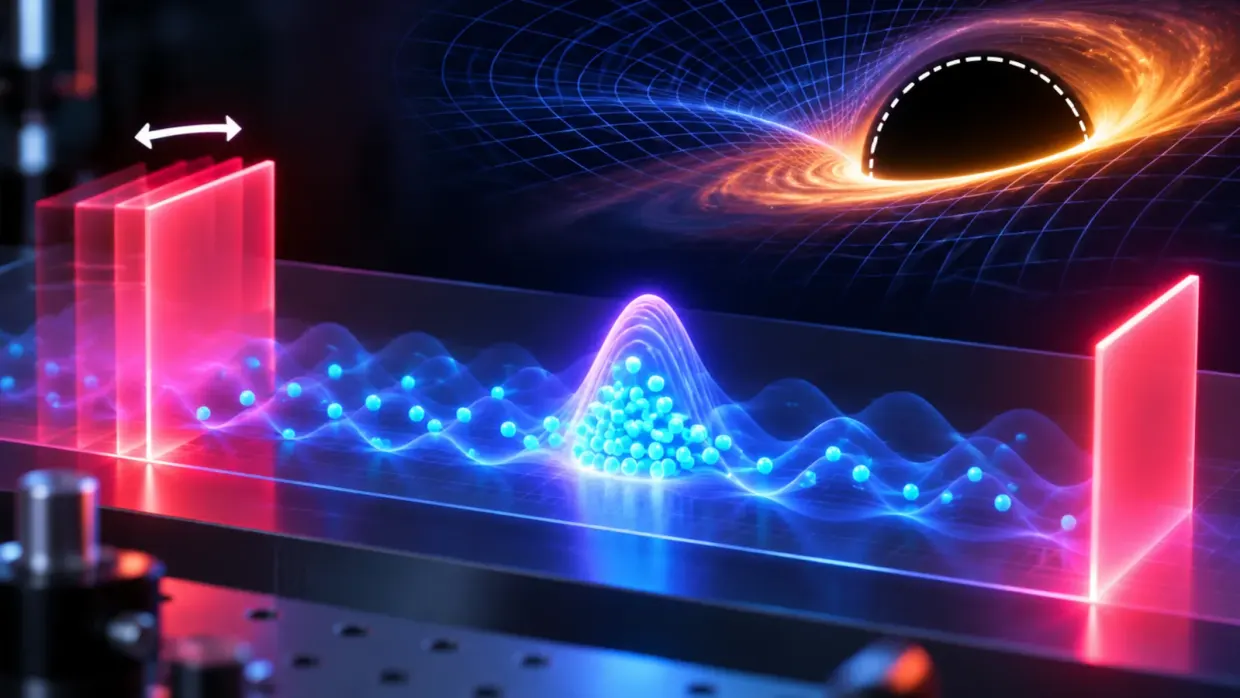
Theoretical study: no material can be fully transparent, as light converts to sound waves
Physicists Nicolis, Piazza and Esposito posted a preprint showing that a quantum conversion of photons into sound waves limits any material's transparency, though the loss can be tiny.

A group of theoretical physicists, Alberto Nicolis, Federico Piazza and Angelo Esposito, reports that no light-bending material can be fully transparent, according to scientificamerican.com. The group posted its findings as a preprint on arXiv.org on October 8. scientificamerican.com
scientificamerican.comscientificamerican.comOpen source ↗ The cause is a quantum process that turns waves of light into waves of sound. The authors argue that even careful engineering cannot produce a material that loses none of the light passing through it, although the loss can be very small.
Today's most transparent materials
The Guinness Book of World Records lists Ivan Smalyukh as the inventor of the most transparent material known. His lab at the University of Colorado Boulder developed gels for window insulation, tuned until they bend light almost as little as air does, which makes them clearer than glass. These gels are designed to be applied thinly: a foot-thick layer would transmit very little light.
Fiber-optic cables carry light on bending paths for miles before the signal needs amplification. Superfluid helium, cooled to a few degrees above absolute zero, is clearer still. In it, quantum mechanics coordinates the motion of atoms, and the liquid flows without friction. It absorbs x-rays, but scientists have not been able to measure an effect on visible light.
How light turns into sound
Nicolis and Piazza considered a material as transparent as possible. It would have to be cold, so that light is not lost in the jiggling of already moving molecules, and inert, with no chemical reactions or electric currents that could absorb light as an energy source. They expected that it would still absorb some photons through subtle quantum processes. scientificamerican.com
scientificamerican.comscientificamerican.comOpen source ↗
Esposito had made a similar estimate for dark matter. He had been working on how to detect a hypothetical dark photon, which could be found if it nudged an atomic nucleus in superfluid helium. That kick triggers a tiny vibration, a quantum mechanical sound wave. As this repeats, the particle loses energy. The same should happen to ordinary photons, which eventually lose so much energy that they become undetectable.
In the idealized superfluid the authors describe, light could travel across the diameter of Earth before becoming noticeably fainter. The model covers only superfluids, but the authors expect other materials to follow similar rules. "I think it's universal for all materials," Esposito says.
Borna Salehian of the Swiss Federal Institute of Technology Zurich, who was not involved in the work, called it a fundamental limitation set by nature. scientificamerican.com
scientificamerican.comscientificamerican.comOpen source ↗