In gut organoids, Salmonella Typhimurium and Typhi migrate toward opposite epithelial surfaces
Live imaging of human intestinal organoids showed the two serovars orient to opposite cell surfaces before invasion; one residue in the Aer receptor sets the response to citrate.
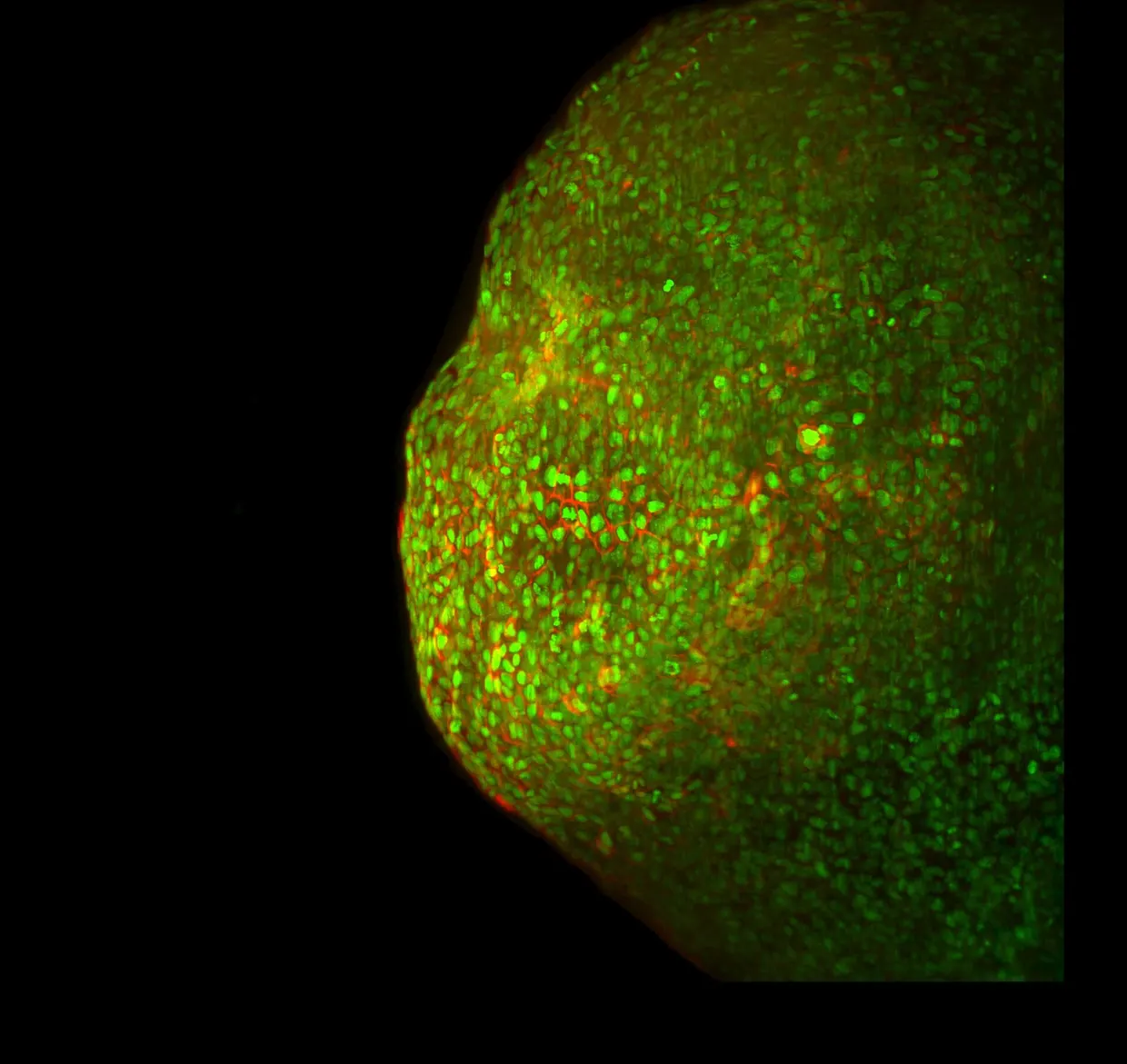
A team from Stanford University School of Medicine reported that two Salmonella enterica serovars sense different surfaces of human intestinal epithelial cells before they invade. The work, published in Nature Communications, used live imaging of human intestinal epithelial cell organoids with controlled polarity nature.com
Nature Communicationsnature.comOpen source ↗. The experiments were done in organoid culture, not in patients or animals.
The serovars studied differ in host range and disease. The generalist serovar Typhimurium and the human-restricted serovar Typhi cause conditions ranging from gastroenteritis to typhoid fever. The authors identify epithelial cell sensing as a pre-invasion stage of infection.
Opposite surface preferences
According to the authors, Typhimurium migrates toward the apical surfaces of epithelial cells and away from the basolateral ones. Typhi shows the opposite behavior. The authors describe this as polarized tropism, and it appears before invasion begins.
This behavior directs Salmonella to epithelial surfaces that permit invasion. The authors also report that it contributes to distinct invasion outcomes for the two serovars nature.com
Nature Communicationsnature.comOpen source ↗.
Chemoreceptors Aer and Tcp
The polarized tropism is coordinated by signaling between two chemoreceptors, Aer and Tcp. Tcp senses citrate released from apical epithelial surfaces, while Aer integrates this signal differently in each serovar.
A single conserved, serovar-specific residue in Aer determines whether Tcp-dependent citrate sensing leads to attraction or repulsion. The same chemical cue can therefore produce opposite movement, depending on that residue.
The authors describe the result as a serovar-specific strategy for recognizing epithelial cell surfaces. They say it gives mechanistic insight into how Typhimurium and Typhi differ in initiating interactions with the human intestinal epithelium nature.com
Nature Communicationsnature.comOpen source ↗.
The work was carried out by researchers at the Department of Microbiology and Immunology and the Department of Pediatrics at Stanford School of Medicine, together with the Child Health Research Foundation in Dhaka. The correspondence author is Denise M. Monack.