EEG aligned to breathing phase tells apart three odors in 17 participants
Researchers aligned EEG responses to the breathing cycle and decoded peppermint, oregano and grapefruit across subjects. The approach requires no task from the participant.
A team reported in Proceedings of the National Academy of Sciences that odor-evoked brain activity in humans is organized by respiratory phase rather than by absolute time pnas.org
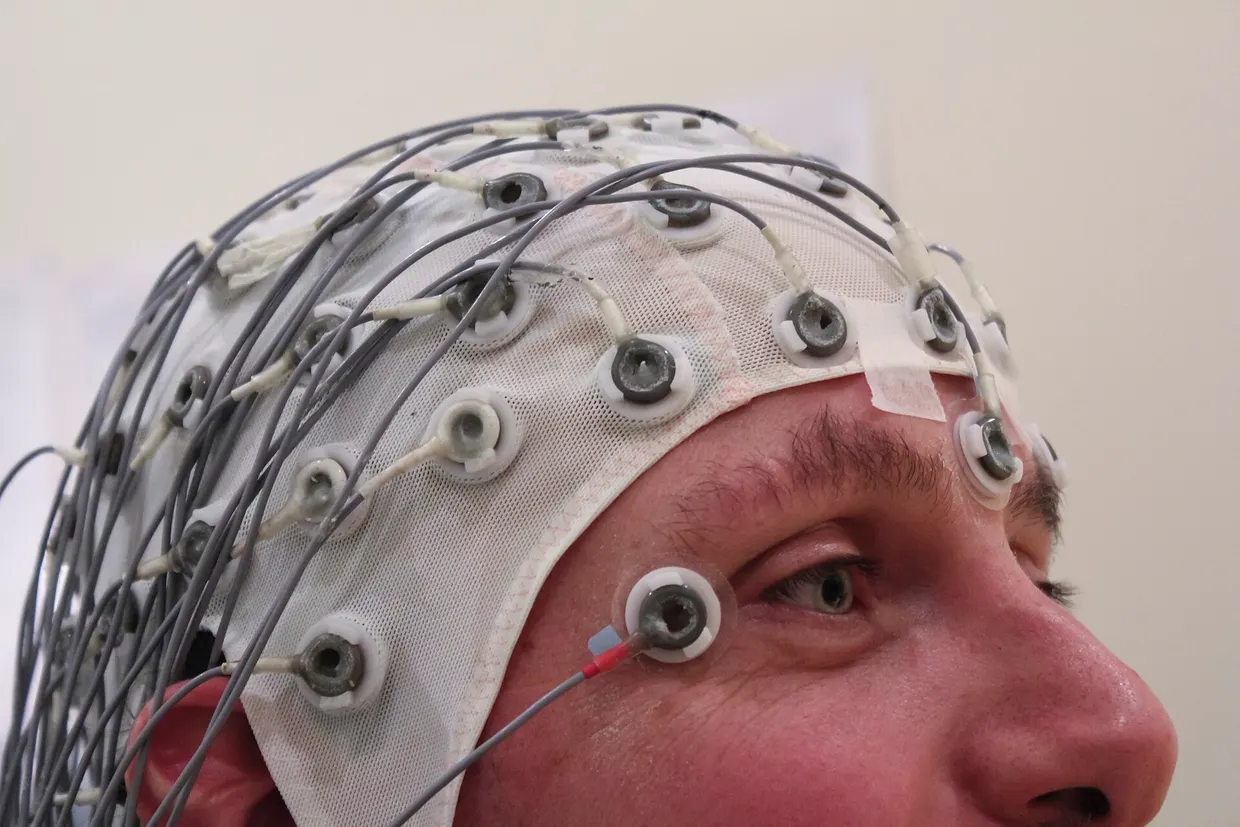
Proceedings of the National Academy of Sciencespnas.orgOpen source ↗. The researchers recorded nasal respiration and electroencephalography (EEG) simultaneously in 17 participants. Peppermint, oregano and grapefruit odors were delivered synchronized to each person's breathing cycle.
Phase-locked EEG responses
Odor presentation produced distinct respiratory phase-locked event-related spectral perturbations (RPL-ERSPs) in frontal and temporal regions. They appeared during the first breath after stimulus onset. The most discriminative signatures were theta-band activity during inhalation and alpha-band activity during exhalation. According to the authors, these patterns were obscured in traditional time-locked analyses because breath duration varies naturally.
Leave-one-subject-out cross-validation gave an AUC of 0.78 for peppermint, 0.68 for oregano and 0.61 for grapefruit. The authors conclude that phase-locked features generalize across individuals.
Perception and habituation
To link the neural signals to perception without requiring participants to name the odor, the team collected free-response descriptions and scored them with a semantic-similarity approach. Recognition strength across the odors paralleled the neural decoding hierarchy pnas.org
Proceedings of the National Academy of Sciencespnas.orgOpen source ↗.
Decoding performance declined over repeated presentations, which the authors attribute to selective degradation of the most informative phase-locked features. They describe RPL-ERSPs as a sensitive, task-free approach to assessing olfactory function.
The authors also provide an open-source, respiration-synchronized olfactometer design costing under $500, intended to enable replication of the method.
Sources · 1
Found a mistake?Read also