University of Chile team ties grain charging to a thin carbon film in silica experiments
Lab experiments on silicon dioxide particles, published in Nature, show that adventitious carbon on the surface helps explain why identical grains charge differently, as in volcanic ash.
Researchers including Nicolás Mujica, Francisco Gracia and Adriana Blanco of the University of Chile have shown in laboratory experiments that a nearly invisible film on grain surfaces affects how particles acquire electric charge. Revista Oeste reports on the paper, published in Nature. The team used silicon dioxide, the main component of sand, under controlled conditions. revistaoeste.com
Revista Oesterevistaoeste.comOpen source ↗
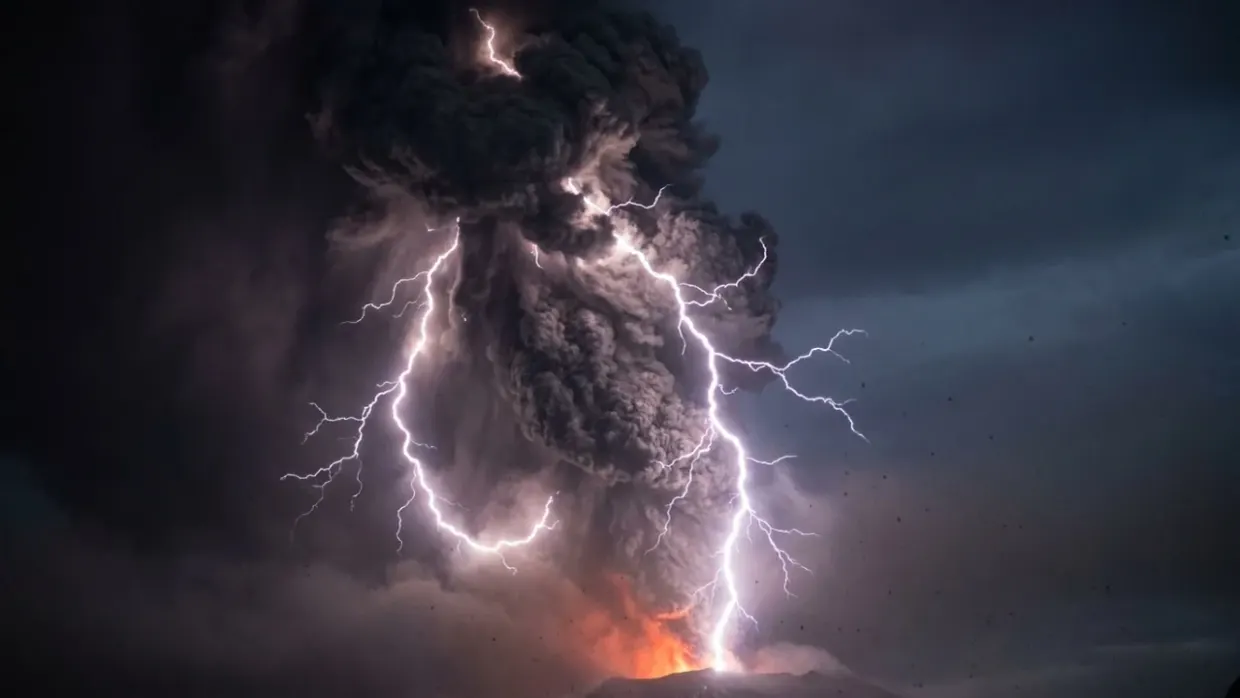
The result is relevant to volcanic ash. During an eruption, particles of sand, dust and ash collide, separate and rub against each other at high speed. Charge is transferred between the grains, and the resulting fields can produce lightning in the plume.
Adventitious carbon on the grain surface
Even when two particles seem to have the same material and similar size, each may be covered with a different amount of carbon molecules deposited naturally from the environment. This film is called adventitious carbon. The paper reports that carbonaceous molecules adsorbed from the environment break the symmetry of contact electrification in oxides.
The researchers followed the surface composition with methods including infrared light, observing how the molecules on the surface changed over time. Some grains accumulated more carbon after exposure to air, while others kept a less contaminated layer. This difference can produce positive, negative or nearly neutral charge. revistaoeste.com
Revista Oesterevistaoeste.comOpen source ↗
When the film was removed by heat or plasma, the electrical behavior stopped looking erratic. The charge followed a more predictable direction, and the researchers were even able to invert the polarity of the particles. The control is not permanent: after the grains return to contact with air, surface contamination gradually comes back, over a period from hours to months depending on exposure.
Ash, powders and other contexts
The fragments that form ash change during the eruption itself. In samples from volcanoes such as Etna, researchers found marks of a process in which magma breaks and rejoins before producing new fragments.
The same phenomenon appears in less visible settings. According to El Mostrador, industrial powders and even ground coffee can agglomerate when granular particles accumulate electricity. revistaoeste.com
Revista Oesterevistaoeste.comOpen source ↗
The contexts cited include the atmosphere, where charges can influence particle dispersion and interactions with microorganisms. In industry, charged powders can cause agglomeration, efficiency losses and electric discharges. In ground coffee, particles can stick together before infusion and alter extraction. In planet formation, electrostatic forces help solid particles approach each other in the early stages.