Göttingen team finds at least ten likely new species of branching worms living inside sponges
Sequencing of museum specimens and microCT imaging showed that branching annelids from sponges form two lineages, one in a new genus Cladosyllis; only three species were known before.
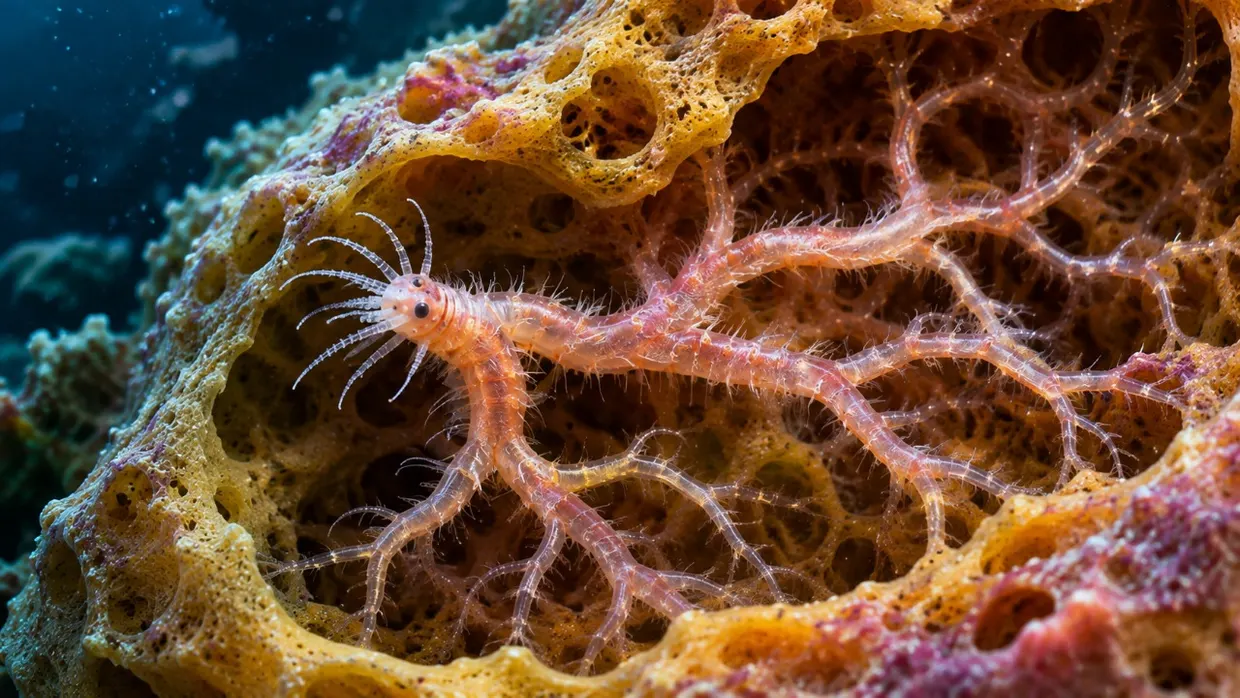
An international team led by the University of Göttingen has reconstructed the evolutionary history of branching marine worms, rare annelids that live inside sea sponges, according to uni-goettingen.de uni-goettingen.de
uni-goettingen.deuni-goettingen.deOpen source ↗. The researchers identified thirteen distinct forms, including at least ten likely new species. Until now, only three species of branching worms had been identified. The results were published in the Zoological Journal of the Linnean Society.
Unlike typical worms, branching worms have a single head that gives rise to a tree-like network of branches, and the body branches repeatedly into multiple posterior ends. They live in symbiosis with sponges and inside them, where this body architecture lets them spread throughout the host.
Museum specimens and microCT
The team combined DNA sequencing of museum specimens with newly collected material and detailed anatomical analyses. Genomic data came from both new samples and decades-old museum material. Some of the sponges hosting the worms came from the Senckenberg collection and date back to 1914. According to Dr Ekin Tilic of the Senckenberg Research Institute and Natural History Museum Frankfurt, microCT imaging made it possible to reveal the worms without damaging the sponges.
Professor Maria Teresa Aguado, Scientific Curator of the Biodiversity Museum at Göttingen University and leader of the study, said the findings would have been impossible without access to museum specimens.
Two lineages and host specialization
The analysis showed that branching worms form a distinct evolutionary group of two major lineages. One belongs to the genus Ramisyllis; the other was assigned to a new genus, Cladosyllis uni-goettingen.de
uni-goettingen.deuni-goettingen.deOpen source ↗. The thirteen forms are distributed across the Indo-Pacific, the Red Sea and New Zealand. According to the authors, specialization on different sponge hosts played a key role in diversification: some species live in deep-sea glass sponges at depths of up to 1,000 metres, others in shallow-water sponges.
For over a century, all branching worms were classified as a single widespread species. Co-author Dr Guillermo Ponz Segrelles noted that, like their bodies, their family tree has many branches, each closely associated with its own sponge species and specific areas.
The study shows that all branching worms descend from a common ancestor, so their body architecture evolved only once. The two lineages produce their branches in different ways. The researchers believe many more species remain undiscovered and that these animals could serve as a model for studying the evolution of complex body forms, symbiosis and marine biodiversity.