Apple's HALO humanoid controller reaches 91% success in six unseen homes on a Unitree G1
Apple researchers validated the HALO motion-control system on a Unitree G1 humanoid; chained tasks dropped to 70% success, and no commercial product was announced.
Eight Apple researchers presented HALO, a motion-control system for humanoid robots, on 4 November 2026, according to ad-hoc-news.de. The paper "Perceptive Humanoid Motion from Simulation" (arXiv 2611.06908) describes an autonomous system validated on Unitree G1 hardware. ad-hoc-news.de
ad-hoc-news.dead-hoc-news.deOpen source ↗ Apple announced no commercial product, price or delivery date.
Results in unmapped homes
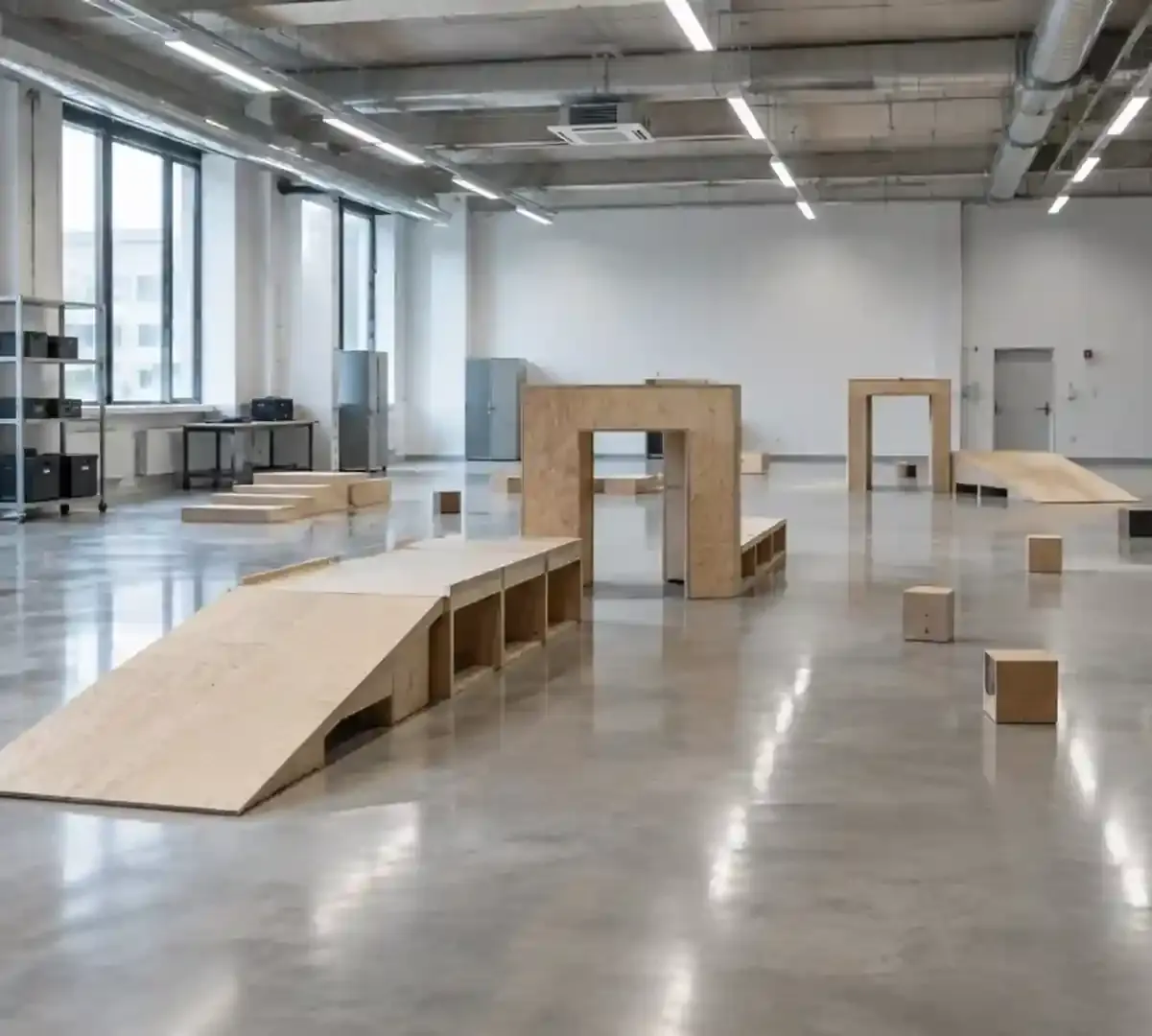
According to the team, HALO reached an average success rate of 91% over 360 single-task trials in six real environments that had never been scanned or mapped. The same 91% was recorded over 6,000 trials in 100 simulated environments.
In single-skill tests in six houses, ten runs each, crawling scored 100%, sideways movement through doors 93% and walking to a set target 92%. Moving on all fours reached 90%, pushing a box 88% and sitting down 85%.
Chained tasks of two to three skills in a real test environment averaged 70%. Door crossing plus walking succeeded in 10 of 10 attempts, crawling plus sitting reached 60%, and the chain of crawling, walking and pushing a box 50%. The team named as the main cause of failure cases where a subsequent subtask started with a previously unseen target. ad-hoc-news.de
ad-hoc-news.dead-hoc-news.deOpen source ↗
Architecture, training and limits
HALO has three control levels. At the top, an orchestrator runs locally as a Qwen3.6-35B-A3B model with 4-bit quantization. The middle level is a motion generator based on Qwen3.5-2B and a diffusion transformer; it replans about three times per second and builds whole-body motion plans of roughly five seconds. The lowest level is a tracker that sends 50 Hz joint commands to the actuators.
The robot is a Unitree G1 with 29 joints and a head camera. For high-level planning, the researchers mounted a Mac mini M4 Pro with 64 GB of memory in a 3D-printed housing on its back. Low-level control runs on a Jetson Orin NX, so the system operates without external cabling.
Training used about 300 hours of synthetic episodes from 1,000 procedurally generated houses, created without human intervention. Data generation took about 48 hours on 250 Nvidia H100 GPUs. The motion generator was trained by imitation learning on 64 Nvidia B200 GPUs, and the tracker on four H100 GPUs with reinforcement learning and policy distillation. ad-hoc-news.de
ad-hoc-news.dead-hoc-news.deOpen source ↗
The team released code for data generation, model training and deployment; no repository address or license terms were given. The system lacks contact sensing and relies mostly on vision. New tasks need manually written prompts and designed motion keyframes, partly based on human video or motion-capture recordings. Independent reproduction of the results is not yet available, and Apple plans to add haptics next.