Physicists link the pseudogap in cuprates to electron pairs
A study reveals a connection between the pseudogap in cuprate superconductors and the formation of electron pairs, shedding light on high-temperature superconductivity.
A team of physicists led by Milan Allan from Ludwig Maximilian University of Munich and Ingmar Swart from Utrecht University has made significant strides in understanding cuprate superconductors. Their findings, published in Science, reveal a connection between the pseudogap phenomenon and the formation of electron pairs. Cuprates are known for their ability to superconduct at higher temperatures than conventional materials, yet the underlying mechanisms remain elusive. The researchers focused on the pseudogap, a state where fewer electrons are detected at certain energy levels.
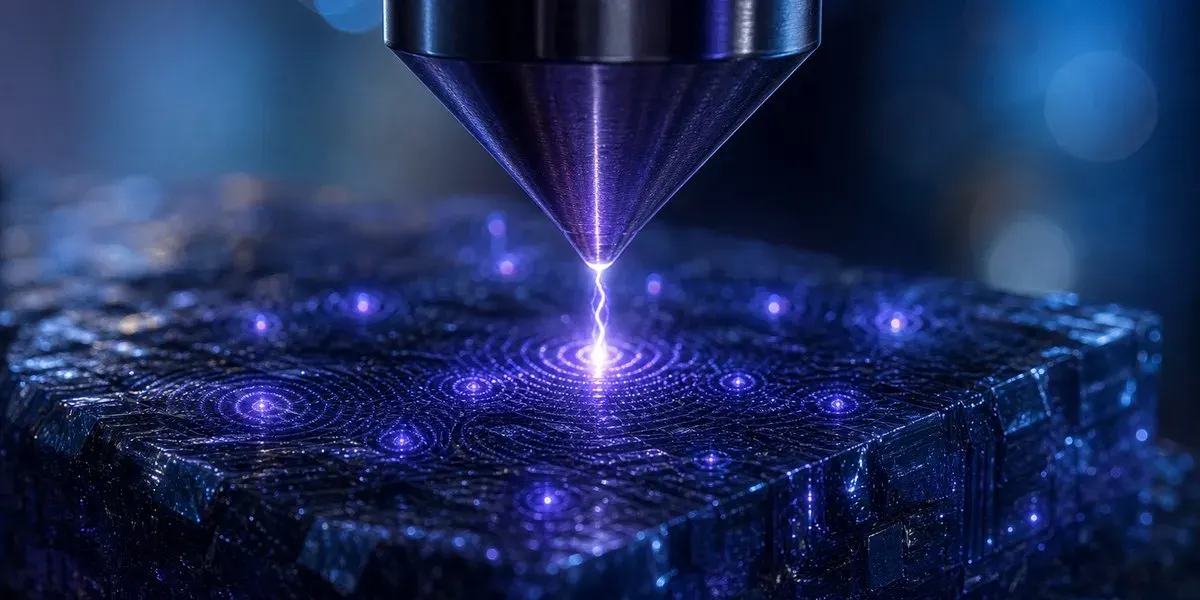
To investigate this, the team studied crystals of a cuprate known as BSCCO, cooled to just above absolute zero. They employed a scanning tunneling microscope to measure shot noise, which reflects tiny fluctuations in electric current caused by individual charges. The expectation was that when two electrons move together as Cooper pairs, the noise level would increase. Remarkably, the researchers found that the additional noise began to rise at the energy level corresponding to the local pseudogap, rather than solely at levels associated with superconductivity.
This correlation was consistent across samples with different chemical compositions. To further validate their findings, the researchers subjected the crystals to magnetic fields of up to six tesla, which suppressed pair formation while maintaining the overall pattern of missing electrons. As the magnetic field strength increased, the noise level decreased to that typical of single electrons, supporting the idea that electron pairing is indeed linked to the pseudogap.
The results suggest that in cuprates, electron pairs may form prior to the onset of phase coherence, which is the state where pairs begin to move in unison, leading to superconductivity. This insight could pave the way for advancements in high-temperature superconductivity research, as it indicates that the challenge lies not in pairing electrons but in enabling these pairs to move together effectively.