Dinosaur fossil rediscovered in London museum reveals new predator
A dinosaur skull fragment, stored since 1924, is reexamined using high-resolution tomography, uncovering details of a 120-million-year-old predator.
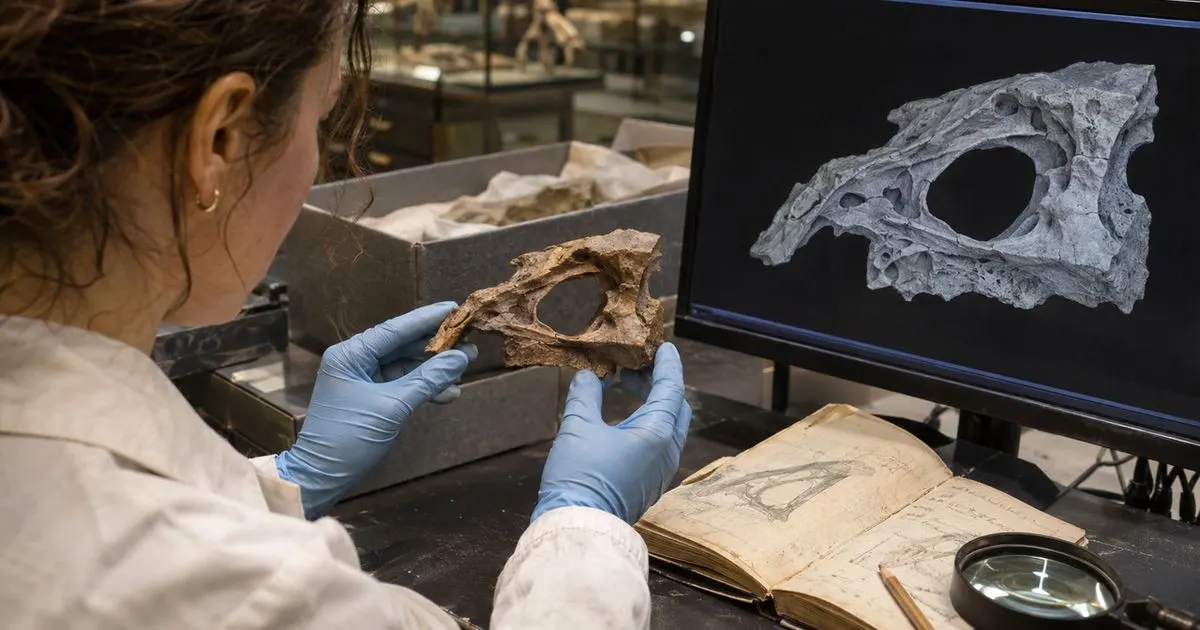
A fossil box has returned to the museum's table after decades in storage. Inside was part of a skull found on an island, with an old label and notes too brief to answer today's questions. Researcher Bia selected the piece to test high-resolution tomography. On the screen, small structures that appeared smooth under laboratory light revealed unexpected details. She did not announce a new species but first sought the notebook of the person who collected the bone, as the history of the piece also depended on where it was found.
The collector who gathered it recorded the region and rock layer, but the fragment was too small for a secure identification with the methods available at the time. The museum cataloged and protected it while researchers prioritized more complete skeletons. Being stored did not mean it was lost. The box had temperature control and a location record, discreet conditions that allowed revisiting the material when more specific questions arose. The label enabled Bia to reconnect the piece with other materials from the same geological formation.
Upon opening the old notebook, she found a drawing of the slope and an observation about the rock. The precision varied between pages; part of the site had changed due to erosion. Bia cross-referenced the drawing with maps and later photographs, without transforming an uncertain reference into an exact coordinate. Preserved ancient collections can gain new questions when documentation accompanies the object, even if not all answers are present.
The images showed internal cavities and contacts between bones that could not be examined without damaging the fossil. Bia created a digital reconstruction and compared it with descriptions of other carnivorous dinosaurs. Some features were shared; a combination seemed less common. She noted which parts were preserved and which were inferred. The computer amplified what the piece contained but did not create the missing bones.
A colleague observed that deformations suffered during fossilization could mimic anatomical differences. They reviewed the images from different angles and looked for signs of compression. The description of paleontological collections for research helps understand why ancient specimens remain available for comparisons. The new technique was useful precisely because they could revisit the same bone without destroying it.
Perhaps, but Bia could not demonstrate this yet. The piece appeared to belong to a theropod, a group of dinosaurs that includes many bipedal carnivores. The fragment did not show arms, claws, or total body size. Illustrating a complete animal from it would require hypotheses, not direct observations. Bia marked in her report the characteristics that justified further investigation and the alternatives that remained possible.
An informal news item about a “new predator” circulated among visitors when they saw the digital model. Bia prepared an explanation for the museum room: they had found new details in an old fossil, not a concluded formal classification. Anyone wishing to name a species would need to compare sufficient material, describe the differences, and submit the study for scientific review. Visitor enthusiasm could coexist with this caution.
The notebook indicated a rock layer that still appeared in part of the slope. Bia went to the island with permission to observe the terrain, without promising to find the rest of the animal. Erosion had exposed new surfaces and removed others. She collected data about the layer, not a piece that would immediately complete the skull. The return helped evaluate the context and limits of the notes made decades earlier.
On the trip, she took a copy of the old drawing. By comparing the slope's inclination with the current landscape, she realized that a mark interpreted as a trail might have been a rock line. She corrected the working map. The discovery was not flashy but avoided misattributing the fossil to the wrong point. Back in the lab, the digital model and field documentation began to tell a more precise, albeit incomplete, story.
A modern analysis revealed previously less visible anatomical structures and justified a broader comparison of the fragment with other theropods. Bia published a preliminary record of the work, indicating doubts and material needed to advance. The fossil remained in the museum, available to other researchers. It did not gain a species name at that moment. The honesty of the conclusion prevented an attractive hypothesis from being taken as a definitive result.
As she closed the box, Bia found the faded signature of the collector on the label. He had preserved a clue without knowing what questions would be asked in the future. The tomography did not transform the fragment into a complete skeleton but showed that preservation and old records could support new investigation. The most interesting detail was not a predator ready to illustrate but the interval between two attentive looks at the same bone.