UEL team links four engineering tools into one earthquake assessment of a modelled five-storey building
University of East London researchers ran a combined workflow on a computer model of a concrete building with Northridge and Kobe records. It is a modelling-stage study.
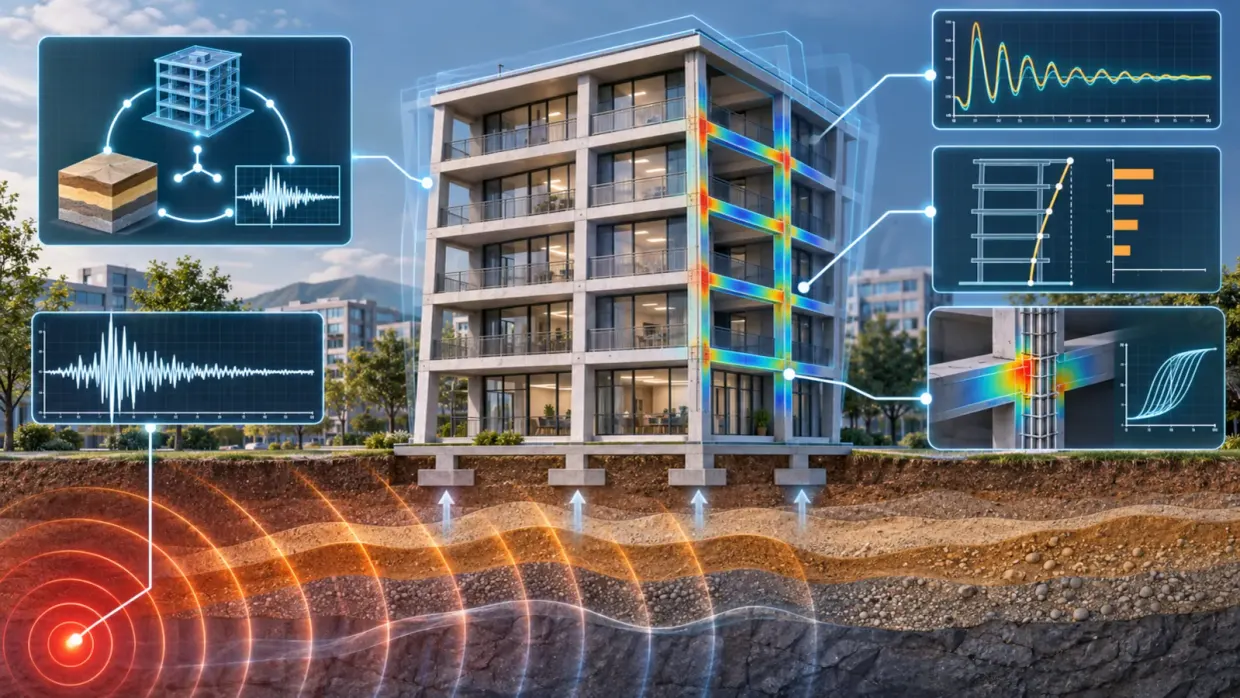
Researchers at the University of East London (UEL), led by Dr Jawed Qureshi, tested a combined engineering workflow on a computer model of a five-storey reinforced concrete building, according to uel.ac.uk uel.ac.uk
uel.ac.ukuel.ac.ukOpen source ↗. The model was loaded with recorded ground motions from the 1994 Northridge and 1995 Kobe earthquakes. The study, co-authored with Bala Karthika Balakrishnan, is published in the journal Buildings.
Four tools in one workflow
Engineers usually assess the soil, the strength of shaking, the movement of the structure and the capacity of its components with separate tools. This makes it hard to see how the factors interact. The UEL workflow brings four specialist tools together under human supervision. They analyse soil layers, ground-motion strength, building deformation and the capacity of a column.
The authors describe the approach as a way to combine information from different disciplines, not to replace engineers: specialists oversee the process and interpret the results. At this stage the engineers still transfer information between the tools by hand.
Results and limits
At the building's natural period, the Northridge record produced approximately 3.4 times the median seismic demand of the Kobe record. The difference in peak structural movement was only 1.32 times uel.ac.uk
uel.ac.ukuel.ac.ukOpen source ↗. The maximum drift between storeys was 0.45 percent for Northridge and 0.34 percent for Kobe. Both values stay below the 1 percent threshold for low damage used in the study. The result shows that stronger shaking does not produce a proportionately larger movement of the building.
Soil data indicated a relatively weak, compliant layer at a depth of 5 to 12 metres. A full calculation of site-specific amplification of the waves was not made in this part of the work.
The initial study used one soil profile, two earthquake records and one example building model. Further testing is needed before the approach could be used routinely in engineering practice. The authors name larger earthquake datasets, greater automation and data from building inspections and structural monitoring as directions for future research.