CERN's ALICE Experiment Systematically Detects Gold Production from Lead
Researchers tracked electromagnetic dissociation in the LHC, where lead nuclei shed protons to yield picograms of gold.
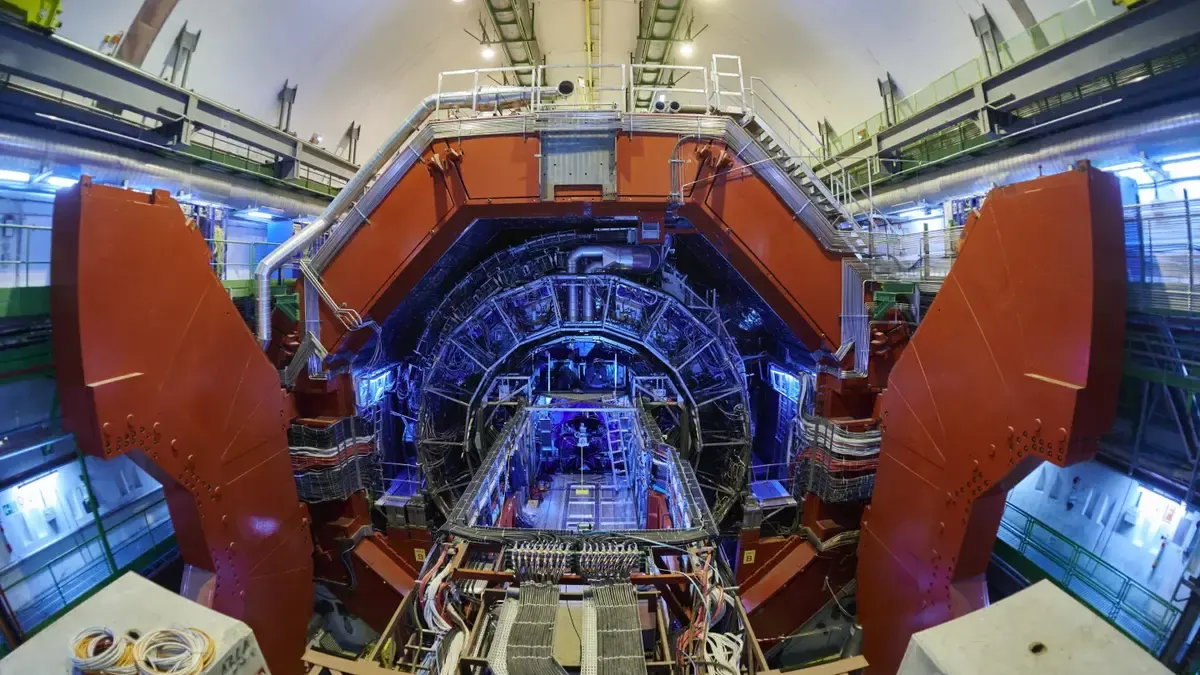
Physicists at the ALICE experiment at CERN's Large Hadron Collider (LHC) have experimentally detected and systematically analyzed the transformation of lead nuclei into gold, according to Novinky.cz novinky.cz
Novinky.cznovinky.czOpen source ↗. The 27-kilometer underground collider near Geneva accelerated lead ions to near light speed, creating conditions where high-energy nuclear interactions shed nucleons.
Mechanism of Electromagnetic Dissociation
A lead nucleus contains 82 protons, whereas gold contains 79. The conversion does not require direct central collisions, which researchers typically use to generate quark-gluon plasma. Instead, transformation occurs when two ultra-relativistic lead ions pass extremely close to each other without colliding.
Because these ions carry large positive electrical charges, their close passage generates intense electromagnetic fields. The field of one ion disrupts the other, ejecting neutrons and protons via electromagnetic dissociation. When exactly three protons and several neutrons are stripped away, the lead nucleus transitions into a gold nucleus.
Detection Yields and Beam Dynamics
Data analysis revealed that during the LHC's Run 2 from 2015 to 2018, four major experiments generated approximately 86 billion gold nuclei novinky.cz
Novinky.cznovinky.czOpen source ↗. The total combined mass of these synthesized nuclei was 29 picograms. Production accelerated during Run 3, which began in 2022; by May 2025, CERN reported that nearly double the amount of gold generated during Run 2 had already formed.
The resulting gold cannot be extracted. Because the gold nuclei possess high kinetic energy and a lower electric charge than lead, the LHC's bending magnets cannot maintain them in the beam trajectory. The newly formed nuclei diverge from the beam within microseconds and collide with the vacuum pipe walls or accelerator components. This effect contributes to beam loss and limits machine luminosity. Further experiments are paused following the planned shutdown of the collider on June 29 for Long Shutdown 3, which is scheduled to last approximately four years.