Memorial University of Newfoundland models 10.56 kW solar boat design
Engineers sized a 10.56 kW photovoltaic propulsion system for an 11.8-meter pleasure craft, modeling 6 hours of daily cruising.
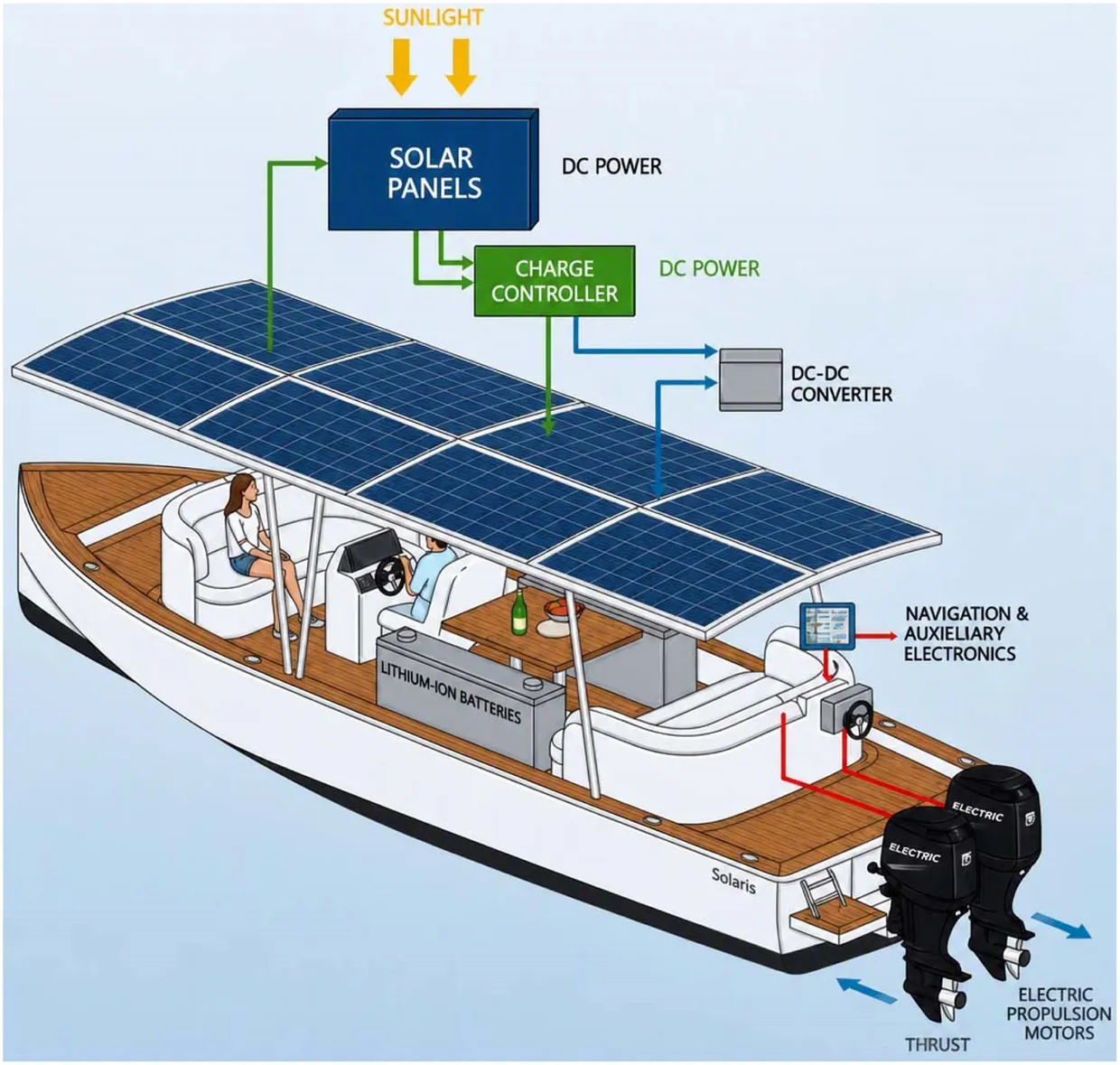
Engineers from the Memorial University of Newfoundland in Canada have modeled a standalone solar-electric propulsion system designed for a small recreational vessel, pv-magazine.com reported. The team designed the setup for an 11.8-meter-long, 5.8-meter-wide pleasure boat accommodating five to six passengers, tailored to solar irradiation profiles in Larnaca, Cyprus pv-magazine.com
pv-magazine.compv-magazine.comOpen source ↗.
Sizing and powertrain specs
Based on a full-load displacement of approximately 2,250 kg and a cruise speed of 5.4 knots, the researchers selected two 2.5 kW brushless DC motors. The propulsion architecture requires an estimated 30 kWh for six hours of daily operation. Energy generation comes from 32 photovoltaic modules rated at 330 W each, providing a total peak capacity of 10.56 kW across roughly 62.4 m². Backup storage comprises eight lead-acid batteries wired into a 48 V, 410 Ah pack with 19.68 kWh nominal capacity, sized to provide two hours of reserve autonomy.
Simulation and power management
The engineering team assessed the design using HOMER Pro for yield estimation alongside dynamic multi-domain modeling in MATLAB/Simulink. The photovoltaic array is split into four subarrays, each regulated by a boost converter with incremental-conductance maximum power point tracking (MPPT) feeding a common 48 V DC bus. A closed-loop PID controller combined with Hall-effect sensors maintains motor shaft speeds at 2,000 rpm, while an energy management system caps battery charging at 50 A and mitigates surplus generation.
Simulations under local clear-sky peak irradiance showed array output reaching up to 10.98 kW, yielding an excess energy margin of 39.8% above baseline propulsion demand pv-magazine.com
pv-magazine.compv-magazine.comOpen source ↗. The researchers noted that bus voltage stayed within ±3% of the 48 V baseline throughout solar-only, hybrid, and battery-only operating regimes, with sea trials remaining as future work.