UTe2 superconductor displays non-volatile memory effect in tests
Physicists identified controllable switching between vortex states in candidate p-wave superconductor UTe2 near absolute zero.
Physicists from Czechia and the University of Cambridge identified an intrinsic memory effect in single crystals of uranium ditelluride (UTe2) at 50 mK under applied magnetic fields, according to nature.com nature.com
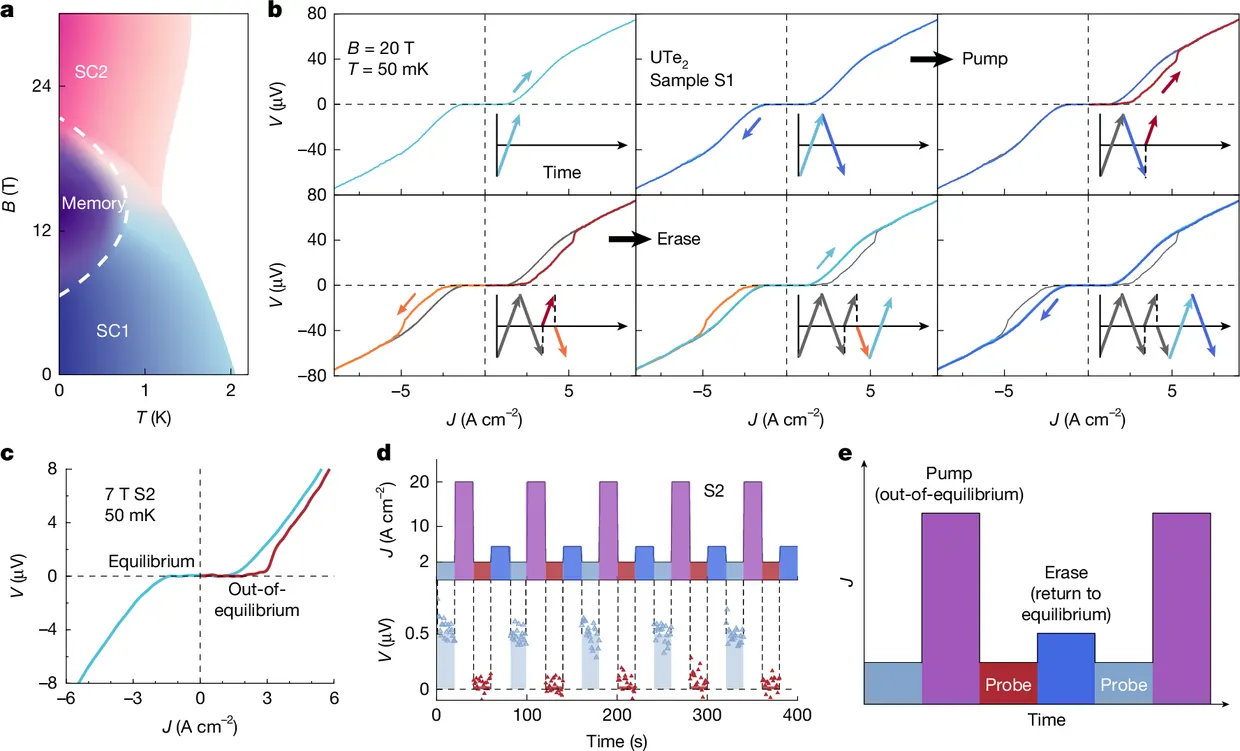
nature.comnature.comOpen source ↗. By applying electrical direct current pulses, the team pushed the heavy-fermion compound between states with different critical current densities Jc. The system retained its high or low critical current density state over extended periods, exhibiting non-volatile storage behavior without requiring proximity to ferromagnetic or semiconducting layers.
Vortex lattice switching
The phenomenon occurs in an intermediate regime between two distinct superconducting phases, labeled SC1 and SC2, when a magnetic field is aligned along the hard b-axis of the crystal. In this region, abrupt changes in current amplitude perturb the material into a disordered out-of-equilibrium glassy vortex state. This disordered configuration exhibits higher vortex pinning forces, which directly enhances the critical current density. The authors reported that the switching depends on the duration and magnitude of the input pulses.
Annealing and reset protocol
Returning the system to its equilibrium condition requires erasing the trapped metastable state. Sweeping the transport current smoothly back to zero acts as an electrical anneal, restoring the original vortex lattice configuration and returning Jc to its baseline value. In contrast to materials like NbSe2 where hysteretic memory manifests near the critical temperature due to thermal effects, the memory response in UTe2 operates at millikelvin temperatures and is driven by competing vortex structures across the phase boundary.