Wellcome Sanger atlas of 12 glioblastomas shows cancer cells follow a shared state trajectory
An atlas of 12 human glioblastomas and more than 1 million nuclei shows cells shifting from developmental-like states to injury response and hypoxia in a pattern shared across tumours.
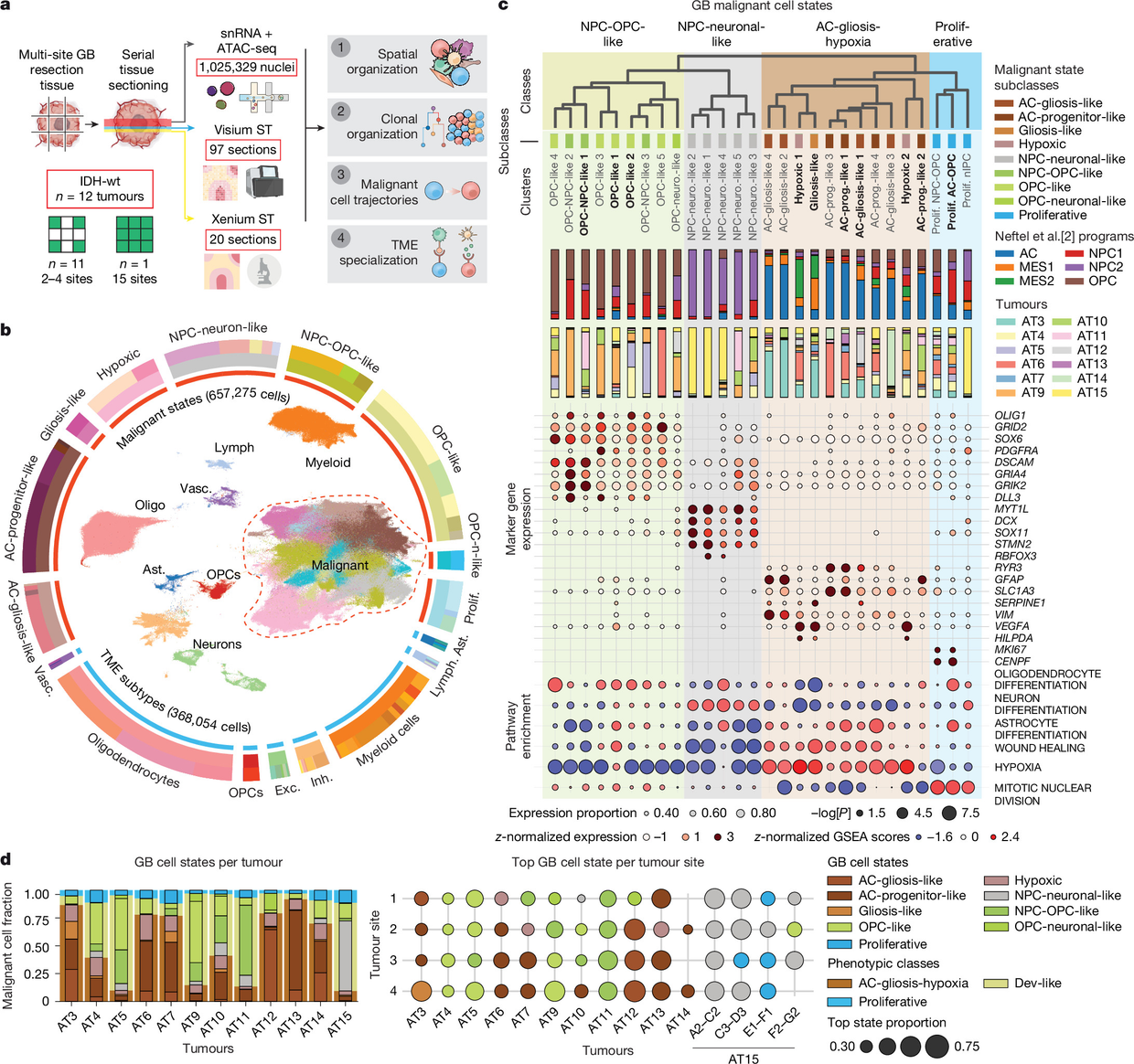
Researchers from the Wellcome Sanger Institute, EMBL, the German Cancer Research Center (DKFZ), the Cancer Research UK Cambridge Institute and collaborators built a single-cell and spatial multi-omic atlas of 12 human glioblastomas, according to a paper in Nature (nature.com) published on 4 November nature.com
nature.comnature.comOpen source ↗. The authors report that tumour heterogeneity follows a spatially patterned transition of cancer cells from developmental-like states to states defined by a glial injury response and hypoxia
nature.com
nature.comnature.comOpen source ↗.
Atlas design
The set covers 12 primary IDH wild-type tumours sampled at 57 sites in total. Most cases were sampled at 4 sites of roughly 1.25 cm3 each, and one tumour at 15 sites, effectively covering it whole nature.com
nature.comnature.comOpen source ↗. Each site was profiled with paired single-nuclei joint RNA and chromatin accessibility sequencing and with Visium spatial transcriptomics on consecutive sections. Selected sites also received Xenium spatial transcriptomics, immunohistochemistry and whole-genome sequencing of tumour microbiopsies
nature.com
nature.comnature.comOpen source ↗.
The dataset includes more than 1 million nuclei (657,275 malignant and 368,054 from the tumour microenvironment) and more than 0.3 million spatial transcriptomes across 97 Visium sections. It is available at gbmspace.org nature.com
nature.comnature.comOpen source ↗.
Trajectory of cancer cells
The transition divides tumours into distinct tissue microenvironments. It appears in a molecularly conserved form across tumours and across genetically distinct subclones nature.com
nature.comnature.comOpen source ↗. Using a new computational framework that maps cell states together with clones in situ, the authors found that subclones are finely intermixed within these microenvironments
nature.com
nature.comnature.comOpen source ↗.
The trajectory was validated with hierarchies based on somatic mutations in vivo and with a patient-derived organoid model ex vivo. The authors also report that it is linked to myeloid heterogeneity and unfolds across regionalized myeloid signalling environments nature.com
nature.comnature.comOpen source ↗.
According to the release, a companion Nature paper used the same data to identify gene regulators that drive and restrict transitions between cell states.
Glioblastoma background
Glioblastoma is an incurable adult brain cancer. Per the release, about 3,200 people are diagnosed with it in the UK each year, average survival is 12 to 18 months, and 4 per cent of patients survive five years or more. The work is a laboratory atlas study, not a treatment trial.
Sources · 2
Found a mistake?Read also