Carbon dots with near-100% quantum yield change emission color with pH, solvent and concentration
Lab-made carbon dots shift fluorescence from blue to red depending on liquid, concentration and acidity; polymer powders with them were used in an encryption demonstration.
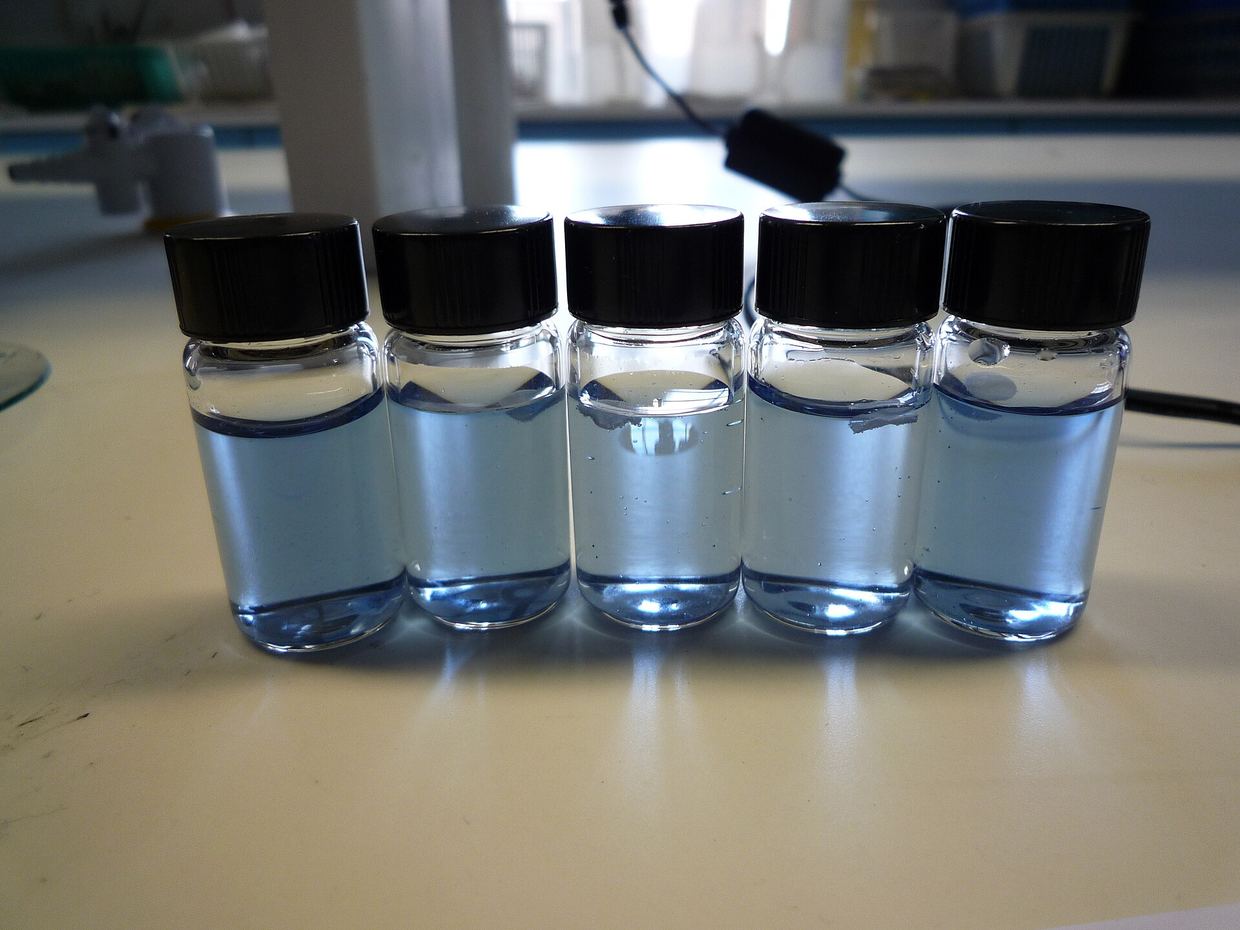
Researchers led by Siyu Lu and Lin Ai reported carbon dots (CDs) whose fluorescence color depends on the liquid, the concentration and the acidity. The paper appeared in ACS Central Science on 2 November 2026. The particles are made in a one-pot solvothermal process, and in aqueous dispersion their photoluminescence quantum yield (PLQY) approaches 100%, according to the authors doi.org
ACS Central Sciencedoi.orgOpen source ↗. The work is at the laboratory stage.
Synthesis and structure of the dots
Two carbon-based compounds were heated in an organic solvent under pressure, which produced particles with carbon-rich cores and chemically responsive surfaces. Two versions, CD1 and CD2, were prepared using different ratios of the starting materials doi.org
ACS Central Sciencedoi.orgOpen source ↗.
The authors attribute the high PLQY to the cross-arranged, nonextended conjugation of perylene-based backbones in the core, which prevents further π–π stacking doi.org
ACS Central Sciencedoi.orgOpen source ↗. Surface functional groups set the solvent-dependent emission through polar interactions and hydrogen bonding
doi.org
ACS Central Sciencedoi.orgOpen source ↗.
Response to stimuli and test applications
As the concentration increases, stronger intermolecular interactions move the emission from monomer-dominated to aggregate-dominated states doi.org
ACS Central Sciencedoi.orgOpen source ↗. At different pH, reversible protonation and deprotonation of surface groups modulates the electronic structure and thereby the emission
doi.org
ACS Central Sciencedoi.orgOpen source ↗. In tests, CD1 fluoresced red in acidic water and green in alkaline water. The change reversed repeatedly without affecting the brightness of the dots.
When CD1 and CD2 were suspended in water, toluene, methanol and ethanol, or when their concentration was varied, the emission ranged from blue to red. The dots were then combined with polymers to make blue, green, yellow and red powders with PLQY approaching 100% doi.org
ACS Central Sciencedoi.orgOpen source ↗.
The powders were used in crafts, including molded Chinese characters and decorative bottles, and flexible films were folded into different shapes. The color changes also served as the basis of a multidimensional encryption system that encodes information through combinations of light, liquid and acidity conditions doi.org
ACS Central Sciencedoi.orgOpen source ↗.
Lu said the team is exploring commercialization of the CDs, particularly for information encryption. Next, the researchers plan to evaluate long-term stability, large-scale manufacturing and production cost.