Boston Children's Hospital: disrupting single autism genes in neural cells alters shared gene network
In cultured human neural progenitor cells, knocking down individual autism genes downregulated other autism genes; X-linked ZFX is proposed to contribute to the female protective effect.
Researchers at Boston Children's Hospital, led by Christopher Walsh, report in Nature (nature.com) that disrupting individual autism spectrum disorder (ASD) genes in human neural progenitor cells produces shared changes in gene expression, including downregulation of other ASD genes nature.com
nature.comnature.comOpen source ↗. The study was published on 4 November 2026. The work was done in cell culture, not in patients or animals. The lead authors are Rebecca Andersen and Maya Talukdar.
Knockdown in neural progenitor cells
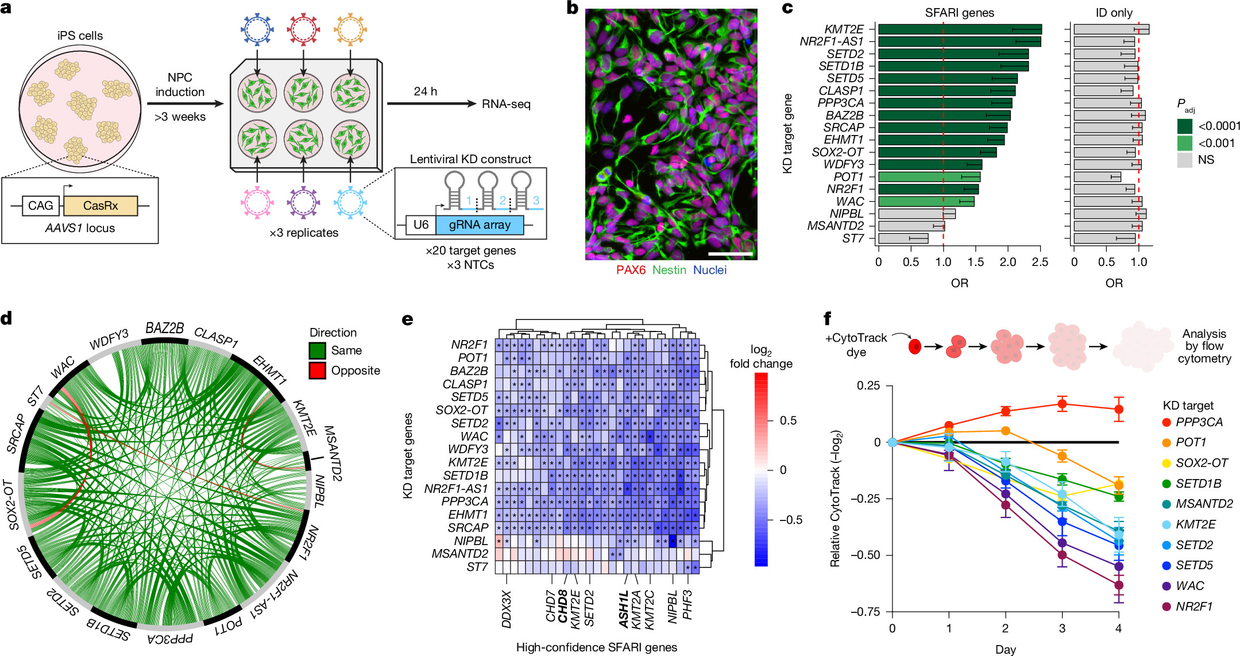
The team used CasRx, a CRISPR enzyme that degrades RNA, with three guide RNAs per target. They knocked down 20 genes in neural progenitor cells derived from a control male (XY) induced pluripotent stem cell line. Eighteen targets came from the SFARI gene database and two were long non-coding RNAs previously linked to ASD, NR2F1-AS1 and SOX2-OT nature.com
nature.comnature.comOpen source ↗.
RNA sequencing after 24 hours showed that nearly all perturbations changed the expression of many genes. The median was 920 differentially expressed genes per perturbation (25th percentile 644, 75th percentile 1,485) nature.com
nature.comnature.comOpen source ↗. Eighteen of the 20 perturbations produced more than 20 such genes and were analysed further; ARHGAP5 and ARID2 were excluded. Each remaining perturbation gave at least 287 differentially expressed genes
nature.com
nature.comnature.comOpen source ↗.
Andersen described the pattern as "transcriptomic convergence": downregulating one autism gene downregulates a number of others.
Regulators and the female protective effect
The authors reconstructed a gene regulatory network de novo to find the regulators behind this convergence. It identified central transcriptional regulators, including the ASD gene CHD8 and candidates such as REST nature.com
nature.comnature.comOpen source ↗.
ASD is three- to four-fold more common in males, and autistic females tend to carry more autosomal risk alleles than autistic males. The biological basis of this female protective effect had remained unknown nature.com
nature.comnature.comOpen source ↗. The network analysis pointed to ZFX, an X-linked transcription factor that is expressed from both the active and the inactive X chromosome in females. ZFX emerged as a key activator of many ASD genes
nature.com
nature.comnature.comOpen source ↗.
The authors propose that the higher ZFX expression observed in the female brain can buffer damaging mutations in diverse ASD genes, contributing to the female protective effect nature.com
nature.comnature.comOpen source ↗. According to the Boston Children's release, more than sixty genes on the X chromosome escape inactivation, ZFX among them. The knockdown experiments used a single male cell line, and the ZFX role in the female protective effect is presented as a proposal.