Researchers Create Laser-Induced Plasma Beam Antenna for Radio Waves
A team from North Carolina State University has developed a plasma beam antenna using a laser, capable of transmitting radio waves at 30 MHz.
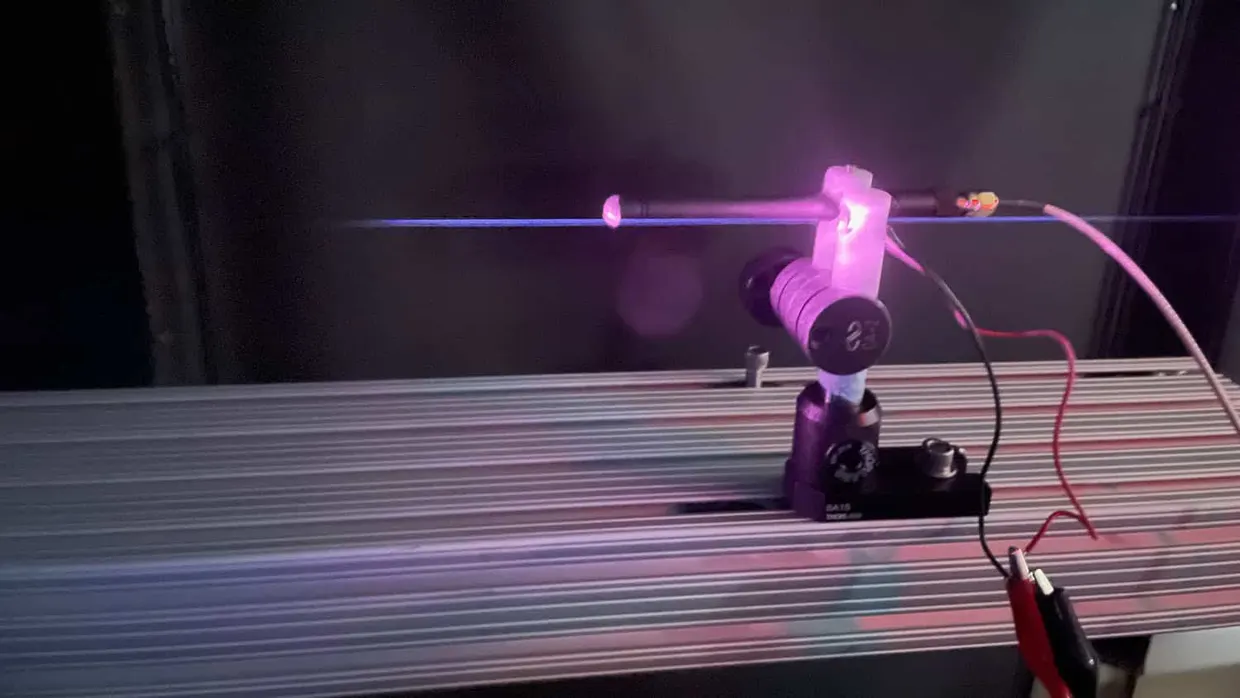
Researchers at North Carolina State University have demonstrated a technique that uses a laser to produce a plasma beam antenna capable of transmitting radio waves. This innovative antenna, which resembles a lightsaber, is tunable and can transmit across a broad range of frequencies. While the researchers have not yet shown its ability to receive signals, they believe it could function as a receiver as well. The findings were reported on news.ncsu.edu.
Plasma Beam Antenna
The length of an antenna is crucial as it determines the frequencies at which radio waves can be transmitted and received. Traditional methods of adjusting antenna length can be challenging, especially in applications like space exploration. The researchers aimed to explore whether lasers could create plasma antennas, allowing for antennas of any necessary length. They successfully demonstrated this concept by ionizing a thin beam of air with a laser, creating a plasma filament.
To make the plasma antenna practical, the team developed a contactless antenna-feed system. This system uses a metal ring as a capacitor, allowing the laser to pass through and create a plasma filament surrounded by the capacitor. By generating an electromagnetic field with the capacitor, the researchers can interact with the plasma beam without direct contact.
Applications and Future Work
The process involves a radio frequency generator feeding a signal into the capacitor, which generates the electromagnetic field, causing the plasma filament antenna to transmit radio waves. By controlling the laser parameters, the characteristics of the plasma filament, including its length, can be adjusted. This capability is valuable for applications requiring antennas that can sweep across all frequencies and control the angle for targeted radar sweeps.
The technology holds promise for various applications, particularly in satellites and space exploration, where payload and frequency scanning capabilities are critical. The researchers noted that in low Earth orbit, there is enough air to form plasma. This work represents a significant step forward, as it is the first demonstration of plasma-filament antennas functioning effectively. The team plans to continue improving the performance of this technology.