University of Wollongong tests liquid-metal wave harvester in a life-jacket prototype with an SOS light
A soft gallium-based converter turned wave-like motion into current and lit an LED SOS display in a vest prototype; 40 units gave about 2 V in lab tests.
A team including Professor Weihua Li of the University of Wollongong (Australia) has built a soft energy converter that powered an SOS light in a life-jacket prototype without a battery, scinexx.de reports scinexx.de
scinexx.descinexx.deOpen source ↗. The device generates current from motion and was demonstrated under simulated waves. It is an experimental demonstration, not a finished life jacket
scinexx.de
scinexx.descinexx.deOpen source ↗.
How the liquid-metal converter works
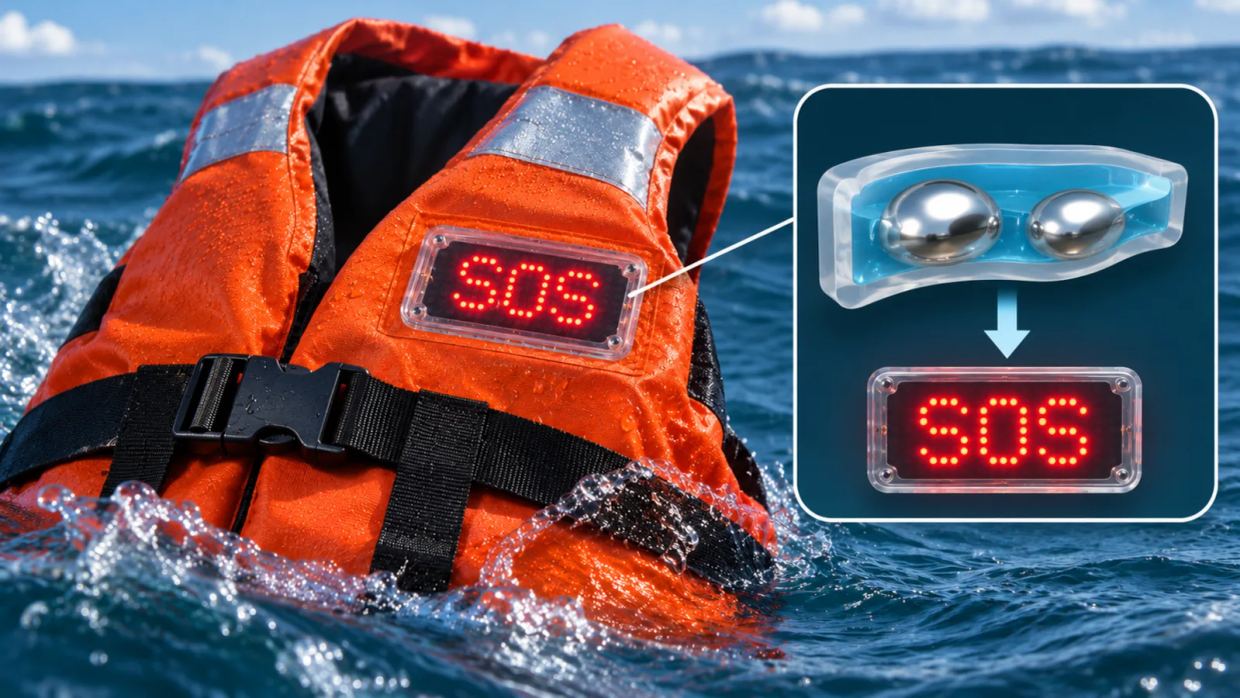
The component contains two drops of gallium-containing liquid metal in an electrically conductive liquid scinexx.de
scinexx.descinexx.deOpen source ↗. When the device moves, the contact areas of the metal with the liquid and with the air change. This alters the electrochemical reactions at the drops and produces an electric current
scinexx.de
scinexx.descinexx.deOpen source ↗.
In tests, an array of 40 units delivered about two volts and ran small light-emitting diodes scinexx.de
scinexx.descinexx.deOpen source ↗. The abstract of the study also gives a power density of 140.2 microwatts per square meter
scinexx.de
scinexx.descinexx.deOpen source ↗. The two figures describe different properties and on their own do not show how much energy larger devices could obtain
scinexx.de
scinexx.descinexx.deOpen source ↗.
Life-jacket demonstration and sensing
The team integrated the technology into a life-jacket prototype and exposed it to simulated wave motion. The generated energy was stored and repeatedly lit an SOS display made of LEDs scinexx.de
scinexx.descinexx.deOpen source ↗. Such a light signal is not an automatically sent radio distress call, and the demonstration does not yet prove reliable long-term operation in the open sea
scinexx.de
scinexx.descinexx.deOpen source ↗.
The same device also responds to pressure, tilt, bending and twisting with changes in its electrical signal. In experiments it registered the pulse at the wrist and movements during walking, running and falling scinexx.de
scinexx.descinexx.deOpen source ↗. Several sensor elements spread over a surface could detect where pressure was applied, which points to wearable motion sensors and soft robots that sense touch
scinexx.de
scinexx.descinexx.deOpen source ↗.
According to the official release, the system delivered more power under laboratory conditions but also worked in seawater scinexx.de
scinexx.descinexx.deOpen source ↗. It remains open how stable the power generation is under sustained load and irregular movement. The next steps are to improve power, durability and reliability under real conditions
scinexx.de
scinexx.descinexx.deOpen source ↗. The study was published in Science Advances (doi: 10.1126/sciadv.aej0867)
scinexx.de
scinexx.descinexx.deOpen source ↗.