JBL shows all five Summit loudspeakers at the 34th Osaka Hi-End Audio Show from November 13
The Summit series, built on professional-audio compression drivers and horns instead of dome tweeters, can be heard together in the Kansai region for the first time at a free three-day show.
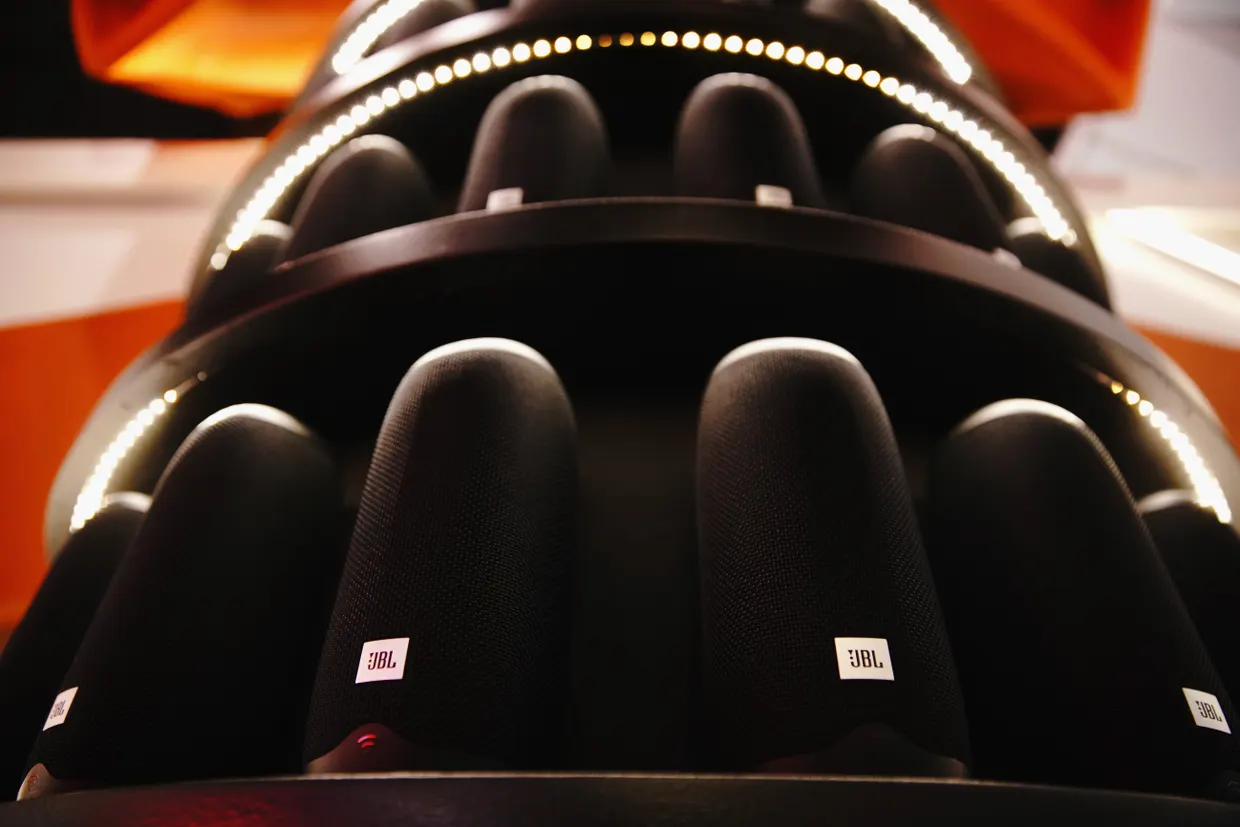
JBL's complete Summit loudspeaker series, five models named after Himalayan peaks, will be shown at the 34th Osaka Hi-End Audio Show, techtimes.com reports techtimes.com
techtimes.comtechtimes.comOpen source ↗. The show opens on Friday, November 13, at Hearton Hotel Shinsaibashi Annex in Osaka's Chuo ward and runs through Sunday, November 15. Admission is free.
Harman International, JBL's parent company, is among the 21 exhibitors, and Japanese audio critics will give lectures during the show. For visitors it is the first chance to hear all five Summit models together in the Kansai region. The Summit is the fifth "Project" loudspeaker family in JBL's 80-year history, after the Hartsfield (1954), Paragon (1957), Project Everest DD55000 (1985) and Project K2 S9500 (1989).
Compression driver and horn
The publication notes that flagship speakers from Wilson Audio, Bowers & Wilkins, Magico and Focal use dome tweeters, while the Summit uses a compression driver and horn from professional audio. The flagship Summit Everest has three 2-inch (50 mm) D2820 compression drivers, which JBL describes as a patented dual-diaphragm, dual-motor design. They feed a single Sonoglass High-Definition Imaging (HDI) horn through a proprietary 3-into-1 expansion manifold.
The D2820 has two concentric annular diaphragms made of Teonex (polyethylene naphthalate). Each diaphragm has its own voice coil, magnetic motor and phasing plug, and all outputs sum into one acoustic load techtimes.com
techtimes.comtechtimes.comOpen source ↗. In a 2015 AES Convention paper, JBL engineer Alexander Voishvillo showed lower total harmonic distortion than single-diaphragm designs at equivalent output levels.
The horn is made of Sonoglass, a fiberglass-based thermoset composite chosen for its internal damping. The HDI horn follows the constant-directivity approach published by JBL's Don Keele in 1975, which keeps the coverage angle stable across frequency.
Low-frequency section and crossover
The Summit Everest is a 3.5-way design with two 10-inch (254 mm) mid-bass drivers and two 15-inch (380 mm) woofers. All four use JBL's Differential Drive motor, with two voice coils wound in opposite directions on one former and working in two magnetic gaps. According to the material, this doubles the heat-dissipation surface and reduces thermal compression.
The crossover sits on four large circuit boards inside the enclosure, with crossover points at 270 Hz, 550 Hz and 850 Hz and 3rd and 4th order filter slopes techtimes.com
techtimes.comtechtimes.comOpen source ↗. Full specifications are listed at JBL.com.