Ce-doped gadolinium fluoro-oxide glass scintillator detects X-rays, gamma rays, neutrons and particles
Researchers in China made a laboratory Ce-doped gadolinium glass scintillator: 29.8 lp/mm in X-ray imaging, plus response to gamma rays, neutrons and particle beams.
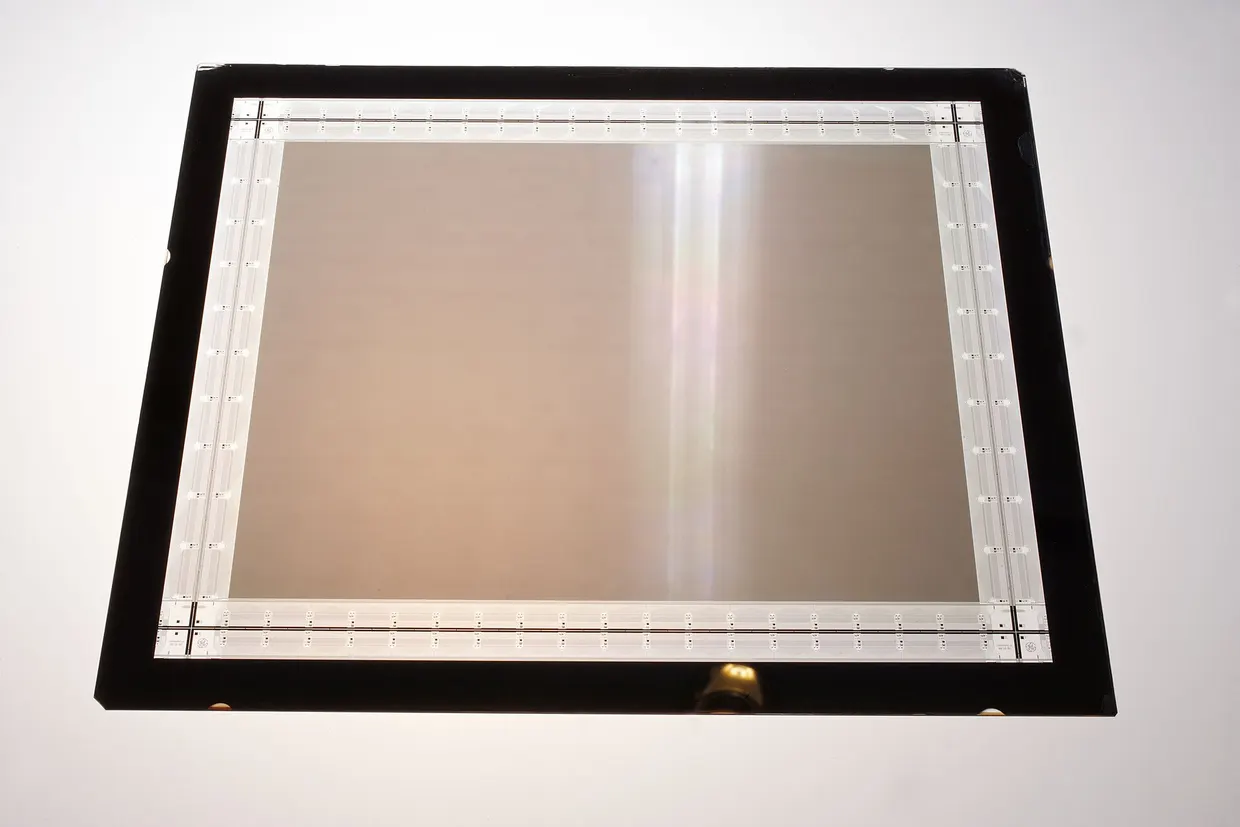
A team led by Zhehao Hua, Sen Qian and Haizheng Tao from Wuhan University of Technology and the Institute of High Energy Physics, Chinese Academy of Sciences, reported a cerium-doped, gadolinium-rich fluoro-oxide glass (GFO:Ce) that works as a scintillator for several kinds of radiation. The paper appeared on 2 November 2026 in The Innovation (7(11), 101426). The samples are laboratory specimens, not a finished detector sciencedirect.com
The Innovationsciencedirect.comOpen source ↗.
Glass for X-ray imaging and gamma spectroscopy
The glass has a density of about 6.0 g/cm3. It is melted under a reducing atmosphere and cast into plates, blocks or thin screens. The authors made 5-mm-thick imaging screens, 5-mm cubes for gamma spectroscopy and 4 × 4 × 1 cm blocks for beam tests.
In X-ray imaging the glass resolves 29.8 line pairs per millimeter. Under a caesium-137 source its light yield is 2,076 ± 51 photons per MeV, with an energy resolution of 22.4 ± 0.5% at 662 keV and an average decay time of 447.2 ns. The response is linear with dose down to a detection limit of 16.58 microgray per second, and the emission survived 20 on-off irradiation cycles. At 493 K the photoluminescence is 52.2% of its room-temperature value.
Neutrons, particle beams and structure
The glass also detects neutrons, with response peaks near 80 and 180 keV and a resolution of 42.6 ± 1.7% at the upper peak. In high-energy beams, a detector cell registered minimum-ionizing particles at 99.2 ± 0.6 photoelectrons for muons and 112.8 ± 2.2 for pions. Both values exceed the 50-photoelectron benchmark set for hadron calorimeters sciencedirect.com
The Innovationsciencedirect.comOpen source ↗.
The authors link this performance to local structure. Gadolinium-oxygen-fluorine polyhedra tend to cluster in the disordered network and pass energy to cerium centres with 85.5% efficiency. The photoluminescence quantum yield is 80.40%.
The limits are stated as well. Energy migration efficiency is only 11–15%, and Auger-type quenching still reduces the light yield. X-ray excited luminescence reaches 62.1% of that of BGO crystal. The authors propose the glass as a platform for industrial and medical radiography and for calorimetry at future colliders, and note that optimization is still to come.
Sources · 2
Found a mistake?Read also