MeerKLASS maps neutral hydrogen with MeerKAT: 21 cm signal over 236 square degrees
The MeerKLASS collaboration measured the large-scale distribution of neutral hydrogen from MeerKAT radio data alone, with a signal-to-noise ratio of 6.2.
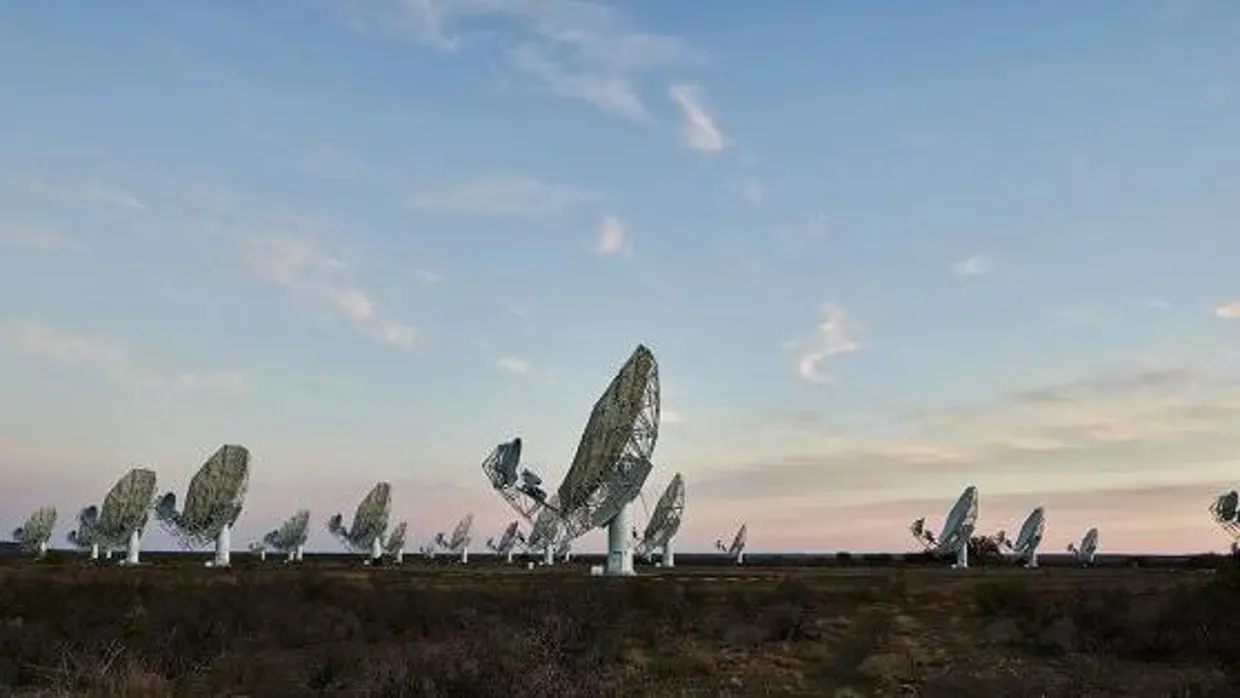
The international MeerKLASS collaboration has measured how neutral hydrogen is distributed on large scales, using the MeerKAT radio telescope in South Africa. The study was published in Monthly Notices of the Royal Astronomical Society and reported by Le Scienze. lescienze.it
Le Scienzelescienze.itOpen source ↗ The signal was emitted about 4.5 billion years ago, when the Universe was just over 9 billion years old. Among the authors are Matilde Barberi-Squarotti (Università Statale di Milano), Stefano Camera (Università di Torino) and Isabella Paola Carucci (INAF, Osservatorio Astronomico di Trieste).
Intensity mapping of the 21 cm line
Hydrogen emits a characteristic radio signal at a wavelength of 21 centimetres. Cosmic expansion changes this wavelength during the signal's journey, so measuring it gives information on the distance and the epoch of origin, Camera explained. The technique, called intensity mapping, collects the combined hydrogen emission of many galaxies, even when individual objects cannot be told apart.
The study analysed observations collected in 2021 over about 236 square degrees of sky. The group's stated aim is to build three-dimensional maps of very large volumes of the cosmos. According to the researchers, such maps could provide new tools to test models of gravity and dark energy.
Separating the signal from contamination
The telescope records all incoming radio radiation, including spurious sources such as the radio background of the Milky Way. Carucci said that this contamination can far exceed the sought cosmic signal, and compared the task to trying to hear a whispered conversation during a concert. lescienze.it
Le Scienzelescienze.itOpen source ↗
The researchers used the 64 MeerKAT antennas as independent telescopes, a mode suited to observing wide areas of sky quickly. They compared maps built from different groups of antennas and from observations made at different times. The cosmic signal is common to the maps, while noise and instrumental effects that are not shared are reduced, Barberi-Squarotti said.
The analysis reached a signal-to-noise ratio of 6.2 and passed a series of robustness checks. The measurement was obtained from the hydrogen radio maps alone, without comparison with external galaxy catalogues. Mário Santos (University of the Western Cape), scientific lead of MeerKLASS, said the work took ten years and involved researchers in seven countries on three continents.
The programme continues with data collection for even more distant epochs, aiming at a volume of the Universe more than a thousand times larger than the one used here. The work also prepares the ground for future cosmological surveys of the SKA Observatory, of which MeerKAT is a precursor. lescienze.it
Le Scienzelescienze.itOpen source ↗