UC Davis team describes Gerrothorax maritimus, a fully marine amphibian from 237 million years ago
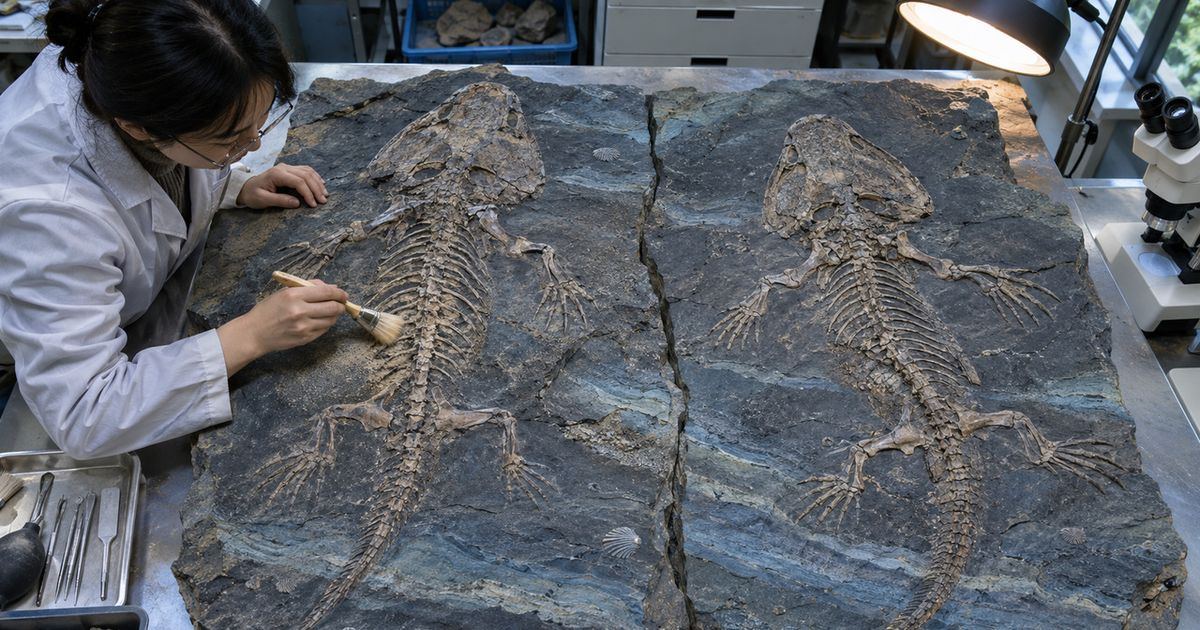
Two nearly complete skeletons from China's Guizhou Province show an armored amphibian that lived in the sea in the Late Triassic, the authors report in Nature Ecology & Evolution.
Researchers from the University of California, Davis, Peking University and the Geological Museum of Guizhou reported fossil evidence of the first fully marine amphibian, according to ucdavis.edu ucdavis.edu
ucdavis.eduucdavis.eduOpen source ↗. The study, published in Nature Ecology & Evolution, describes two nearly complete skeletons dated to the Late Triassic, nearly 237 million years ago
ucdavis.edu
ucdavis.eduucdavis.eduOpen source ↗. The animal was named Gerrothorax maritimus
ucdavis.edu
ucdavis.eduucdavis.eduOpen source ↗.
The fossils were found in an area of China's Guizhou Province that was once covered by ocean and lay hundreds of miles from large land masses ucdavis.edu
ucdavis.eduucdavis.eduOpen source ↗. Corresponding author Ryosuke Motani, a professor in the Department of Earth and Planetary Sciences at UC Davis, said the team had mostly studied marine reptiles and fish from this ecosystem, and the amphibian is an unusual member of its lineage.
Why a marine amphibian is unusual
Of the more than 8,000 species of modern amphibians, none are known to live in fully marine environments, and less than 2% show some degree of salt tolerance ucdavis.edu
ucdavis.eduucdavis.eduOpen source ↗. The fossil record had also contained no evidence of a fully marine amphibian
ucdavis.edu
ucdavis.eduucdavis.eduOpen source ↗. Motani explained that amphibian skin is permeable and is used for respiration and water intake, which ties modern species to freshwater or nearby habitats.
Anatomy and evidence for life in the sea
The well-preserved skeletons allowed the authors to reconstruct the animal: a disc-shaped, flattened body covered in bony armor, almost three feet long ucdavis.edu
ucdavis.eduucdavis.eduOpen source ↗. By body mass it is probably close to the giant salamander, Motani said, but it was much chunkier. The armor may have defended against predators such as ichthyosaurs. From the armor and skull shape, the researchers hypothesize a bottom-dwelling suction feeder, similar in style to the modern wobbegong carpet shark.
The authors propose that the armor limited water absorption through the skin, so the animal would have drunk seawater through the mouth and absorbed it in the digestive tract. Gills, present in the genus Gerrothorax, would have let it filter out the salt.
Several lines of evidence point to a marine habitat. The fossils lie in deep-sea sediments. The fingers are preserved, whereas carcasses at sea tend to dry out and lose limbs before sinking, so the animals probably died near where they lived, Motani said ucdavis.edu
ucdavis.eduucdavis.eduOpen source ↗. Geochemical analysis also showed that the proportion of strontium isotopes in the fossils closely resembles that of Late Triassic oceans
ucdavis.edu
ucdavis.eduucdavis.eduOpen source ↗.
Sources · 2
Found a mistake?Read also