ST-Comb optical carrier encodes 154 bits per wavepacket; 100% recovery in proof-of-concept tests
Teams from Shanghai and Westlake University encoded data in spatiotemporal topological states of ultrafast pulses, a proof-of-concept for turbulence-tolerant optical links.
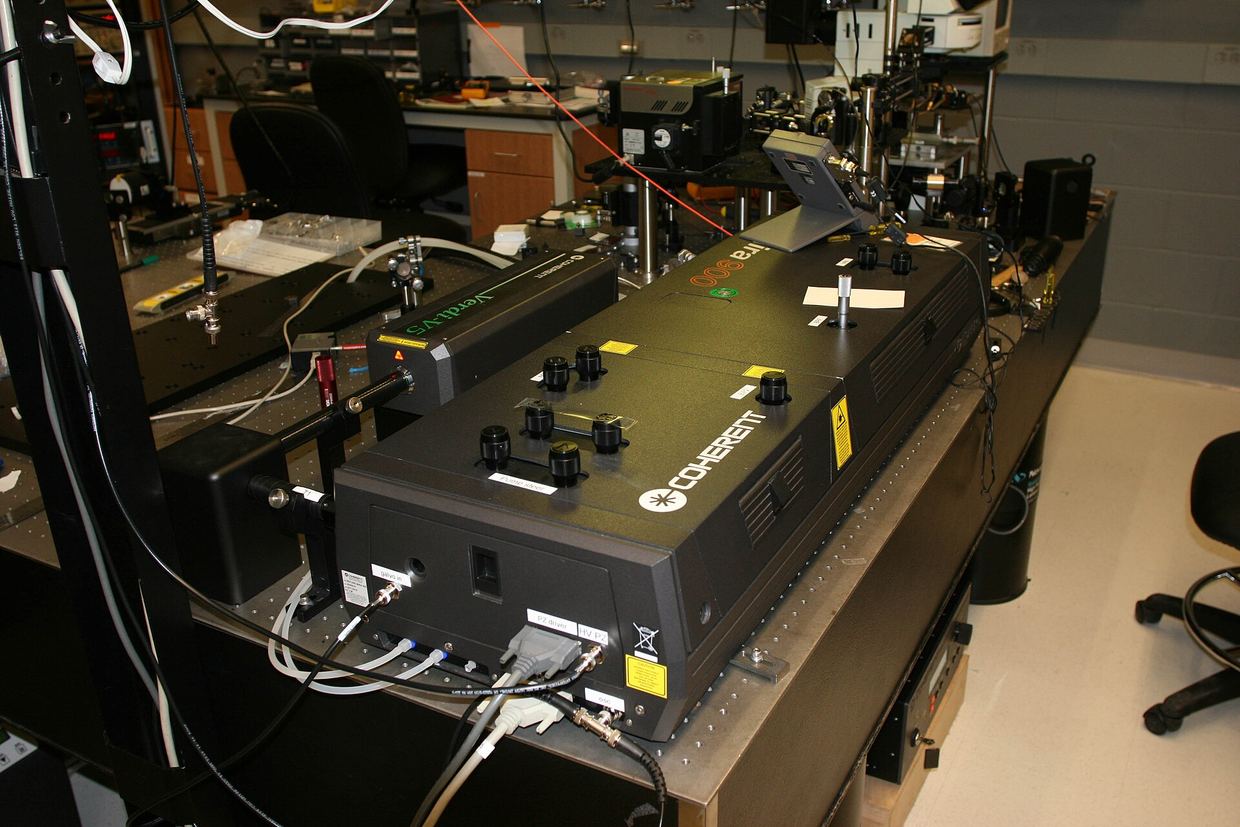
A team led by Guangyu Fan (University of Shanghai for Science and Technology) and Qiwen Zhan (Westlake University) described in eLight a spatiotemporal topological comb (ST-Comb), a way to encode digital data into ultrafast optical wavepackets. In the proof-of-concept, one wavepacket carried 154 mapped digital bits. According to the authors, they were recovered with 100% recognition accuracy in laboratory, phase-screen-equivalent turbulence and 100 m outdoor conditions. doi.org
eLightdoi.orgOpen source ↗
How the ST-Comb encodes data
The wavepacket is divided into several independently addressable temporal sub-pulses, and each is assigned a programmable spatiotemporal topological state. The modulator sets the amplitude, delay, spatiotemporal topological charge, radial mode and ST-CEP of every sub-pulse. doi.org
eLightdoi.orgOpen source ↗
Sub-pulse spacing ranges from about 100 femtoseconds to 10 picoseconds, which corresponds to a sub-terahertz to terahertz primary spectral spacing. The overall train lasts about 5 to 50 picoseconds and produces finer spectral features in the 20 to 200 gigahertz range. Tuning ST-CEP changes the spectral fingerprint while largely preserving the temporal-slot structure. doi.org
eLightdoi.orgOpen source ↗
Inspired by lock-in detection, the scheme shifts useful information into a terahertz-scale spatiotemporal-spectral region away from dominant low-frequency technical noise. doi.org
eLightdoi.orgOpen source ↗
The demonstration used 11 information-bearing temporal slots. Each slot selects from 14 predefined topological modes through a binary mask, giving 14 bits per slot and 154 bits per wavepacket. The first Gaussian sub-pulse serves as a co-propagating Guide-Star reference and is not counted as payload. doi.org
eLightdoi.orgOpen source ↗
At the receiver, coherent reconstruction relative to the Guide-Star is followed by temporal slicing. A recognition algorithm then identifies the topological superposition or spectral fingerprint in each slot and maps it back to bits. On a test set of 1000 randomly generated ST-Comb samples, classification accuracy was 100%. doi.org
eLightdoi.orgOpen source ↗
Turbulence and outdoor tests
The experiments showed that local field fidelity decreases as phase-screen-equivalent turbulence grows stronger. The metric describing the global spatiotemporal-spectral fingerprint stayed comparatively stable over the tested range. doi.org
eLightdoi.orgOpen source ↗
The team also ran a 100 m outdoor free-space transmission at the Sheshan Station of the Shanghai Astronomical Observatory. Controlled phase screens additionally emulated accumulated turbulence for 100 m, 1 km and 10 km of propagation. Across the evaluated outdoor and phase-screen-equivalent datasets, the encoded states were recovered with 100% recognition. The 1 km and 10 km cases are equivalent turbulence tests, not physical outdoor links. doi.org
eLightdoi.orgOpen source ↗