Proteomics identifies Denisovan skull fragments and a radius in Bianfu Cave, Southwest China
Of more than 60,000 bone fragments from Bianfu Cave, protein analysis identified Denisovan remains, including a radius, filling a gap in the record for Southwest China.
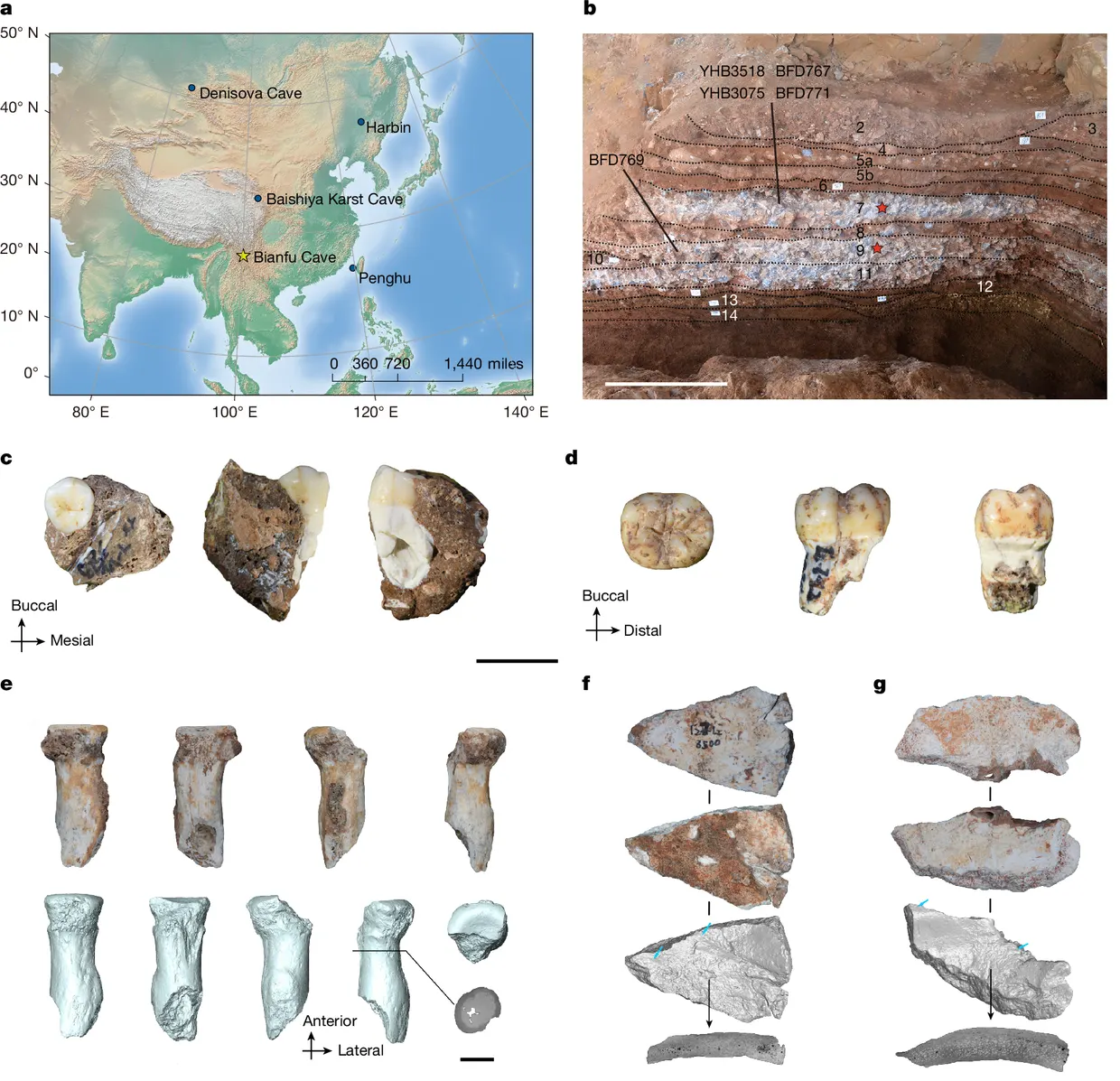
A team of researchers screened more than 60,000 bone fragments from Bianfu Cave in Southwest China and identified Denisovan remains among them, according to a study published on nature.com. nature.com
nature.comnature.comOpen source ↗ Three hominin bones were found: two parietal fragments and one proximal fragment of a radius. They come from layers dated to approximately 167–134 thousand years ago.
Screening and protein analysis
The authors first screened the fragments by morphology. Of these, 76 were selected for zooarchaeology by mass spectrometry (ZooMS) and 17 for proteomic sequencing. Proteomic analysis confirmed the three new bones as Denisovan, as well as two hominin teeth found during the excavation. The teeth, a lower fourth premolar and a lower second molar, come from layer 7, as does the radius and one of the parietals; the second parietal is from layer 9.
According to the authors, Bianfu Cave is now the Denisovan locality with the most abundant remains of this group outside Denisova Cave in Siberia.
Why the finds matter
Before this work, only a few finds outside Denisova Cave had been identified as Denisovan by molecular methods: a partial mandible and a rib from Baishiya Karst Cave (Xiahe) on the Tibetan Plateau, the Penghu mandible from the Taiwan Strait, and the nearly complete Harbin cranium from northeastern China. nature.com
nature.comnature.comOpen source ↗ Most putative Denisovan fossils were confined to northern and southeastern China, leaving a gap in the southwest. The authors note that genomic data show substantial Denisovan ancestry in present-day populations of Southeast Asia and Oceania, so the southwestern region is of interest for studying their dispersal.
Postcranial remains were also scarce. Known Denisovan elements of this kind were limited to the Denisova 3 phalanx and the Xiahe 2 rib, and long bones with diagnostic features were absent. The Bianfu Cave radius provides direct information on the radial morphology of Denisovans and some insight into their postcranial phenotype. The authors describe the results as refining the understanding of the evolutionary history of this hominin group.