DNA Typewriter traces lineage of 1.28 million cells in one mouse embryo over nearly two weeks
Researchers recorded cell divisions in a mouse embryo with a CRISPR-inspired molecular recorder and built a time-calibrated lineage tree covering about 10% of the embryo's cells.
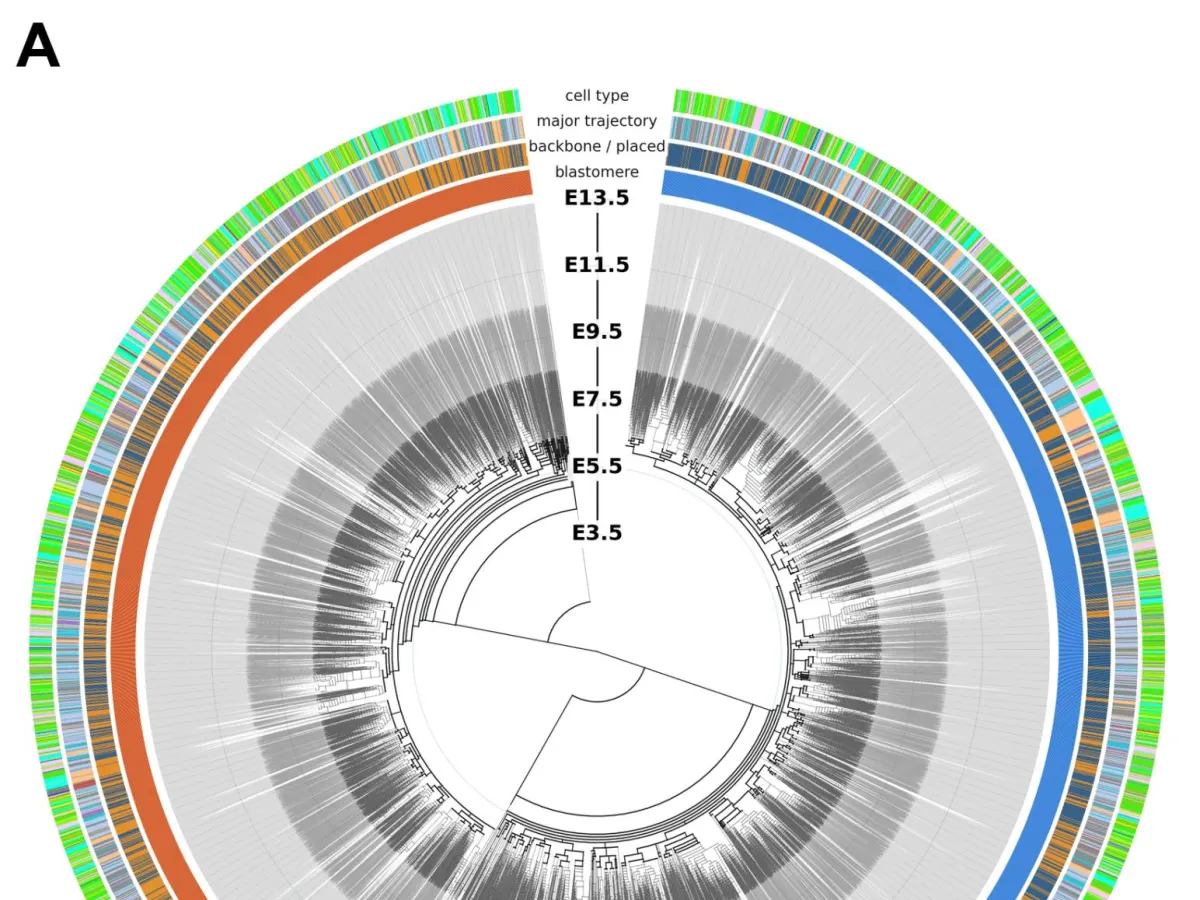
Researchers have used DNA Typewriter, a sequential molecular recorder, to follow the cell lineage of a mouse over nearly two weeks of development, according to a study in Science. From a single embryo they reconstructed a time-calibrated, parsimony-supported phylogeny rooted in the zygote. The tree includes 1.28 million cells, each with a transcriptional profile science.org
Sciencescience.orgOpen source ↗. The work was carried out on a mouse embryo.
Recording divisions in DNA
DNA Typewriter was created in 2022 and, as Sciences et Avenir describes it, draws on the CRISPR approach to modifying DNA. At each cell division the tool writes new marks into the DNA. Daughter cells inherit them in the order in which they were added, so the marks form a genetic log that shows kinship between cells.
The system was introduced into a fertilized mouse egg, and the embryo developed for nearly two weeks. More than 1.5 million cell nuclei were then analyzed to reconstruct the tree, according to the publication. The tree covers about 10% of the embryo's cells.
What the lineage shows
A burst of editing marks the daughters of the first cleavage, and these cells serve as inline replicates science.org
Sciencescience.orgOpen source ↗. The authors quantified clonal dominance arising during gastrulation. Sibling cells on the tree share cell type far more often than by chance, while siblings of different types mark terminal differentiations.
Temporal sweeps of clade co-occurrence recovered a dated hierarchy of couplings between cell types. Imputed labels for internal nodes recapitulated known state paths. The authors write that a lineage-anchored ontogeny of mammalian development, long out of reach, is coming into view.
The researchers also created NextCell, an interactive browser for exploring the tree online.