Room-temperature supersolid of light observed in a liquid-crystal polymer microcavity
An international team created a supersolid state of a quantum fluid of light at room temperature in a microcavity with liquid crystal, with no cryogenic cooling needed.
An international team of physicists has reported room-temperature supersolidity for a quantum fluid of light, according to a paper in Science Advances science.org
Science Advancesscience.orgOpen source ↗. A supersolid combines superfluid behavior with the periodic density modulation typical of crystals. In Bose-Einstein condensates, this state is produced by spin-orbit coupling (SOC).
Microcavity with liquid crystal and polymer
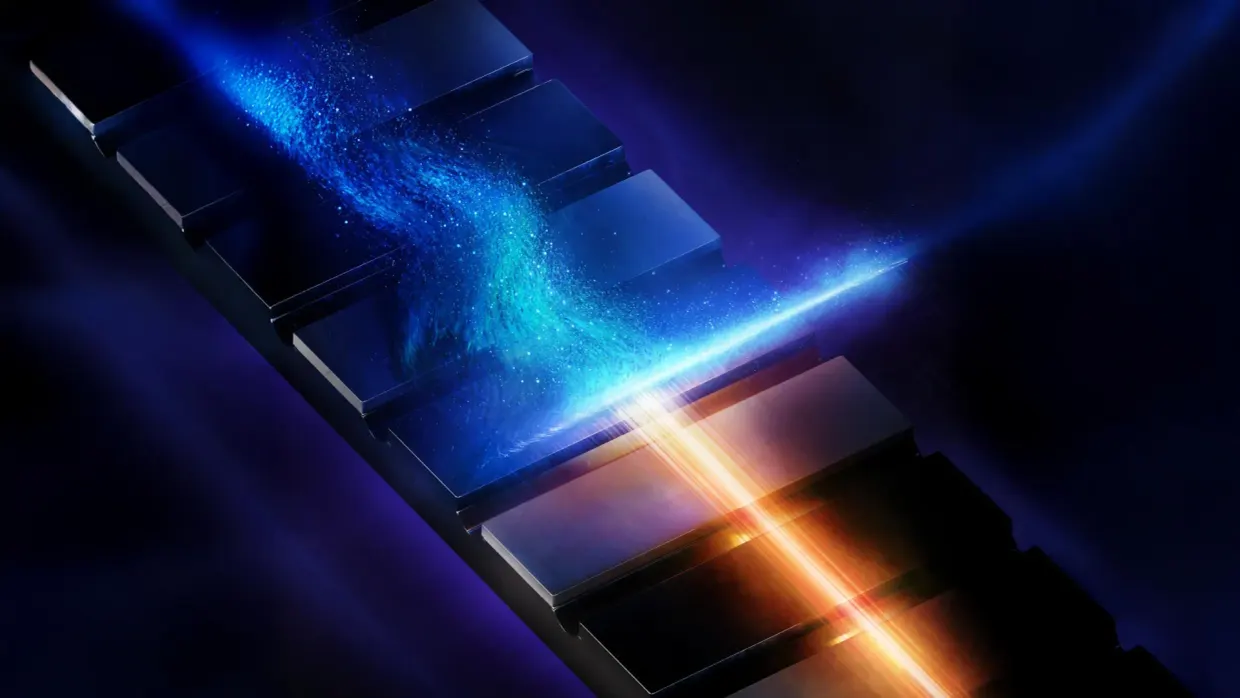
The authors built an original optical microcavity filled with a nematic liquid crystal and two layers of the organic polymer MeLPPP, which hosts exciton resonances. The liquid crystal induces Rashba-Dresselhaus SOC, which creates two distinct degenerate minima in the dispersion. The researchers demonstrated exciton-polariton condensation in both minima. Laser pulses supplied the energy for the process.
The liquid crystal can be controlled by voltage, and the setup does not need a cryogenic fridge. According to physicist Wiktor Piecek, the microcavities can operate at temperatures approaching 60 °C (140 °F).
Stripes, vortices and limits
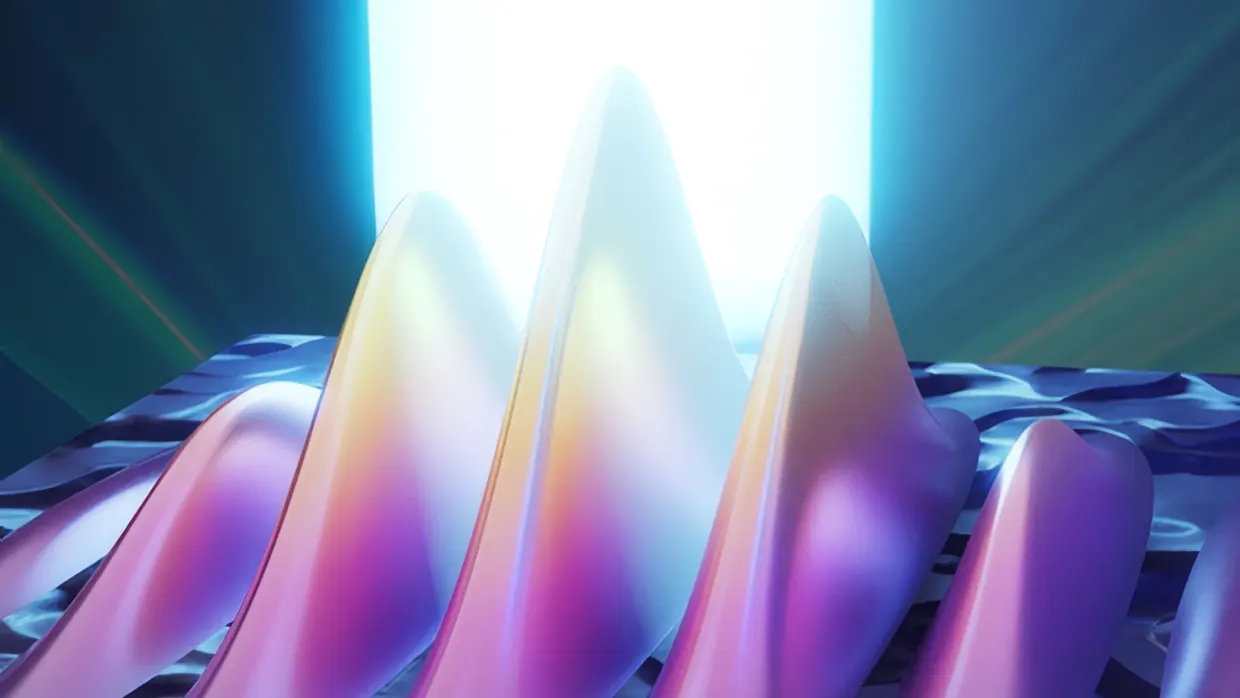
In real space, the condensate shows density stripes. Their position is random from one condensate realization to another, despite a random disorder potential in the sample science.org
Science Advancesscience.orgOpen source ↗. The authors interpret this as immunity of the stripes to disorder and as spontaneous breaking of translational invariance. Physicist Guillaume Malpuech of CNRS called it a textbook example of spontaneous symmetry breaking: theory predicted that the supersolid could choose among several equivalent states, and this is what was observed.
The team also recorded the random appearance of vortices, another feature of superfluids. The vortices appeared as defects in the stripe pattern.
The experiment has constraints. The materials degraded over time because the semiconductor reacted with the liquid crystal. According to physicist Marcin Muszyński, the whole sequence of measurements had to be planned in advance, since repeating one meant fabricating a new sample. The condensate lived only fractions of a second, which was enough for observation. Multiple samples gave the same results, and computer simulations supported them.
As next steps, the researchers name extending the lifetime of the core reactions and a more detailed study of the quantum vortices. In the paper, they write that the work opens new perspectives for quantum fluids of light in the presence of spin-orbit coupling and beyond science.org
Science Advancesscience.orgOpen source ↗.