Khufu's Great Pyramid surveyed at 37 points: its 2.3 Hz frequency differs from the 0.6 Hz of the surrounding soil
Ambient-noise measurements at 37 points of the Great Pyramid of Khufu show a fundamental frequency of about 2.3 Hz, far from that of the soil, which limits resonance during earthquakes.
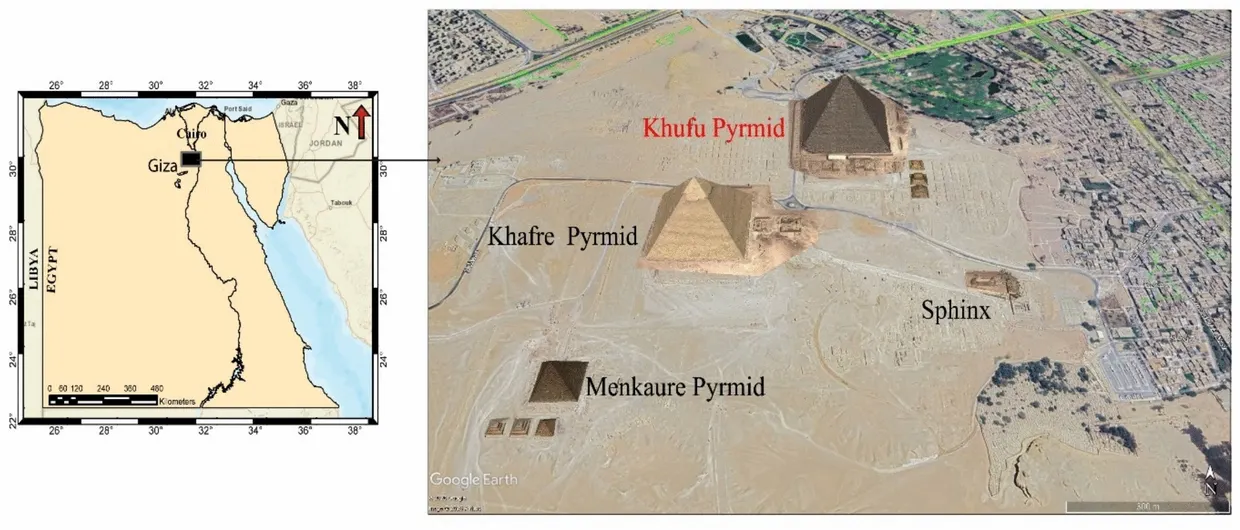
Researchers carried out an ambient noise survey of the Great Pyramid of Khufu using horizontal-to-vertical spectral ratio (HVSR) analysis at 37 measurement points, according to a paper published on nature.com nature.com
nature.comnature.comOpen source ↗. The points were distributed across the internal chambers, the construction blocks and the adjacent soil. The pyramid was completed in Egypt's Old Kingdom (2600–2450 BCE), and the study aims to explain its structural longevity and earthquake resilience.
Frequencies of the structure and the soil
The pyramid showed uniform fundamental frequencies of 2.0–2.6 Hz, with an average of about 2.3 Hz across all structural elements. The surrounding soil has a fundamental frequency of about 0.6 Hz. According to the authors, this difference prevents resonance amplification through soil-structure interaction, a key mechanism protecting the monument during seismic activity.
The pyramid was originally built to a height of 146.59 m, with a base of about 230.33 m per side. Its present height is about 137 m because the casing stones and apex have been lost. It contains an estimated 2,300,000 stone blocks.
Amplification and relieving chambers
Seismic relative amplification increases systematically with elevation up to 48.68 m nature.com
nature.comnature.comOpen source ↗. It diminishes substantially within the pressure-relieving chambers, at 48.86–61.07 m. The authors conclude that the geometry of these chambers actively reduces the seismic response.
The seismic vulnerability assessment of the subsurface foundation gave a low value, kg = 8.2, which the authors read as excellent bearing capacity and minimal earthquake-induced risk. They state that future earthquakes are likely to cause only limited damage to the main pyramid body.
The paper notes that the area has been affected by numerous earthquakes within an epicentral radius of 80 km over 4600 years without serious damage to the main body of the pyramid. On 12 October 1992, an earthquake of magnitude 5.8 struck Giza, and several casing stones fell from the upper parts of the pyramids. The authors regard their measurements as quantitative evidence that the ancient builders understood geotechnical conditions and took the site into account when designing the structure.