Arase satellite detects multi-MeV electrons breaching Earth's inner radiation belt barrier
Data collected during the May 2024 superstorm reveals in situ acceleration of ultra-relativistic electrons deep within L* < 3.
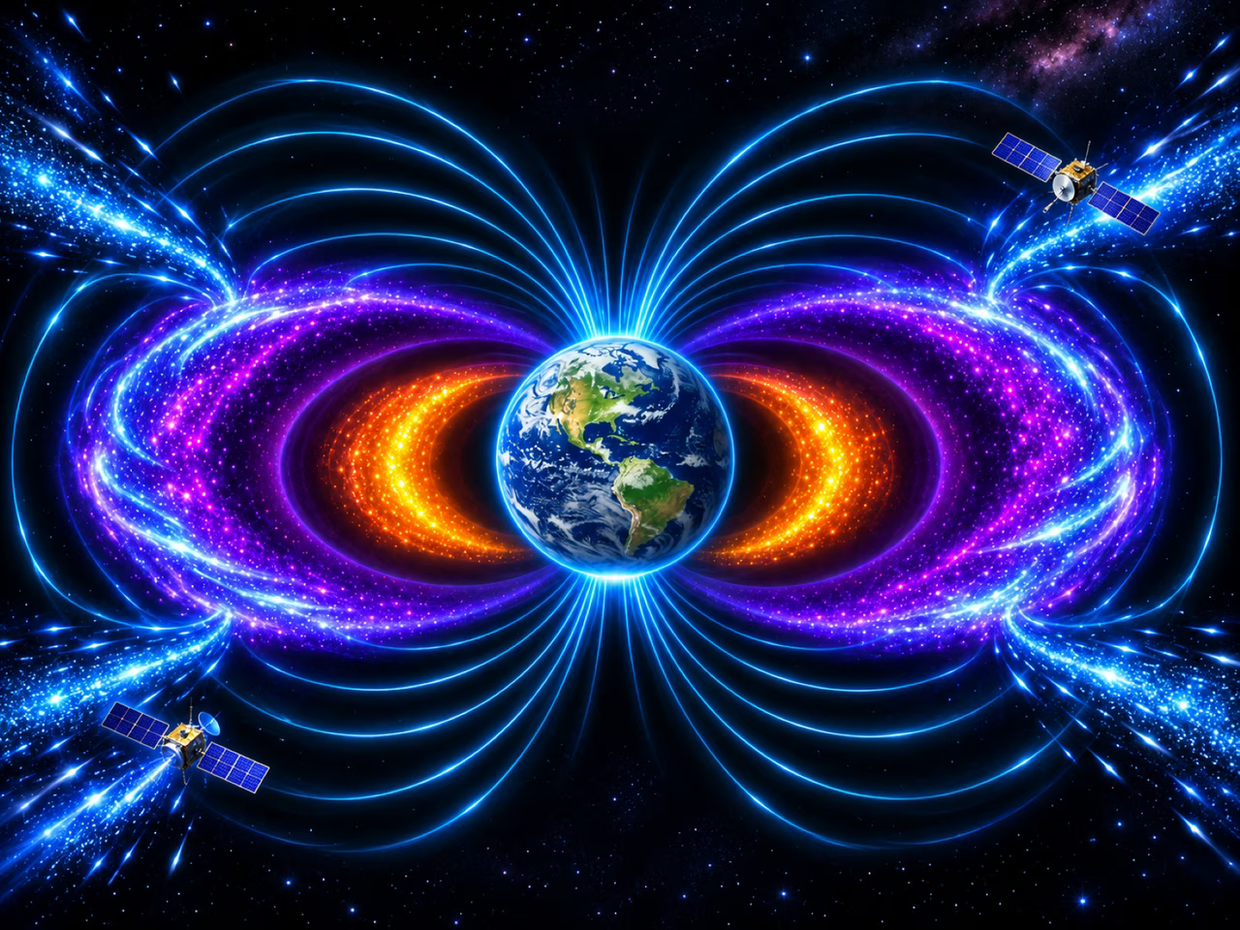
Observations from the Japanese Arase satellite during the extreme geomagnetic superstorm of May 2024 have shown that ultra-relativistic electrons can breach the inner boundary of Earth's radiation belts, according to a study published in Geophysical Research Letters doi.org
Geophysical Research Lettersdoi.orgOpen source ↗. The region defined by L* < 3, historically regarded as an impenetrable barrier shielding satellites from damaging high-energy particles, experienced rapid in situ generation of multi-MeV electrons. Phase space density profiles revealed the development of a localized maximum at L* ∼ 3, demonstrating that direct acceleration established an active source within the normally quiet inner magnetosphere
doi.org
Geophysical Research Lettersdoi.orgOpen source ↗.
Measurements from the satellite instruments showed that relativistic electron fluxes at energies around 3 MeV increased by more than 5,000 times compared to baseline conditions prior to the storm doi.org
Geophysical Research Lettersdoi.orgOpen source ↗. This local peak acted as a primary source feeding both inward and outward radial diffusion deep inside the magnetosphere. The May 2024 storm reached category G5, representing the strongest space weather event recorded in more than two decades, providing a rare opportunity to study how the inner belt behaves under severe driving conditions.
Chorus wave interactions
The spacecraft simultaneously detected intense electromagnetic chorus waves operating inside a strongly depleted plasma region doi.org
Geophysical Research Lettersdoi.orgOpen source ↗. Researchers linked the persistence of this low-density cavity to enhanced magnetospheric convection coupled with a negative ionospheric storm. Under these specific plasma parameters, wave-particle interactions between background chorus emissions and lower-energy electrons triggered efficient local acceleration up to relativistic energies
doi.org
Geophysical Research Lettersdoi.orgOpen source ↗.
Implications for satellite safety
Ultra-relativistic electrons, capable of penetrating structural shielding and damaging sensitive spacecraft avionics, were previously assumed to be blocked naturally beyond three Earth radii doi.org
Geophysical Research Lettersdoi.orgOpen source ↗. The findings confirm that the protective barrier of the inner belt can break down during extreme space weather disturbances. The documented event provides direct observational parameters required to update radiation belt dynamic models and refine radiation hardening margins for low-to-medium Earth orbit missions.