Polish researchers discover new oxide mineral copernikite in Morasko meteorite
Scientists have identified copernikite, an oxide mineral with a tunnelled hollandite structure, inside an iron meteorite that fell 5,000 years ago.
Polish researchers have identified a previously unrecognized mineral inside the iron-rich Morasko meteorite, which fell near Poznań between 5,000 and 6,000 years ago, as reported by The Times of India timesofindia.indiatimes.com
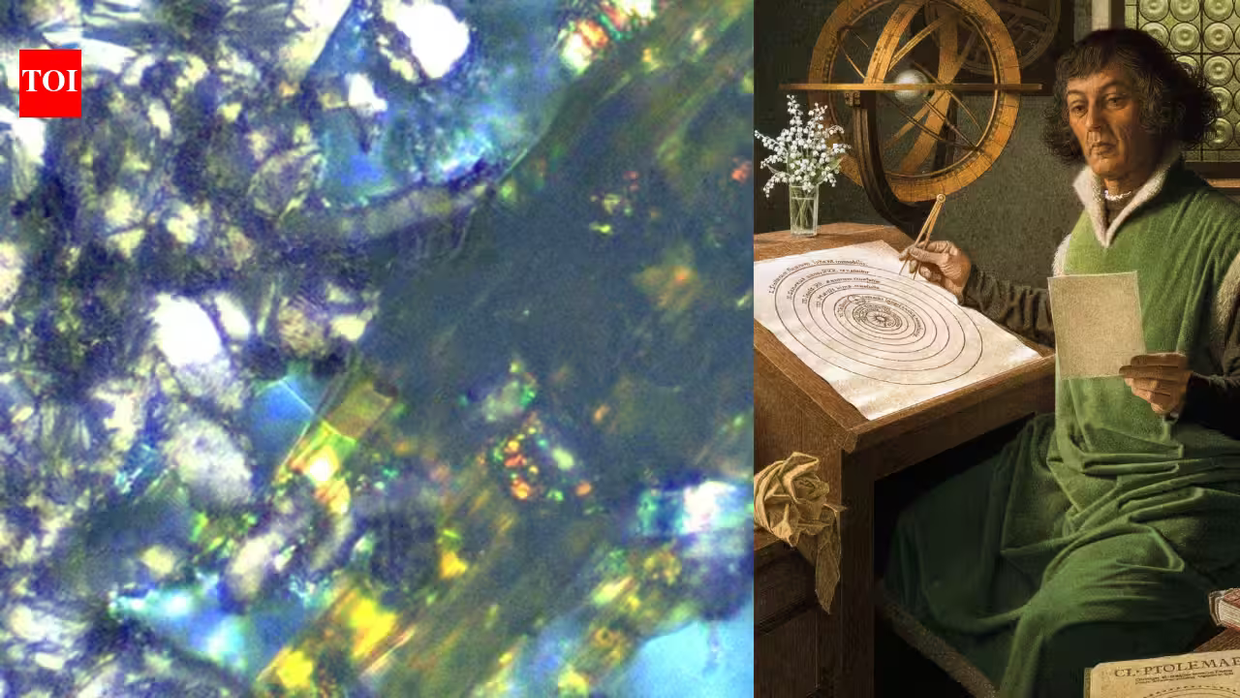
The Times of Indiatimesofindia.indiatimes.comOpen source ↗. The Commission on New Minerals, Nomenclature and Classification of the International Mineralogical Association (CNMNC-IMA) formally accepted the mineral under the name copernikite in early 2026. Copernikite has the chemical formula K(Ti₇Cr)O₁₆ and is named in honor of astronomer Nicolaus Copernicus. Its identification brings the count of new minerals discovered by University of Silesia researchers to 80.
Hollandite structure and microscale inclusions
Copernikite was identified in only one examined specimen, where it occurs within fluorapatite inside a graphite-rich region bearing troilite inclusions timesofindia.indiatimes.com
The Times of Indiatimesofindia.indiatimes.comOpen source ↗. Individual mineral grains are extremely small, measuring no more than 0.3 millimeters across. The substance exhibits a green color derived from chromium, appearing light gray under reflected light during microscopic observation. The research team determined that copernikite belongs to the priderite group within minerals possessing a hollandite-type tunnel structure. According to the University of Silesia, this is the first oxide mineral featuring a tunnelled hollandite structure ever confirmed in a meteorite
timesofindia.indiatimes.com
The Times of Indiatimesofindia.indiatimes.comOpen source ↗.
Structure composition and previous Morasko findings
The internal lattice of copernikite consists of octahedra containing titanium and chromium, which link to form internal channel walls timesofindia.indiatimes.com
The Times of Indiatimesofindia.indiatimes.comOpen source ↗. The spaces inside these tunnel-like arrangements host potassium, barium, and calcium atoms. While comparable chemical phases were documented in 1982 within Australian lamproites, they lacked the detailed analyses required to confirm a distinct mineral species. Copernikite marks the fourth new mineral species recovered from the Morasko meteorite's troilite-graphite nodules, following the descriptions of moraskoite in 2015, czochralskiite in 2016, and crisaite in 2025.
The research was conducted by a multi-institutional team, including Professors Evgeny Galuskin, Irina Galuskina, Joachim Kusz, and Dr. Maria Książek from the University of Silesia, Professor Andrzej Muszyński from Adam Mickiewicz University, and Grzegorz Zieliński from the Polish Geological Institute – National Research Institute timesofindia.indiatimes.com
The Times of Indiatimesofindia.indiatimes.comOpen source ↗.