Georgia Tech Model Finds Asteroid 1998 KY26 Too Warm to Preserve Water Ice
Numerical simulations indicate subsurface temperatures on asteroid 1998 KY26 exceed 212 kelvins, challenging dark comet acceleration theories.
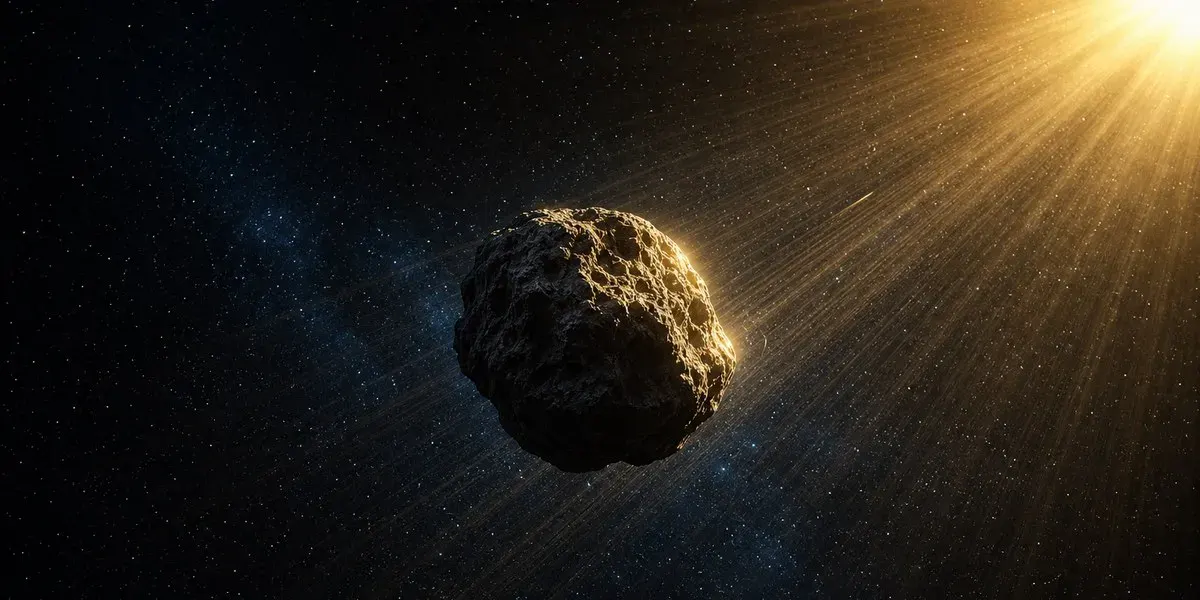
Aerospace engineers Corbin Hansen and Masatoshi Hirabayashi from the Georgia Institute of Technology modeled the surface and subsurface temperatures of asteroid 1998 KY26, reporting that the body is too warm to retain water ice, ua.news reports ua.news
ua.newsua.newsOpen source ↗. The object measures approximately 11 meters in diameter, rotates once every 5.35 minutes, and exhibits an unusual acceleration oriented perpendicular to its orbital plane. The findings were published in the journal Icarus.
Sublimation and Thermal Limits
One initial hypothesis proposed that 1998 KY26 functions as a dark comet, generating thrust via sublimating volatiles without forming an observable dust tail. For long-term preservation of subsurface water ice, temperatures must remain below approximately 145 kelvins, or minus 128 degrees Celsius. However, simulations incorporating the asteroid's orbit, size, reflectivity, and expected composition demonstrated that even in its coldest zones, the average temperature reaches at least 212 kelvins, or minus 61 degrees Celsius.
Calculations indicate that an initial water ice mass fraction of 1% would completely dissipate in a little more than 2,000 years. Furthermore, if outgassing ice generated the observed out-of-plane acceleration, the required mass loss would exhaust the entire volatile supply within 62 years. Because the duration of the object in its present orbit remains unidentified, volatile activity cannot be entirely excluded, though alternative mechanisms such as solar radiation pressure offer competing explanations.
Target of Hayabusa2 Mission
Clarification of the physical mechanisms governing 1998 KY26 will depend on direct in situ observation. The Japanese spacecraft Hayabusa2 is traveling toward the celestial body, with an operational rendezvous scheduled for July 2031 ua.news
ua.newsua.newsOpen source ↗. The upcoming measurements are expected to settle whether non-gravitational acceleration originates from remaining volatile reserves or radiation forces acting on its surface.