Cotswold Archaeology finds Anglo-Saxon hall and 7th-century settlement near Gloucester
Excavators on the edge of Gloucester found a post-built hall and a small settlement linked to the Hwicce kingdom. Timber buildings of this period rarely leave traces in western England.
Archaeologists from Cotswold Archaeology, excavating on the edge of Gloucester, have uncovered the remains of an Anglo-Saxon hall and a small early medieval settlement, according to Berliner Morgenpost, which cites the specialist portal The Past morgenpost.de
Berliner Morgenpostmorgenpost.deOpen source ↗. The settlement is dated to the early to middle 7th century AD. Researchers link the finds to a kingdom that covered parts of present-day Worcestershire and Gloucestershire.
Hall and settlement
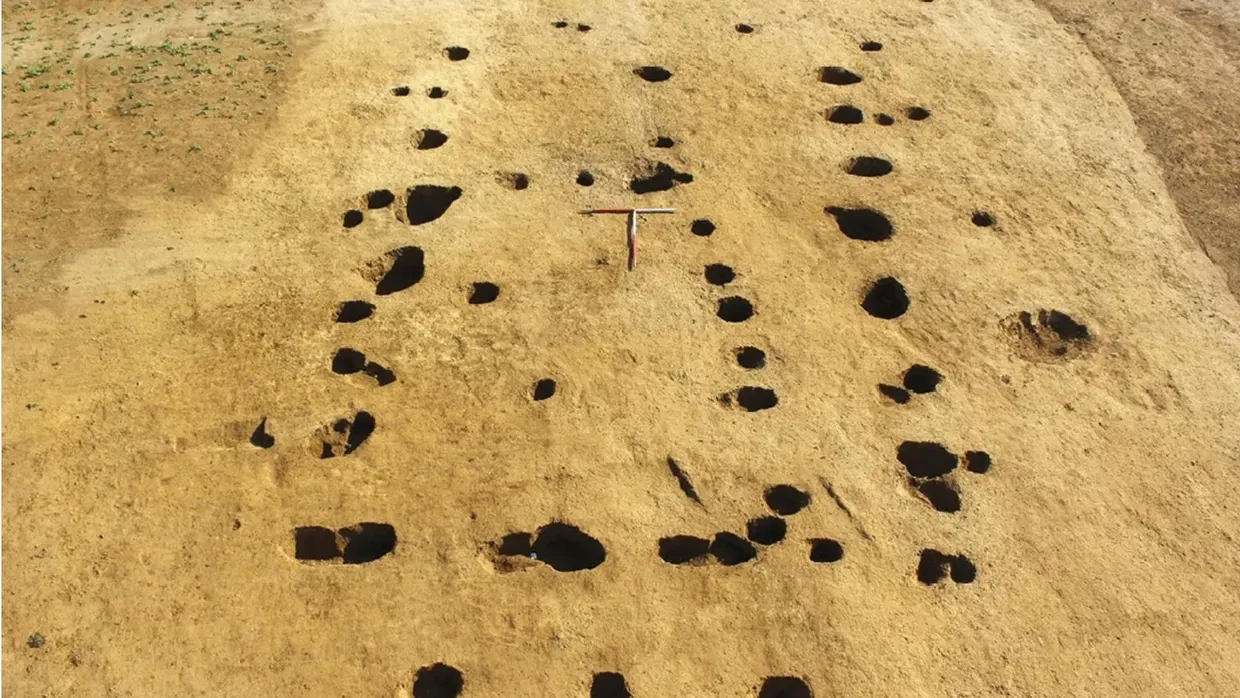
According to initial findings, the settlement consisted of six post-built structures and one building with a sunken floor. The team also found traces of a fence and evidence of a cattle yard or a funnel-shaped structure.
Alongside these, the archaeologists found the remains of a hall built on posts. The building was altered and extended in two main phases during its use. In the later rebuild a porch and an annex were added, which enlarged the original 4 x 5 metre building into a hall of 5.6 x 9 metres.
The finds are described as very rare. Houses of that period in western England were mostly simple timber constructions and have left few traces. Remains such as this hall with its rebuilding phases and the accompanying structure help in understanding settlement patterns and social organisation in the 7th century AD morgenpost.de
Berliner Morgenpostmorgenpost.deOpen source ↗.
The Hwicce kingdom and earlier layers
The hall is attributed to the kingdom of Hwicce, a small early medieval realm. According to the Anglo-Saxon Chronicle, Hwicce emerged after the Battle of Deorham in 577 and covered parts of Worcestershire and Gloucestershire as well as the southern half of Warwickshire. After the Battle of Cirencester in 628 it became a dependent sub-kingdom of Mercia, and during the 8th century it was fully absorbed into that kingdom. Among its best-known rulers was Osric, who promoted the founding of monasteries. His grave is in Gloucester Cathedral.
The site also holds evidence from earlier periods. These include a Bronze Age watering place, as well as pits and postholes dated between the 1st and 4th centuries AD. Together with fragments of Roman pottery, they point to earlier settlement in the area. The archaeologists assess that the later inhabitants may have reused Roman building materials, and that they may also have deliberately drawn on the traditions and history of earlier residents. Earlier work at the same site had already exposed significant prehistoric and Roman settlement structures.