RESCUE-TNK phase 2: intra-arterial tenecteplase raised reperfusion to 61.0% in medium vessel stroke
In a phase 2 randomised trial of 80 patients with acute ischemic stroke from medium vessel occlusion, intra-arterial tenecteplase achieved successful reperfusion more often than standard care.
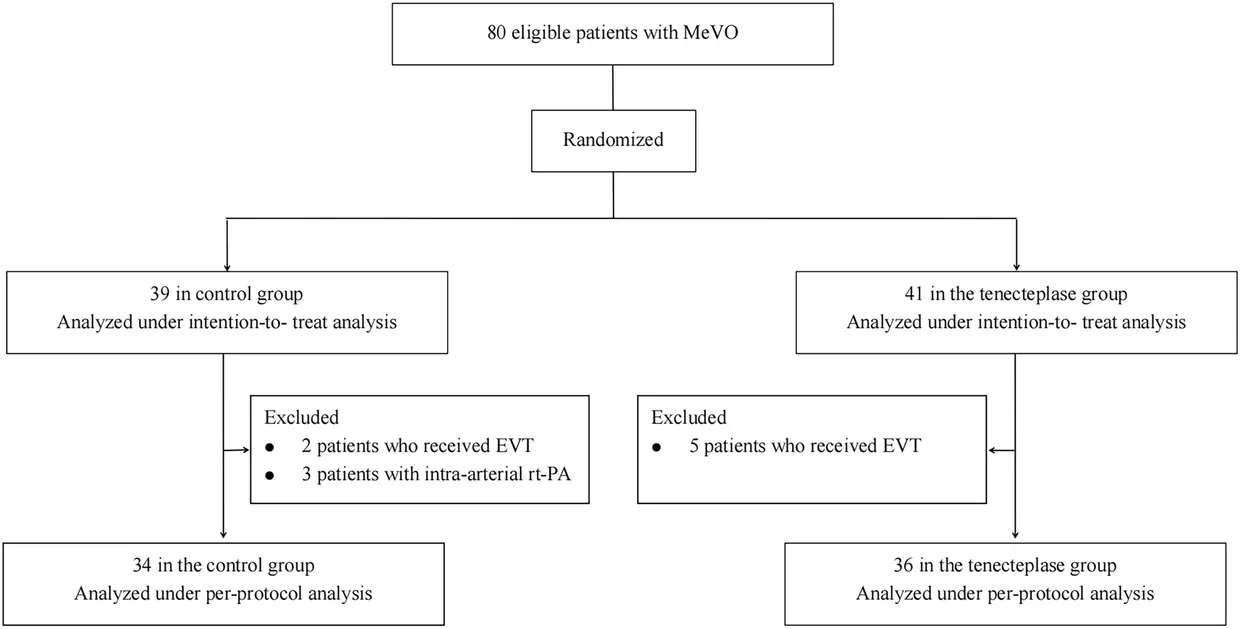
Results of RESCUE-TNK, a phase 2 prospective, randomised, open-label, blinded-endpoint, multicentre study, were published in Nature Communications. It tested intra-arterial tenecteplase in acute ischemic stroke caused by medium vessel occlusion (MeVO). From March 2023 through June 2025, 80 patients were enrolled and assigned in a 1:1 ratio to tenecteplase (41 patients) or standard care (39 patients). nature.com
Nature Communicationsnature.comOpen source ↗
Background and patients
Endovascular treatment is the standard therapy for large vessel occlusion, while the most effective approach for MeVO remains unclear. Three recent randomized trials failed to establish a clear advantage of endovascular treatment over standard medical care in this population. The authors hypothesized that intra-arterial tenecteplase would increase successful reperfusion with a comparable safety profile.
The median age was 67.0 years and 54 patients (67.5%) were male. The median NIHSS score was 13.5. The occlusion was primary in 47.5% of patients and secondary in 52.5%. The most common site was the M2 segment of the middle cerebral artery (50.0%), followed by the M3 segment (21.3%). The median tenecteplase dose was 6 mg.
Reperfusion and safety results
The primary outcome was successful reperfusion of the occluded medium vessel. It was reached in 61.0% (25/41) of the tenecteplase group and in 28.2% (11/39) of the control group. The unadjusted odds ratio was 3.98 (95% CI 1.56 to 10.16; P = 0.004), and the adjusted odds ratio was 3.81 (95% CI 1.29 to 11.20; P = 0.015). The per-protocol analysis of 70 patients gave a similar result, with an odds ratio of 3.36. nature.com
Nature Communicationsnature.comOpen source ↗
Symptomatic intracranial hemorrhage within 24 hours was similar in the two groups.
All secondary outcomes were prespecified as exploratory. At 90 days the median modified Rankin Scale score was 3 in both groups. An excellent functional outcome was seen in 34.1% of patients on tenecteplase and 20.5% of controls, a numerical difference that was not statistically significant (odds ratio 2.01, 95% CI 0.73 to 5.52). No differences between groups were found in secondary outcomes.
The study was funded by the Shenyang Science Tech Project and hospital-initiated grants, and is registered at ClinicalTrials.gov as NCT05657470. nature.com
Nature Communicationsnature.comOpen source ↗
Sources · 1
Found a mistake?Read also