Zhejiang University achieves 1350-hour T50 lifetime in green perovskite LEDs at 1000 nits
Researchers built green perovskite LED prototypes with sub-bandgap operation voltages, suppressing ion migration and extending actual T50 operational lifespan beyond 1000 hours.
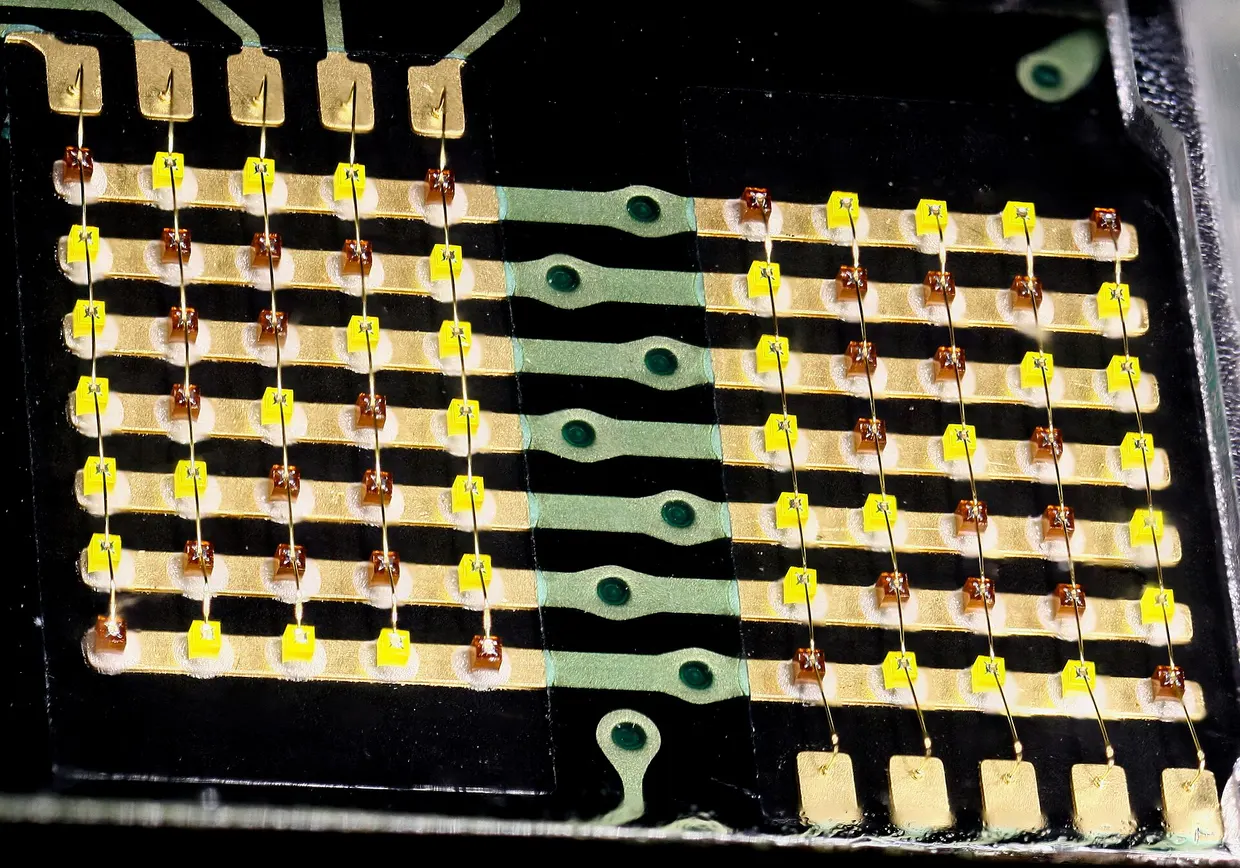
Engineers from Zhejiang University and collaborator institutions reported green perovskite light-emitting diodes (PeLEDs) that reach an experimentally measured T50 operational lifetime of 1350 hours at an initial luminance of 1000 cd m⁻² nature.com
Nature Communicationsnature.comOpen source ↗. According to findings published in Nature Communications, the fabricated devices demonstrated a peak external quantum efficiency of 24.5% and a maximum energy-conversion efficiency of 28.0%. The team also integrated the devices into a flexible active-matrix PeLED display prototype aimed at wearable optoelectronics.
Sub-bandgap injection mechanism
While previous visible PeLED stability values were typically derived from extrapolation models or limited to under 1000 hours during direct testing, the researchers addressed degradation via an interlayer engineering approach. A fluorinated self-assembled monolayer was introduced between the metal oxide layer and the polymeric hole-transport layer. This molecular configuration produces Ohmic-like charge injection properties across the interface.
Because of the modified junction, the required driving voltage at approximately 1000 nits drops to sub-bandgap levels of roughly 2.1 V. Operating below the nominal bandgap value suppresses electric-field-induced ion migration inside the perovskite emitter layer, which has served as a primary bottleneck for prolonged visible-light emission under display-relevant conditions.
Photon output dynamics
Measurements performed during the study revealed that accumulated photon emission over the T50 lifespan grew sharply when driving voltages were brought down into the sub-bandgap regime nature.com
Nature Communicationsnature.comOpen source ↗. The authors noted that minimizing voltage requirements across the multi-layer stack preserves material composition and prevents accelerated degradation under high sustained brightness. The architecture confirms the feasibility of achieving continuous operation above the 1000-nit threshold without resorting to theoretical extrapolation models.