GRB 260310A: weak gamma-ray flash, one of the brightest afterglows, jet likely viewed off-axis
A nearby burst at z ≈ 0.153 gave a modest gamma-ray flash but a very bright afterglow. The authors explain the mismatch by a jet viewed off-axis.
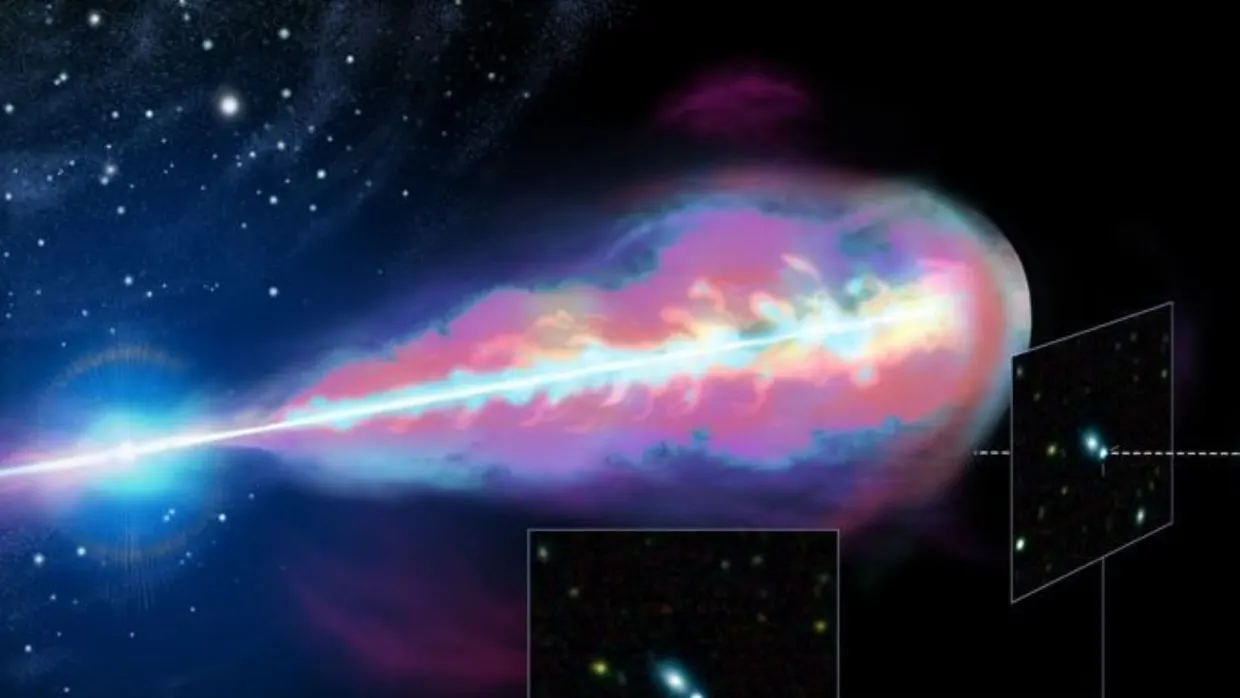
A team led by Yu-Han Yang of the University of Rome Tor Vergata has published a multiwavelength study of GRB 260310A in The Astrophysical Journal Letters. The long gamma-ray burst lies at z ≃ 0.153 and is associated with a broad-lined Type Ic supernova iop.org
The Astrophysical Journal Lettersiop.orgOpen source ↗. NASA's Fermi telescope detected its 53-second gamma-ray flash on 10 March 2026. The isotropic gamma-ray energy was only about 3.5 × 10^50 erg, yet the afterglow is among the brightest ever observed in X-ray, optical and radio bands.
A spectrum taken at Calar Alto Observatory on 13 March showed only the afterglow. By 4 April it carried the broad features of a supernova. Against earlier bursts, the afterglow ranks in the brightest 1% in X-rays and visible light and the brightest 5% in radio. The burst is closer than about 97% of bursts with known distances. After correction for distance, its intrinsic afterglow brightness is ordinary: the optical peak is fainter than about 80% of other bursts, and the X-ray output is in the bottom 15%.
Off-axis jet geometry
The authors argue that weak prompt emission, a hard peak energy and a late afterglow onset are naturally explained by a jet viewed off-axis. The optical afterglow rose slowly, with slope α ≈ −1, and peaked at about 0.1 day. According to the team, matching the usual relation between gamma rays and afterglow would require roughly 30 times more gamma-ray energy than was observed.
Radio spectra measured with the Karl G. Jansky Very Large Array are consistent with synchrotron radiation. They show both reverse-shock and forward-shock components, a first test of reverse-shock models in an off-axis geometry iop.org
The Astrophysical Journal Lettersiop.orgOpen source ↗.
X-ray rebrightening
The X-ray afterglow faded slowly for about nine days, then dropped quickly. Around day 18 it began to rise again and faded after about day 30. It was monitored for up to about 68 days with no evidence of spectral evolution. Chandra data showed two fainter sources nearby, but the brightening came from the afterglow itself. A linear polarization of about 1.7% at 15 GHz, 55 days after the burst, indicates that the forward shock dominates emission from radio to X-rays at late times.
One interpretation is a two-component jet. In the team's model the narrow core extends about 0.8 degrees from the axis, the broader outflow about 16 degrees, and Earth lies about 10 degrees off-axis. If the rebrightening is the emergence of the core viewed further off-axis, an on-axis observer would see extreme luminosities and energetics. The alternative is extra energy injected into the blast weeks after the burst, and the authors have not ruled it out. None of their standard models reproduced the light at all wavelengths over the full two months.
In the Swift archive, only 13 of more than 1,300 long bursts were tracked for more than 15 days.