Dianjunus fungus from Yunnan forms stromata up to 50 cm tall and 2.2 kg, a new family Dianjunaceae
Researchers in China described a new genus and family of fungi whose stromata are the largest documented in Ascomycota; molecular dating places the family's origin about 65 million years ago.
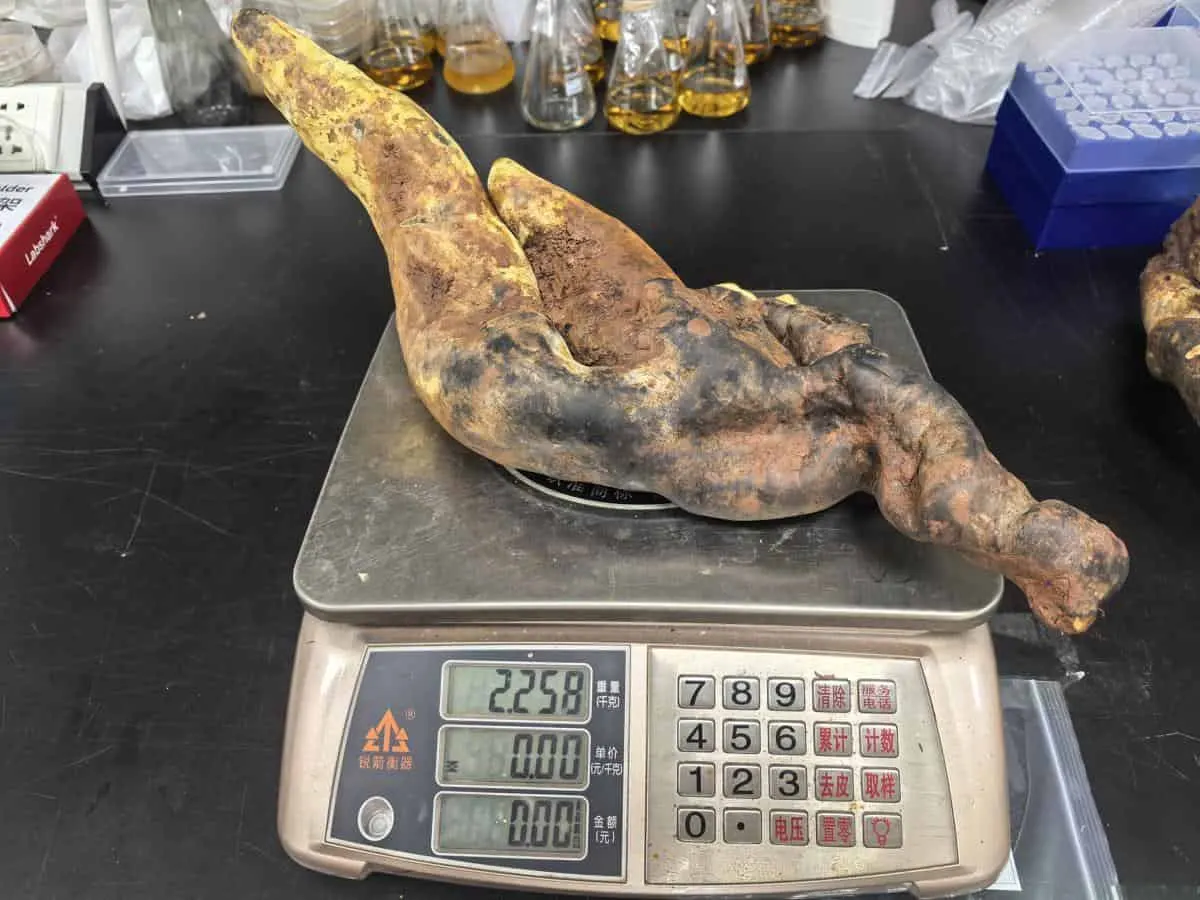
During fungal diversity surveys in Yunnan Province, China, researchers collected specimens between August 2024 and July 2025 in tropical and subtropical forests in Kunming, Xishuangbanna and Chuxiong. The fungus forms massive upright stromata up to 50 cm high, and the heaviest weighed 2.2 kg, according to a paper in Frontiers in Fungal Biology frontiersin.org
Frontiers in Fungal Biologyfrontiersin.orgOpen source ↗.
Morphology and phylogeny
The stromata typically measure 20 to 50 cm in height, and most collected specimens weighed between 250 and 600 g. Young specimens have rounded, bulb-like tops, while mature ones produce fleshy, finger-like branches. The surface is whitish at first and turns yellow as the fungus matures. It grows from underground roots and surrounding soil, often near recently dead or decaying trees.
These are the largest fructifications documented within Ascomycota, a group with about 65,000 known species. The authors also describe a nodulisporium-like anamorph with periconiella-like branching patterns.
The team combined morphology with sequences of four regions (ITS, LSU, RPB2 and TUB2), compared against 202 fungal strains. The specimens fell into a distinct branch of the order Xylariales, a sister clade to Graphostromataceae frontiersin.org
Frontiers in Fungal Biologyfrontiersin.orgOpen source ↗. To confirm this, the researchers sequenced the whole genomes of three specimens and compared over 300 conserved genes across 66 fungal samples. On this basis they proposed the new genus Dianjunus and the new family Dianjunaceae. The genus name refers to the ancient Dian Kingdom of Yunnan.
Age and lifestyle
Divergence time estimation dates the origin of Dianjunaceae to the early Paleocene, about 65 million years ago, with a possible range of 50 to 80 million years. This is the period after the Cretaceous–Paleogene extinction, when an estimated 75% of plant and animal species disappeared. Study author Indunil C. Senanayake of the Kunming Institute of Botany noted that the sudden availability of dead plant material may have created new opportunities for wood-associated fungi.
The genome contains considerably fewer carbohydrate-active enzymes than many related wood-decaying species and very few pectin lyases. Fruiting bodies were observed only after the death of the host tree. The authors therefore put forward a working hypothesis of a transition from an endophytic to a saprotrophic lifestyle.
More than 6,000 fungal species have been documented in Yunnan, while researchers estimate the province could contain over 100,000. The authors say the find highlights the unexplored fungal diversity of East Asian forests frontiersin.org
Frontiers in Fungal Biologyfrontiersin.orgOpen source ↗.