Ten mummified crocodiles, about 2,500 years old, found in an untouched tomb at Qubbat al-Hawa, Egypt
Archaeologists led by Alejandro Jiménez Serrano opened an untouched tomb near Aswan. The crocodiles were dried without resin and include a species no longer found in Egypt.
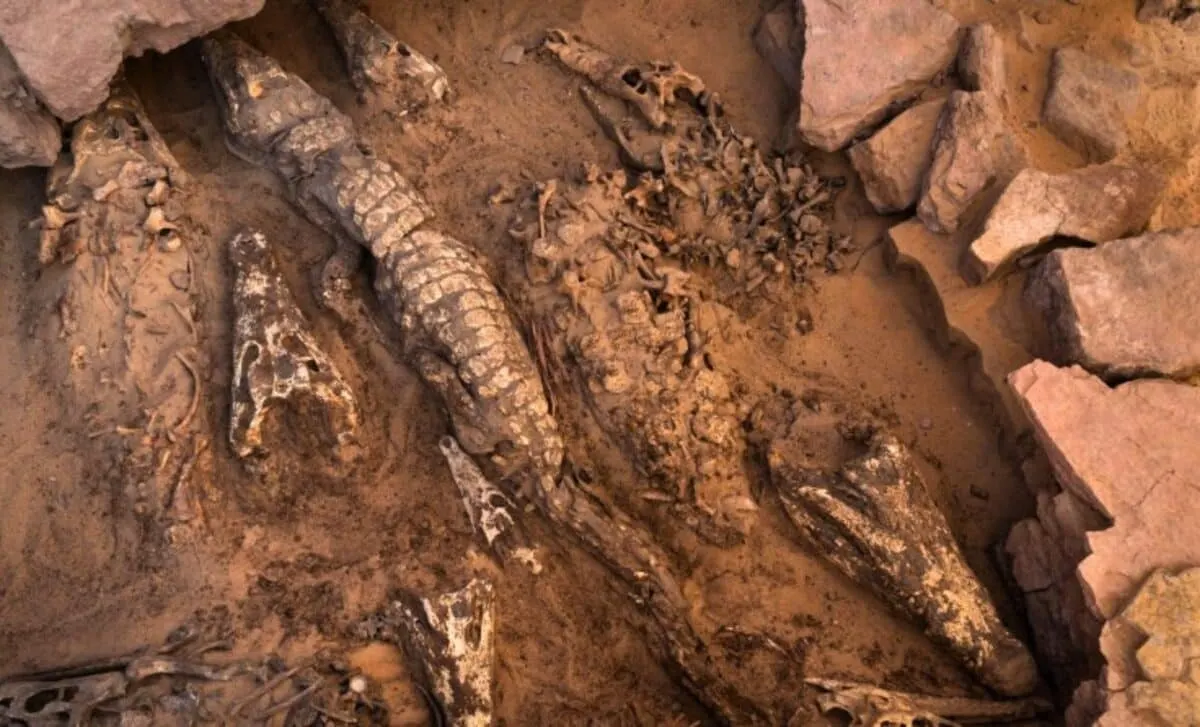
In 2019, archaeologists opened an untouched tomb at Qubbat al-Hawa, on the west bank of the Nile opposite Aswan in southern Egypt, and found ten mummified crocodiles: five bodies, some nearly complete, and five severed heads, according to dailygalaxy.com dailygalaxy.com
dailygalaxy.comdailygalaxy.comOpen source ↗. The remains are roughly 2,500 years old.
Since 2018 the site has been excavated by a team led by Alejandro Jiménez Serrano of the University of Jaén, Spain. Under a thick deposit of Byzantine-era garbage they found seven small tombs that ancient robbers had never entered. One held the crocodiles, placed next to considerably older human burials. The animals were examined by archaeozoologist Bea De Cupere of the Royal Belgian Institute of Natural Sciences.
Mummification without resin
The crocodiles had no resin coating, and insects had eaten almost all the linen; only scraps, traces of palm leaves and rope survived. This let researchers examine the animals directly rather than through X-rays or CT scans. The bodies had not been opened: one specimen still contained gastroliths, stones that crocodiles swallow, which indicates it was never gutted.
The researchers suspect a simple process. The bodies were buried in sand elsewhere, where hot, dry conditions removed moisture, then dug up, wrapped and carried to the tomb. The five heads appear to have been detached only after drying dailygalaxy.com
dailygalaxy.comdailygalaxy.comOpen source ↗. Because Egyptian embalmers used large quantities of resin from the Ptolemaic period onward, beginning in 332 BC, the team dates the burial earlier, probably to the 5th century BC.
Adults and two species
The burial most likely relates to the worship of Sobek, the god associated with water and fertility, whose major temple stood at Kom Ombo, about 50 kilometers (30 miles) north of Aswan. According to the team's study, about 80 percent of roughly 300 previously examined crocodile mummies were juveniles. The Qubbat al-Hawa animals were adults, approximately 1.8 to 3.5 meters (5.9 to 11.5 feet) long. The researchers believe they were probably killed elsewhere and dried before being brought to the tomb; how they died is unknown.
From the shape of skulls and bodies, the team identified two species among the ten: the Nile crocodile (Crocodylus niloticus) and the West African crocodile (Crocodylus suchus). Scientists recognized the latter as a separate species only relatively recently, and it no longer lives in Egypt.