NestedBD Bayesian method infers cancer cell trees from single-cell copy number profiles
NestedBD, tested on simulated data and two colorectal cancer samples, infers tree topologies and branch lengths more accurately than the compared methods, the authors report.
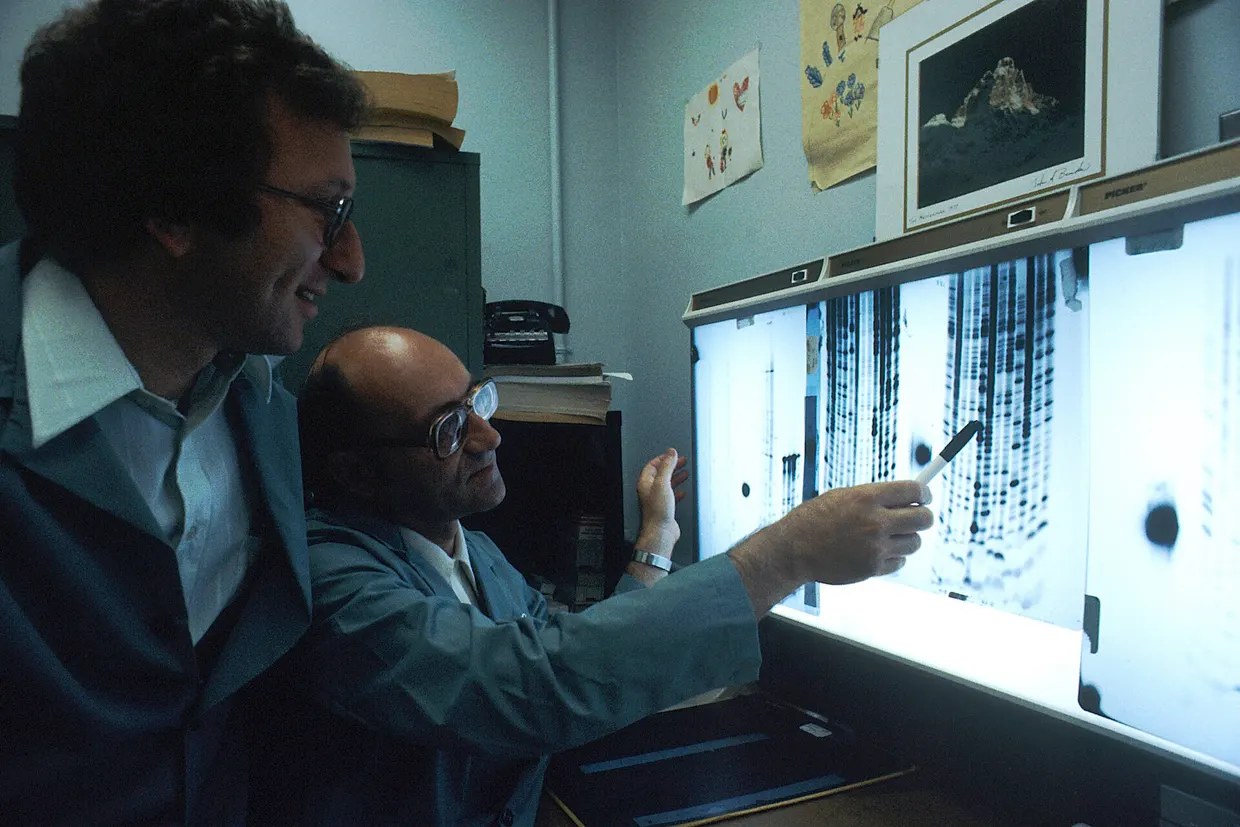
Yushu Liu, Mohammadamin Edrisi, Zhi Yan, Huw A. Ogilvie and Luay Nakhleh described NestedBD, a Bayesian method for inferring evolutionary trees of cancer cells from single-cell DNA sequencing data. The trees include topologies and branch lengths with relative mutation rates. The work is published in Algorithms for Molecular Biology and is built on a new birth-death evolutionary model of copy number aberrations (CNAs) biomedcentral.com
Algorithms for Molecular Biologybiomedcentral.comOpen source ↗. The method was evaluated on simulated data sets and on two colorectal cancer samples.
Birth-death model of copy number changes
For each genomic bin, an amplification is treated as a birth event at rate lambda and a deletion as a death event at rate mu. Transition rates scale with the current copy number, and a bin with zero copies stays at zero. In the baseline formulation both rates are set to one shared constant. The number of states is capped, by default at nine copies.
The bins are treated as independent. The authors contrast this with tools such as MEDICC, which capture dependencies between adjacent bins but become computationally intractable on growing single-cell data sets. Observed copy numbers are modelled as normally distributed around true integer values with a constant error variance. Inference uses Markov chain Monte Carlo sampling over topology, divergence times, error variance and molecular clock parameters, with a random local clock for differing mutation rates between lineages. A dynamic programming step corrects noisy leaf profiles and reconstructs ancestral profiles. The software is open source and runs within BEAST 2.
Benchmarks on simulated and patient data
Simulated trees contained 20 and 50 cells, with event multipliers of 90, 125 and 250 for low, medium and high CNA frequencies. Reads were aligned with BWA and profiled with Ginkgo, giving a median error rate of 0.24. NestedBD was compared with maximum parsimony, neighbor-joining on Hamming distances and the copy number method Lazac. Sampling used five coupled chains of 80 million iterations, with the first 20 percent discarded as burn-in.
According to the authors, NestedBD inferred more accurate topologies and branch lengths than traditional phylogenetic tools and state-of-the-art methods. They also report that the birth-death model can improve the accuracy of copy number estimation biomedcentral.com
Algorithms for Molecular Biologybiomedcentral.comOpen source ↗. On the two colorectal cancer samples the method produced evolutionary histories the authors describe as plausible. The code is available on GitHub.
Sources · 2
Found a mistake?Read also