Bern team identifies 103 Amazonian treefrogs by iris pattern in a field study, without marking
A field study in French Guiana photographed the eyes of Osteocephalus oophagus to tell individuals apart, offering an alternative to toe-clipping, which can affect survival.
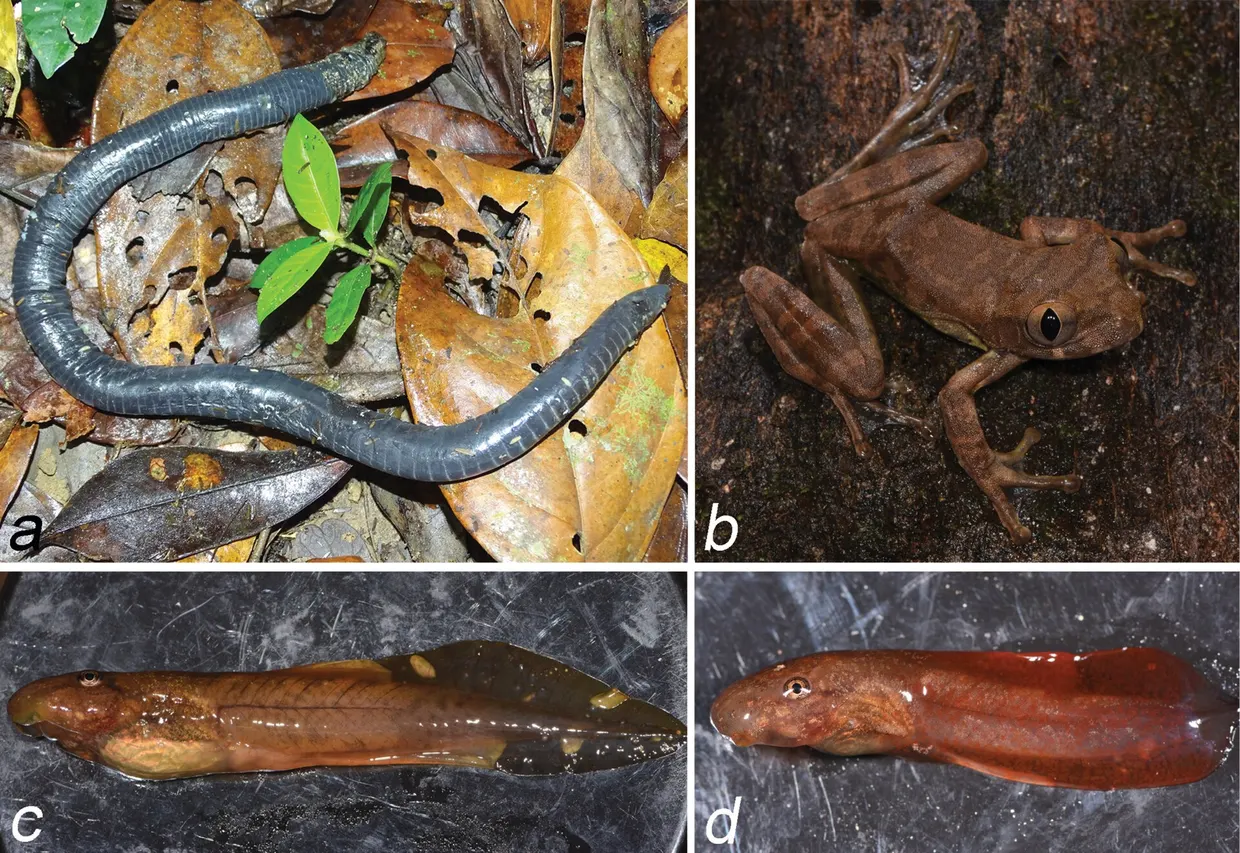
Researchers at the Division of Behavioural Ecology, University of Bern, with colleagues from the University of Music and Performing Arts in Graz, used iris patterns to identify individual Amazonian treefrogs without handling them. The study, led by Dr Mélissa Peignier and published in the open-access journal Herpetozoa, is described by eurekalert.org eurekalert.org
eurekalert.orgeurekalert.orgOpen source ↗. Across 392 captures, the team identified 103 individual frogs of the species Osteocephalus oophagus.
Why not toe-clipping
Identifying wild animals has long meant tagging, branding or clipping. For amphibians, the standard approach has often been toe-clipping, a procedure that can affect survival, physiology and behaviour. Dr Peignier said she was uncomfortable with this approach, especially for arboreal frogs that rely on their limbs to climb trees.
O. oophagus has golden irises crossed by fine black radial lines. The pattern resembles a human fingerprint.
Field method and results
Fieldwork took place over three rainy seasons, from 2021 to 2023, on a river island of roughly five hectares in the Nouragues Nature Reserve in French Guiana eurekalert.org
eurekalert.orgeurekalert.orgOpen source ↗. On later encounters, the researchers photographed each animal's eyes without touching it. They compared the images with a reference library held on a rugged tablet. Frogs recognised this way were left undisturbed.
The identifications were independently verified with Wild-ID, a software package for photographic mark-recapture analysis.
The iris patterns proved highly distinctive. Within a single season, between 56% and 80% of frogs were recaptured and reliably re-identified. According to the authors, this shows the patterns are stable enough for short-term monitoring. Frogs in amplexus, the mating embrace, could also be photographed without disruption.
The authors state that suitability will vary between species and that the approach should be tested case by case before wider adoption. They see considerable promise for amphibians with complex irises eurekalert.org
eurekalert.orgeurekalert.orgOpen source ↗. Dr Peignier said that reliable identification by naturally occurring features may reduce the need for more invasive marking techniques while still providing the data needed for scientific questions.