Tohoku University Builds Electronics-Free Mechanical Reflex for Bipedal Robots
Engineers developed a mechanical reflex module that reproduces the patellar tendon reflex and generates bipedal walking without electronic sensors.

Researchers at Tohoku University have developed an electronics-free mechanical reflex module for musculoskeletal robots that reproduces the human knee-jerk reflex and enables bipedal walking, according to tohoku.ac.jp tohoku.ac.jp
tohoku.ac.jptohoku.ac.jpOpen source ↗. The system performs sensing, computation, and actuation entirely within its physical structure without relying on electronic sensors or processing circuits.
Traditional musculoskeletal robots rely on complex electronic sensor arrays to monitor the stretch and strain of artificial muscles. These conventional architectures introduce higher computational overhead, wiring complexity, and substantial energy demands. To eliminate these constraints, the engineering team designed an autonomous mechanical alternative inspired directly by biological muscle spindles.
Mechanical Muscle Spindle Architecture
The reflex module mechanically detects when an artificial muscle elongates beyond a specified threshold tohoku.ac.jp
tohoku.ac.jptohoku.ac.jpOpen source ↗. Once this mechanical limit is reached, the device triggers an immediate contracting response through its structural mechanism. Because the module incorporates adjustable activation thresholds, engineers can tune the physical response characteristics without digital signal processing.
During laboratory benchmarks, the unit successfully duplicated the human patellar tendon reflex tohoku.ac.jp
tohoku.ac.jptohoku.ac.jpOpen source ↗. When applied beneath the artificial knee joint, mechanical tapping triggered an immediate extension movement in the lower leg assembly, mirroring biological quadriceps contraction.
Bipedal Gait Implementation
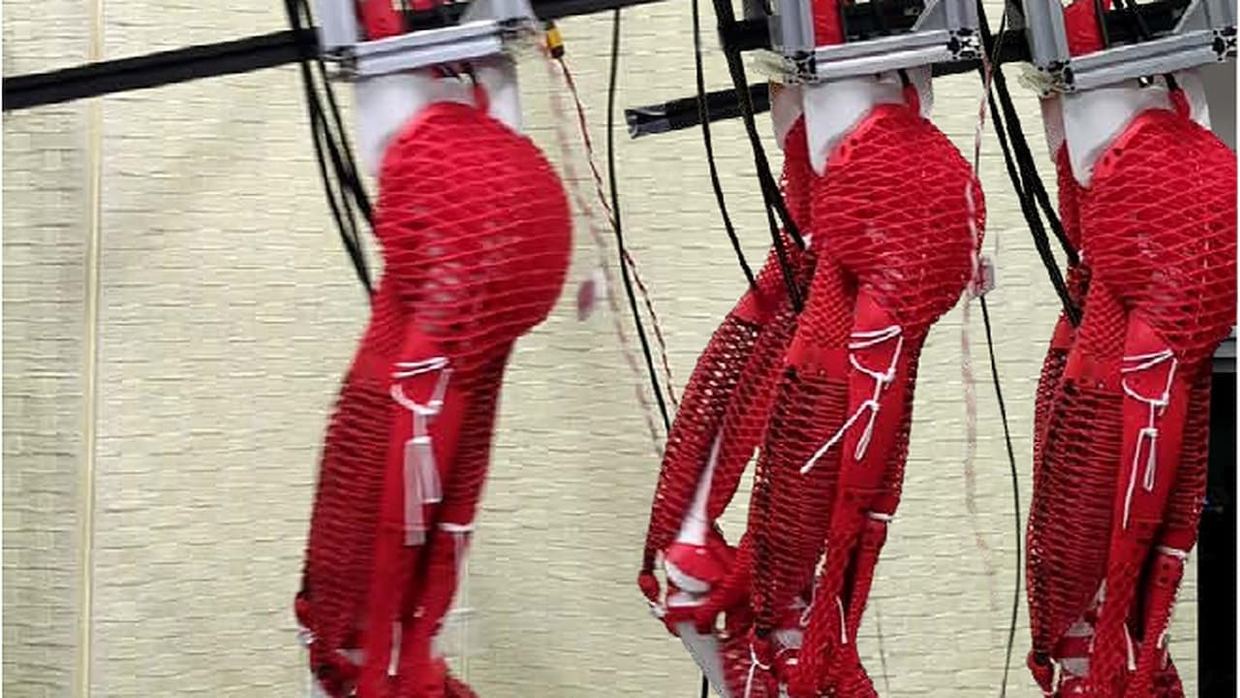
To achieve sustained locomotion, the researchers integrated the mechanical reflex modules into a bipedal musculoskeletal robot combined with a minimal high-level control framework tohoku.ac.jp
tohoku.ac.jptohoku.ac.jpOpen source ↗. This supervisory system adjusted the mechanical activation thresholds dynamically depending on the current phase of the movement cycle.
By modulating the physical reflex sensitivity during stride transitions, the musculoskeletal robot generated stable bipedal walking gaits tohoku.ac.jp
tohoku.ac.jptohoku.ac.jpOpen source ↗. According to the authors, embedding reflexive loops directly into physical hardware substantially reduces system complexity and overall power consumption. The development team plans to scale this architecture to build robots driven by significantly larger arrays of artificial muscles.