Photonic quantum walk experiment: dephasing enhances non-Hermitian skin effect drift
Physicists at Anhui University and partners showed experimentally that the non-Hermitian skin effect survives decoherence, and under dephasing the drift can exceed the coherent case.
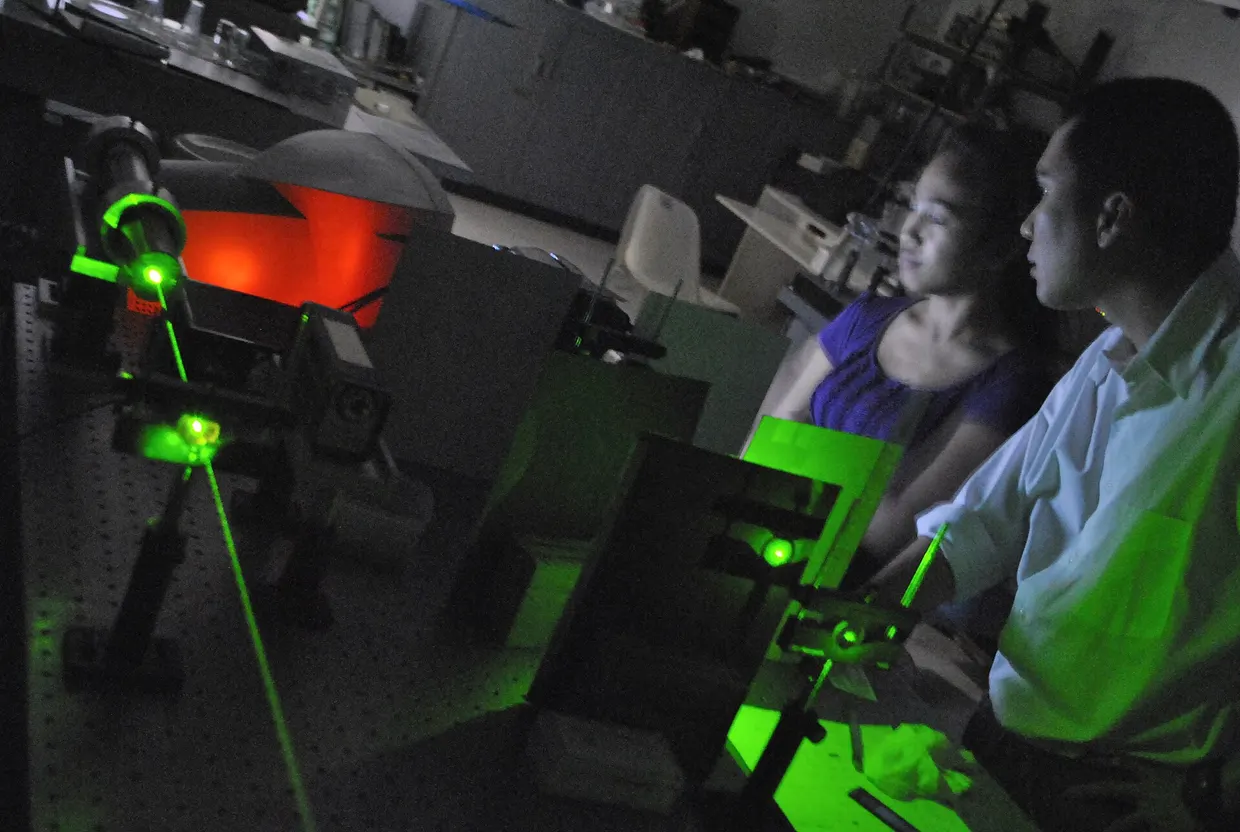
Researchers from Anhui University, Southeast University, Politecnico di Milano and the IFISC institute in Palma de Mallorca have experimentally tested how the non-Hermitian skin effect behaves under decoherence. The work by Kunkun Wang, Lei Xiao, Stefano Longhi and Peng Xue was published in Nature Communications on 6 November 2026. nature.com
Nature Communicationsnature.comOpen source ↗ The experiment used photonic quantum walks with two tunable decoherence channels: dephasing and amplitude damping.
Skin effect and decoherence
The non-Hermitian skin effect is directional bulk-to-boundary transport induced by structured dissipation. Decoherence and dissipation arising from interaction with the environment act on transport in two ways. They suppress coherent propagation, but they also induce diffusion and mitigate localization in disordered systems.
According to the authors, it remained a largely open question whether skin-effect transport can persist, be enhanced or be hindered under decoherence.
Dephasing and amplitude damping
Under dephasing, the skin effect survived up to the fully incoherent regime. The authors observed that dephasing even enhanced it, yielding drift velocities that exceed those of coherent dynamics. nature.com
Nature Communicationsnature.comOpen source ↗
Amplitude damping gave a different picture, with a pronounced dependence on the order of operations. When it was applied before the non-Hermitian loss operator, it suppressed the skin effect and ultimately eliminated it in the fully incoherent limit. When it was applied afterward, the skin effect persisted and could be enhanced at sufficiently large loss strengths.
The authors state that the work bridges quantum and classical non-Hermitian dynamics and demonstrates the resilience of the skin effect to decoherence. They also suggest that decoherence could be harnessed to enhance directional transport in noisy, nonequilibrium systems.