UC San Diego measures dark modes in polariton chemistry: thousands of times fewer than predicted
UC San Diego researchers used 2DIR microscopy to count dark modes in optical cavities and found far fewer than calculated, which makes cavity-controlled chemistry viable.
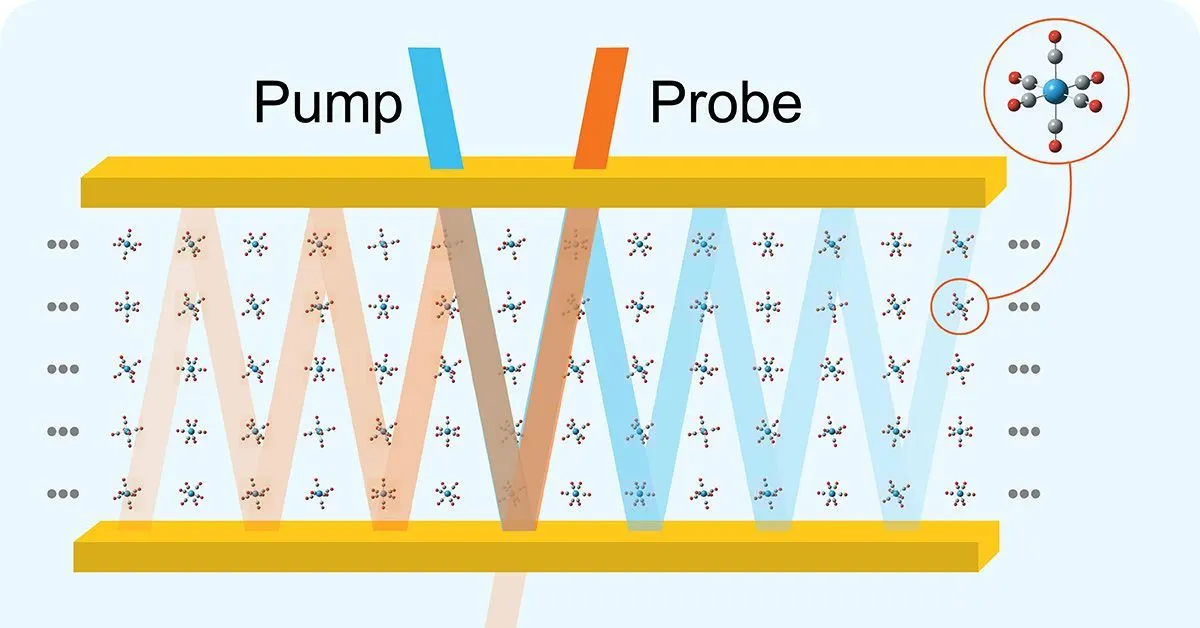
Researchers at UC San Diego have directly measured how many inactive molecular states, known as dark modes, accompany active polaritons in an optical cavity, according to today.ucsd.edu. The study was published on November 13, 2026 in Chem and led by Harsh H. Bhakta and Wei Xiong. The measured number of dark modes is thousands of times lower than theoretical projections today.ucsd.edu
today.ucsd.edutoday.ucsd.eduOpen source ↗.
Why dark modes were a problem
Polariton chemistry explores how to control chemical reactions by trapping molecules inside optical cavities where light and matter interact strongly, a regime called strong coupling. Dark modes are the inactive molecular states, while polaritons are the active ones. Earlier calculations indicated that millions of dark modes should greatly outnumber active polaritons. On that basis, it seemed impossible for light-matter coupling to influence chemistry.
What the 2DIR measurement showed
The team used two-dimensional infrared microscopy (2DIR) to measure the spatial dynamics of these states directly. The paper is titled "2DIR Hyperspectral Imaging of Polariton Propagation Reveals Fewer Dark Modes per Polariton". Until this measurement, the dark-mode count rested on theoretical calculations. According to the researchers, the result shows that active states are prominent enough to make cavity-controlled chemistry viable.
The work establishes the lower population limit of polaritonic states that can influence chemical reactions. The authors present it as a foundational framework for future research in polariton chemistry today.ucsd.edu
today.ucsd.edutoday.ucsd.eduOpen source ↗. Forming polaritonic states does not require additional energy input. For that reason, the researchers say, the approach could open a path to more energy-efficient chemical manufacturing and pharmaceutical production.