Engineered E. coli produces 1.805 g/L of antibiotic Angustmycin A in a 1.2-L bioreactor
Researchers built an E. coli strain that makes the N-nucleoside antibiotic Angustmycin A from glucose. A lab-scale fed-batch run reached 1805 mg/L at 96 h.
Researchers have engineered an Escherichia coli strain that produces the N-nucleoside antibiotic Angustmycin A (also known as guvermectin) de novo from glucose, according to a paper in Microbial Cell Factories. biomedcentral.com
Microbial Cell Factoriesbiomedcentral.comOpen source ↗ In fed-batch fermentation in a 1.2-L bioreactor, the final strain reached 1805 ± 74.1 mg L−1 at 96 h, a volumetric productivity of about 18.8 mg L−1 h−1. The authors describe this as the highest Angustmycin A titer reported to date.
Angustmycin A has broad-spectrum antimicrobial activity and a registered agricultural use as a plant growth-promoting biochemical pesticide. It is still produced mainly by native Streptomyces strains, whose slow growth, long fermentation cycles and limited genetic tractability constrain titer improvement and process development. A fast-growing, genetically flexible host was therefore the goal of the work.
Four stages of strain engineering
In the first stage, the six-enzyme pathway was consolidated onto a single medium-copy plasmid, and the pfkA gene was deleted to redirect fructose-6-phosphate (F6P) flux. Together these changes raised production from 142 mg L−1 to 649 ± 9.0 mg L−1.
The second stage addressed a bottleneck: pathway analysis identified the solubility of the enzyme AgmC as a primary constraint. biomedcentral.com
Microbial Cell Factoriesbiomedcentral.comOpen source ↗ Recruiting AgmC into liquid–liquid phase separation condensates, with AgmA co-recruited, raised production to 699 ± 7.2 mg L−1.
The third stage combined orthogonal optimization of cultivation parameters with chromosomal engineering of the gltA 5′-UTR to moderate flux through the TCA cycle. Shake-flask production rose to 1225 ± 12.9 mg L−1.
Bioreactor result and stated levers
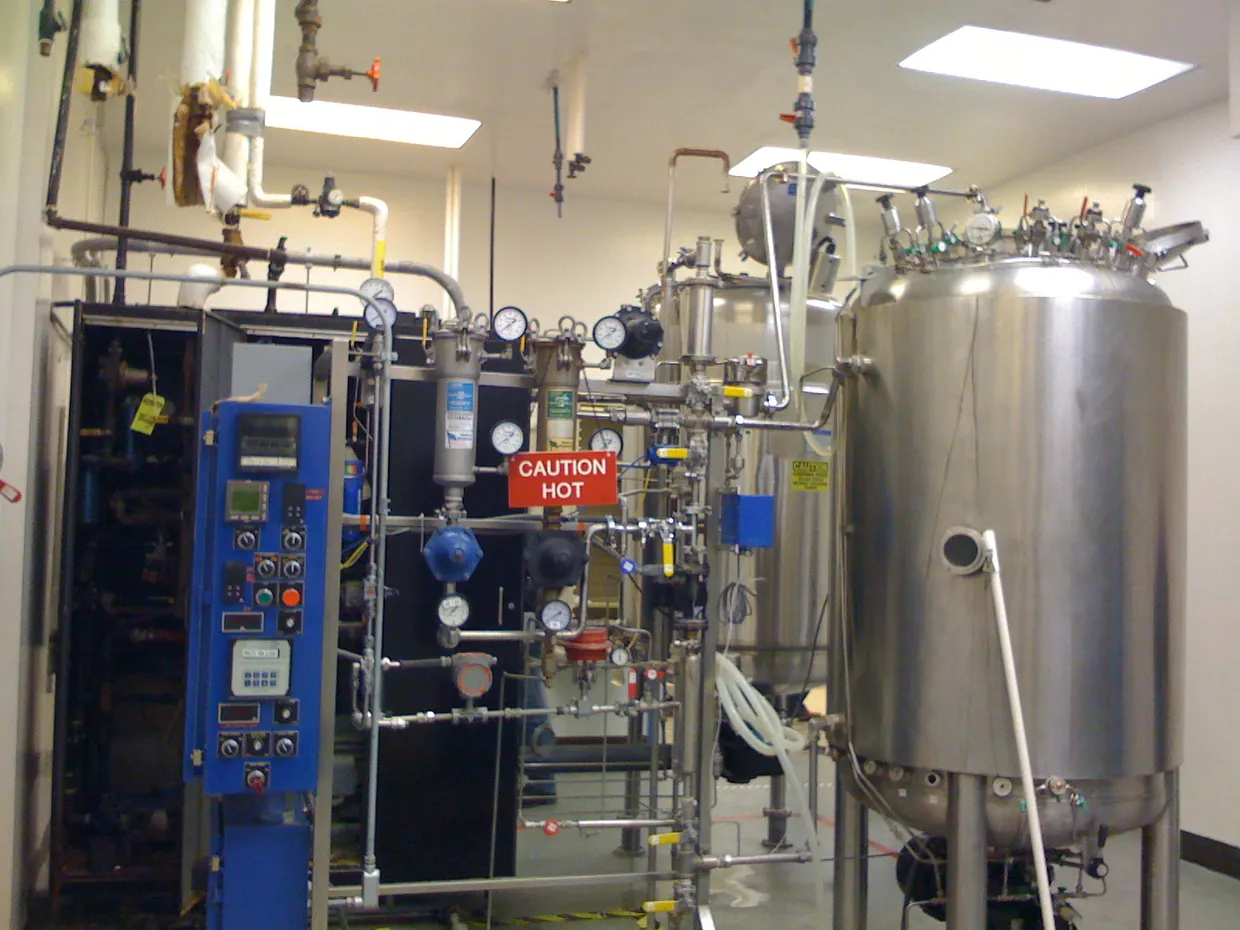
The fourth stage was fed-batch cultivation of the final strain in the 1.2-L bioreactor, which gave the 1805 ± 74.1 mg L−1 figure at 96 h. In extended fed-batch cultivation, the maximum titer was approximately 1.92 g L−1. All results come from laboratory-scale cultivation.
The authors identify two main levers for pathway performance: rewiring F6P flux and mitigating the limited availability of soluble AgmC. biomedcentral.com
Microbial Cell Factoriesbiomedcentral.comOpen source ↗ They add that combining precursor-flux redistribution with bottleneck-guided enzyme recruitment may serve as a transferable framework for microbial production of related N-nucleoside natural products.
Sources · 2
Found a mistake?Read also