POSTECH and VF Space: wire-laser 3D-printed 316L steel shows up to 2× the yield strength of rolled
Laser wire-deposited 316L blocks reached 444–514 MPa yield strength versus about 256 MPa for rolled steel; the team traced the gain to delta ferrite.
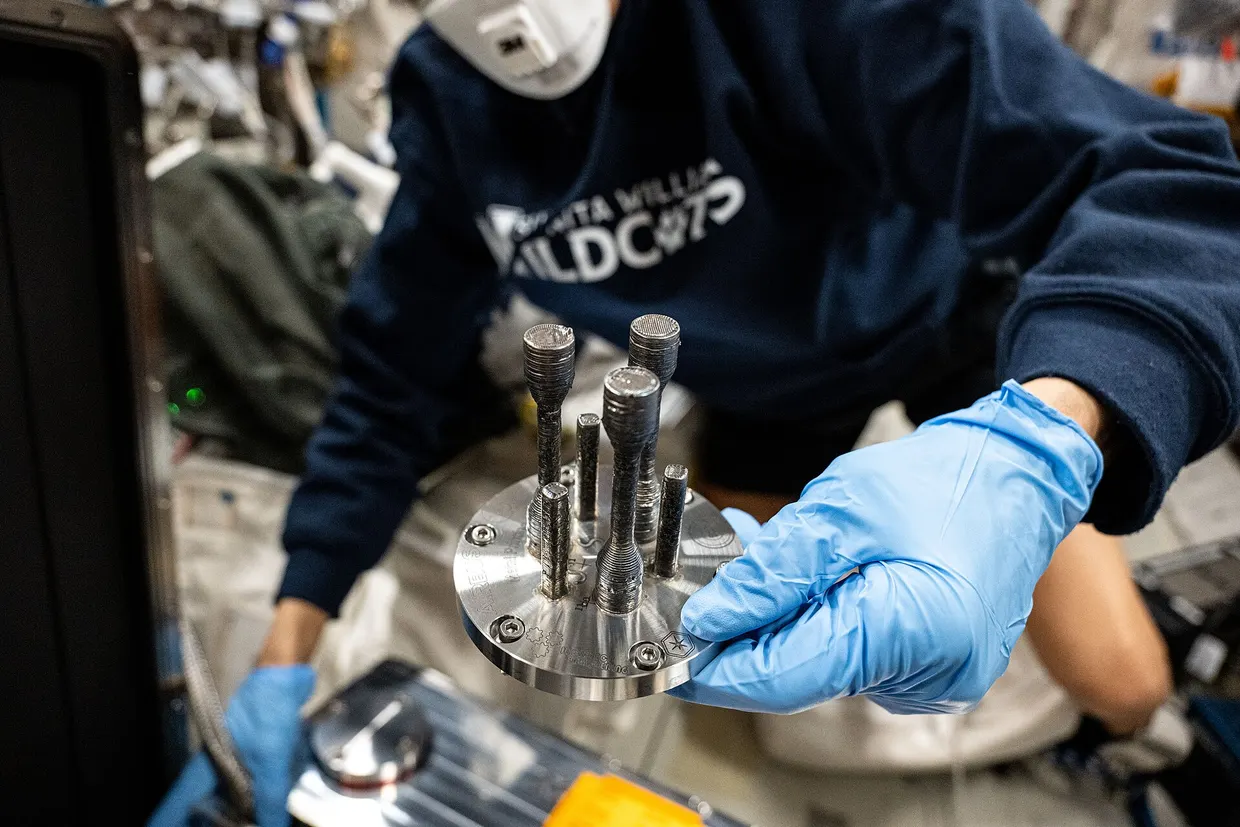
A POSTECH team led by Prof. Kim Hyoung Seop of the Departments of Eco-friendly Materials and Materials Science and Engineering, working with metal 3D printing company VF Space, has found that 316L stainless steel built by laser-melting metal wire has a yield strength up to about twice that of a conventional product, kpinews.kr reported. The group announced the result on the 9th. The study was published online in the journal Materials Science and Engineering: A. kpinews.kr
kpinews.krkpinews.krOpen source ↗
In this process, metal wire is melted by a laser and stacked layer by layer. The method can make large parts efficiently, but how the internal structure of metal built this way changes, and how strong it is, had not been fully established. The researchers note that this must be understood before industrial use.
Samples and tensile tests
VF Space used a metal 3D printer to melt 316L stainless steel wire 1 mm in diameter and build a block measuring 4 cm in each dimension. 316L resists corrosion even in seawater and is widely used in kitchenware, medical devices, ships and chemical equipment.
The POSTECH team cut the block in three mutually perpendicular directions and pulled the specimens from both ends. They examined the interior by electron microscopy, synchrotron radiation and computer simulation. kpinews.kr
kpinews.krkpinews.krOpen source ↗
Yield strength, the point at which metal stops returning to its original shape and begins to bend, was about 444–514 MPa depending on direction. That is 70–101% above the roughly 256 MPa of a conventional rolled product, and about double in the strongest direction. The metal also stretched 37–46% before breaking.
Delta ferrite as the cause
The authors attribute the strength to a fine microstructure called delta ferrite, distributed evenly through the metal. Metal bends as dislocations, defects in the atomic arrangement, slide through it. Delta ferrite formed during rapid laser melting and solidification, and it blocked the paths along which dislocations move.
Part of this structure is honeycomb-shaped, which keeps force from concentrating in one place and lets the metal bear load evenly. kpinews.kr
kpinews.krkpinews.krOpen source ↗
The team says the link between process, internal structure and strength could serve as a recipe for tuning the process to a desired performance, and expects use in large parts for ships and plants.