Sandia model: X-ray burst direction changes asteroid deflection nearly fivefold in simulation
A Sandia National Laboratories simulation of a nuclear X-ray burst gave 3.9 mm/s or 0.8 mm/s for one asteroid, depending on the side irradiated.
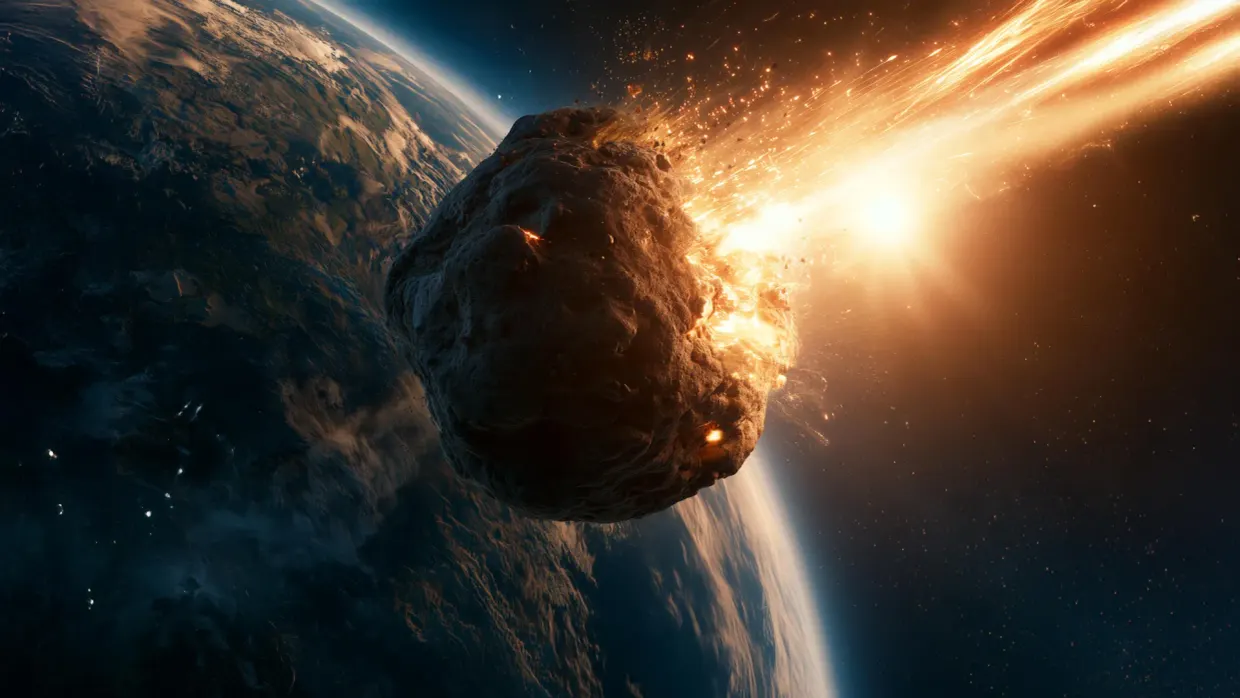
Physicist Nathan Moore of Sandia National Laboratories and colleagues published a computer study in the journal Icarus. It shows that the direction of an X-ray burst from a nuclear explosion strongly affects how an asteroid is deflected, sciencedaily.com reports sciencedaily.com
sciencedaily.comsciencedaily.comOpen source ↗. In one simulation, the asteroid's speed changed by 3.9 millimeters per second when it was irradiated from one direction and by 0.8 millimeters per second from another. That is a nearly fivefold difference in deflection velocity, the change in forward speed caused by the burst.
For another simulated asteroid, the change in rotation rate differed by a factor of 17 depending on the direction of the X-rays. "We expected aim to matter," Moore said. "What surprised us was how much". The authors note that real asteroids have ridges, depressions and uneven surfaces, unlike the spheres often used in earlier calculations.
Combining two simulation codes
Earlier models forced researchers to choose between representing an asteroid's complex shape and calculating the physical forces in detail. Doing both required impractical computing power. The Sandia team, which describes its model as the most accurate asteroid deflection model yet, combined two codes already used at the laboratory.
ALEGRA is normally used for fast, high-energy experiments, such as magnetically imploding wires on the Z machine. SPARTA, a direct simulation Monte Carlo code, usually models comparatively weak, slowly evolving forces, such as the drag of the solar wind on a satellite sciencedaily.com
sciencedaily.comsciencedaily.comOpen source ↗. According to Moore, the new algorithm is over 1,600 times faster than the old models.
The model can rebuild an asteroid from detailed 3D images taken during spacecraft flybys. The explosion's strength, its distance from the asteroid and the direction of the radiation can then be varied. The software calculates how much material vaporizes across the surface and shows it as a heat map. From that it estimates the resulting push, the change in rotation and the extent of surface damage.
Limits of the current model
The aim of a deflection mission would be to change the trajectory without breaking the asteroid into several dangerous fragments. The model has not yet reached that point. "Right now, our computer model only considers breakup of rocks on the surface. We can't predict breakup of the entire asteroid body accurately yet," Moore said.
An intense X-ray burst triggers many physical effects that influence one another, which makes exact prediction of a real deflection attempt very difficult. Closing that gap will require further research, investment and more advanced computational tools sciencedaily.com
sciencedaily.comsciencedaily.comOpen source ↗. The work builds on an earlier experiment on Sandia's Z machine, which first showed that X-rays can deflect a small piece of asteroid material.