Scripps: viscous marine snow carries over six times more carbon to the deep ocean
Researchers at Scripps and the University of Lincoln used 3D microscopy and found, in lab experiments and simulations, that marine snow viscosity affects how deep carbon sinks.
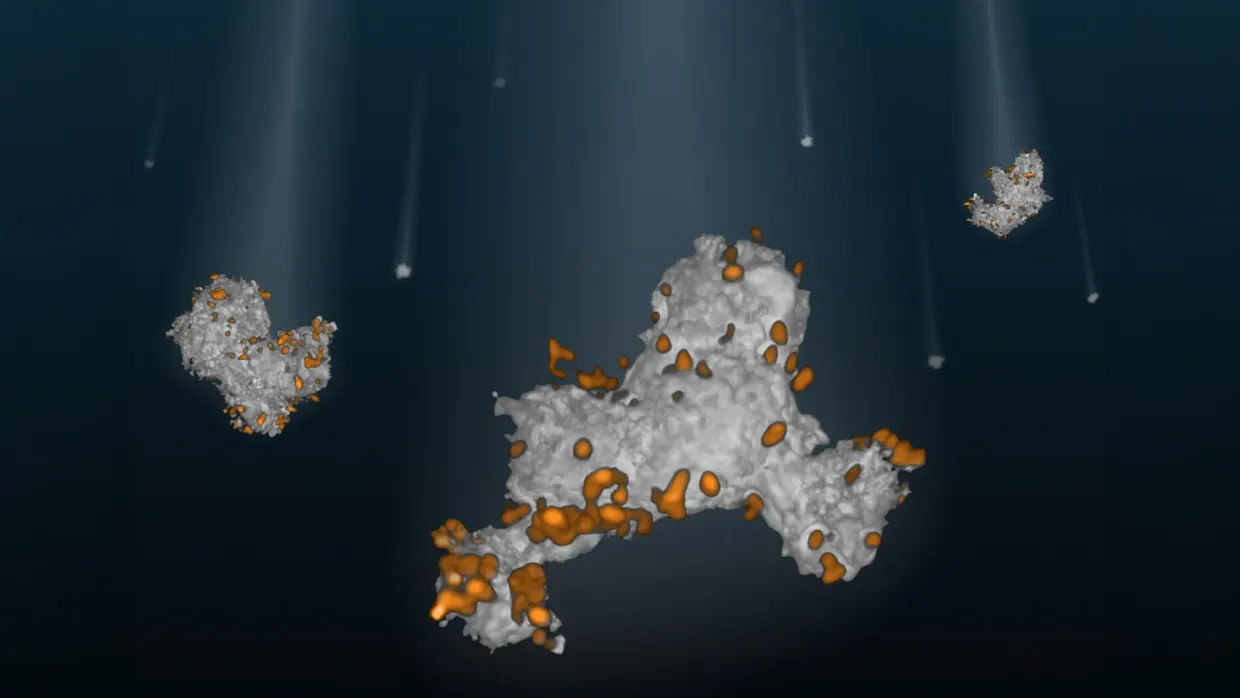
Researchers at the Scripps Institution of Oceanography (UC San Diego) and the University of Lincoln report that the viscosity of marine snow affects how quickly bacteria break it down and how far it sinks, according to scripps.ucsd.edu. The study was published Oct. 8 in the journal Science. scripps.ucsd.edu
scripps.ucsd.eduscripps.ucsd.eduOpen source ↗ By the authors' estimate, high-viscosity marine snow can carry more than six times as much carbon to the deep ocean as low-viscosity particles.
Marine snow and the carbon cycle
Marine snow is made of tiny clumps of organic and inorganic detritus: mucus, feces, silt, dead plankton and similar material. These clumps rain from the shallows into the deep. Scientists estimate that they move more than 10 gigatons of carbon away from the surface every year. Only about two gigatons are believed to sink deep enough to be stored for hundreds to thousands of years.
What limits this part of the carbon cycle has been an open question. The new work identifies one factor behind the gap between the two figures.
Imaging bacteria inside mucus
The project began in 2021, when Bryce Inman, then a postdoctoral scholar at Scripps, set out to visualize the physical structure of mucus. Four years of attempts, including work with microbiologist Farooq Azam, failed until a method worked in 2025. scripps.ucsd.edu
scripps.ucsd.eduscripps.ucsd.eduOpen source ↗ The team combined 3D confocal microscopy with specialized fluorescent molecules. This let them map the physical terrain of individual marine snow particles and see how bacteria interacted with it. According to the authors, it is the first study of live bacteria interacting with the physical structure of marine snow, or of any mucus. The method is described in a companion paper in Nature Communications.
The researchers found that bacteria colonize less viscous regions near a particle's surface far more easily than the more viscous regions deeper inside. Inman compared it to a worm in an apple: the flesh is easy to penetrate, but the core is tough. In laboratory experiments, more viscous marine snow took bacteria longer to degrade and fragment. Computer simulations also suggest that the more viscous the particles are, the deeper they sink.
The authors say the imaging method should help studies of bacteria in mucus more broadly. Interactions between mucus and bacteria matter for coral reefs, kelp forests, land plant root systems, and the digestive tracts of animals and humans.