MIT reprograms NK cells inside mice with mRNA nanoparticles, tumors regress in tests
Lipid nanoparticles with mRNA delivered CAR instructions to NK cells inside the body, with no cell engineering in a lab. So far this has been shown only in mice.
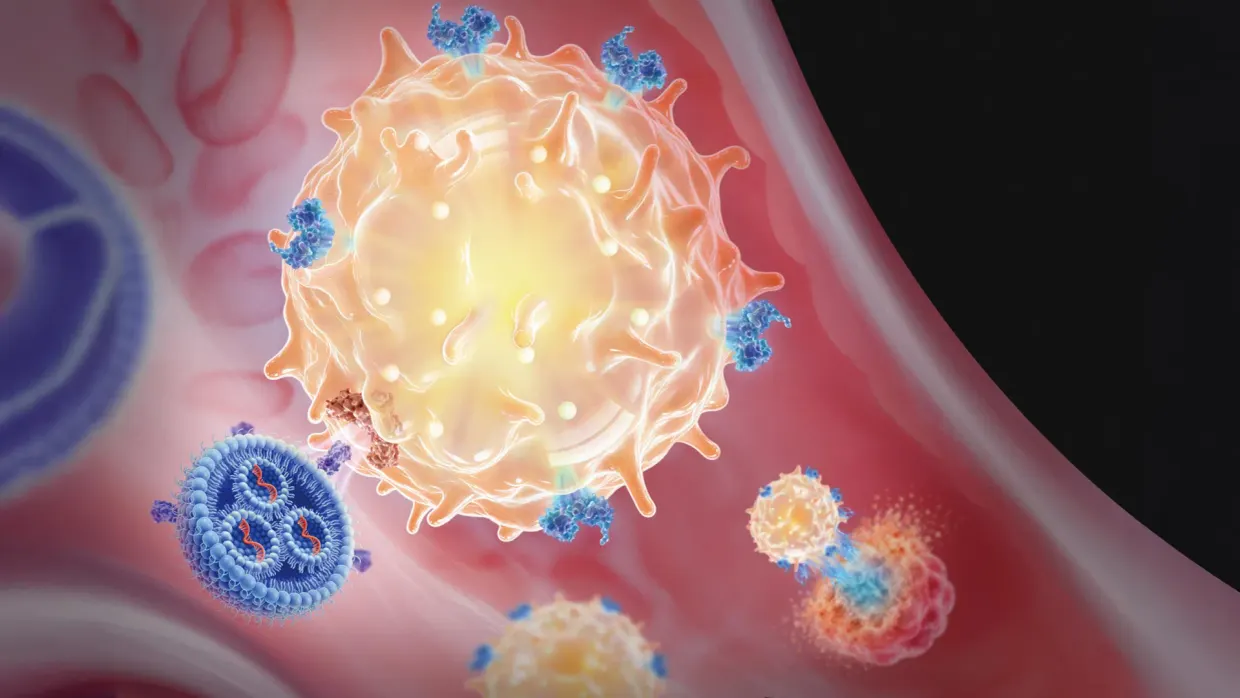
Researchers at MIT have developed a technique that turns NK cells into CAR-bearing cells directly inside the body, sciencedaily.com reports. The work was published in Nature Biotechnology and tested in mice. Lipid nanoparticles carrying messenger RNA delivered instructions to NK cells, which then produced a chimeric antigen receptor (CAR) and attacked their targets. sciencedaily.com
sciencedaily.comsciencedaily.comOpen source ↗
Daniel Anderson, a professor in MIT's Department of Chemical Engineering, is the senior author. The lead authors are postdoctoral researcher Yuang Chen and graduate students Julia Monkovic and Haseeb Mughal; Robert Langer also contributed.
Why in-body engineering matters
Over the past decade the U.S. Food and Drug Administration has approved seven therapies based on CAR T cells. Their preparation is complex: blood is collected from the patient and sent to a specialized facility, where T cells are separated, genetically modified and expanded, and the finished cells are then returned to the hospital and infused.
NK cells are of interest because they can be used against diseased T cells, including T-cell cancers and T-cell autoimmune diseases. CAR T cells aimed at T cells may attack one another, while NK cells are a different cell type and avoid this problem. Producing CAR NK cells outside the body still requires much of the same equipment and labor, and none of these therapies has FDA approval. sciencedaily.com
sciencedaily.comsciencedaily.comOpen source ↗
Nanoparticles and results in mice
The team designed lipid nanoparticles whose surface is covered with antibody fragments that bind to receptors on NK cells. The mRNA inside encodes a CAR that can be set to recognize different proteins, for example CD19 on B cells or CD3 on T cells.
After injection into mice, about 80 percent of the targeted NK cells were modified. In an aggressive melanoma model, complete remission was recorded in three of five mice that received nanoparticles directed at NK cells. In humanized mice with T-cell lymphoma, tumors disappeared after five injections; according to the researchers, the effect was comparable to CAR NK cells made by the traditional method outside the body.
The method was also tested in a model of autoimmune hepatitis, where pathological T cells attack liver cells. A single nanoparticle injection eliminated the autoreactive T cells, after which the damaged liver tissue of the mice recovered. sciencedaily.com
sciencedaily.comsciencedaily.comOpen source ↗
The authors note that the safety and effectiveness of the approach in humans still need to be tested.